Mistral's open coding model Devstral 2 claims sevenfold cost advantage over Claude Sonnet


Mistral AI has introduced the second generation of its open-source coding models: Devstral 2 and Devstral Small 2.
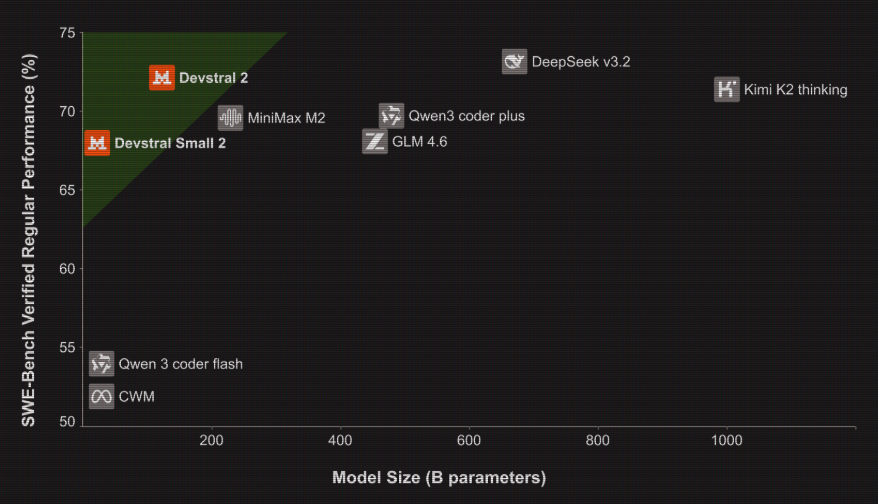
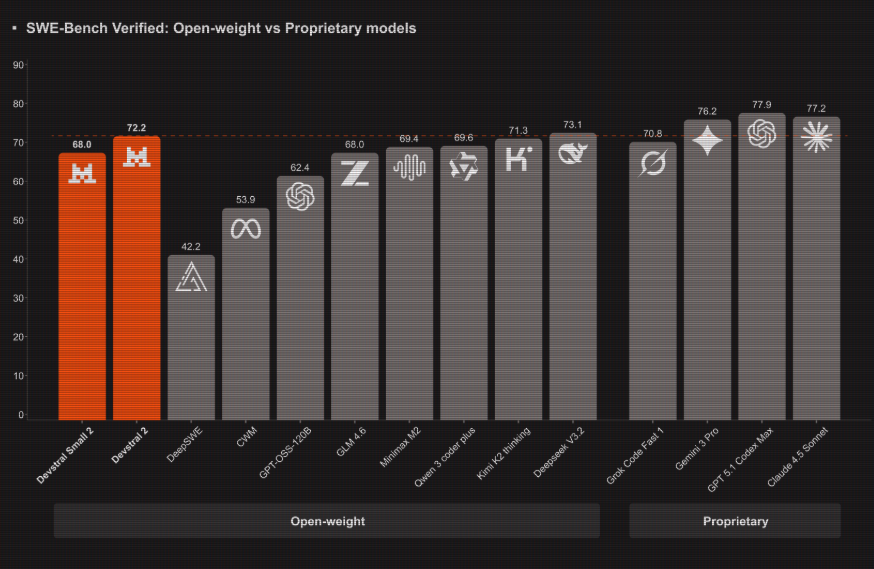
The flagship Devstral 2 features 123 billion parameters and scores 72.2 percent on the SWE-Bench Verified benchmark, outperforming many competing open models. According to Mistral AI, the model is up to seven times more cost-efficient than Claude Sonnet, and it requires four H100-class GPUs to run. Meanwhile, the smaller Devstral Small 2—coming in at 24 billion parameters—is optimized to run locally on standard hardware.
Licensing restrictions for high-revenue companies
The release comes with distinct licensing terms for each model. While Devstral Small 2 is available under the free Apache 2.0 license, the larger Devstral 2 ships under a "Modified MIT License" that includes a revenue cap. Companies generating more than $20 million in monthly revenue must purchase a commercial license or access the model via the API. This restriction extends to any derivatives or fine-tunes created from the model. The models are available via Hugging Face.
Automating workflows with Vibe
Alongside the models, the company introduced Mistral Vibe, an open source command-line tool. Vibe lets developers use natural language to automate code changes and fix bugs across multiple files. Devstral 2 is currently available for free via the API, with future pricing set at $0.40 per million input tokens.
AI News Without the Hype – Curated by Humans
Subscribe to THE DECODER for ad-free reading, a weekly AI newsletter, our exclusive "AI Radar" frontier report six times a year, full archive access, and access to our comment section.
Subscribe nowRead on for the full picture.
Subscribe for hype-free coverage.
- Full access to every article on THE DECODER
- No ads
- Join the comments and community discussions
- A weekly AI news recap via mail
- 6x/year: "AI Radar" — deep dives on the AI topics that matter most
- Daily AI news, always up to date
- Our full ten-year archive
- Covered by a team with 10+ years in AI