OpenAI's Sam Altman and Science VP Kevin Weil hype AI-assisted dog cancer story ignoring there's no proof the vaccine worked

Update, March 29, 2026:
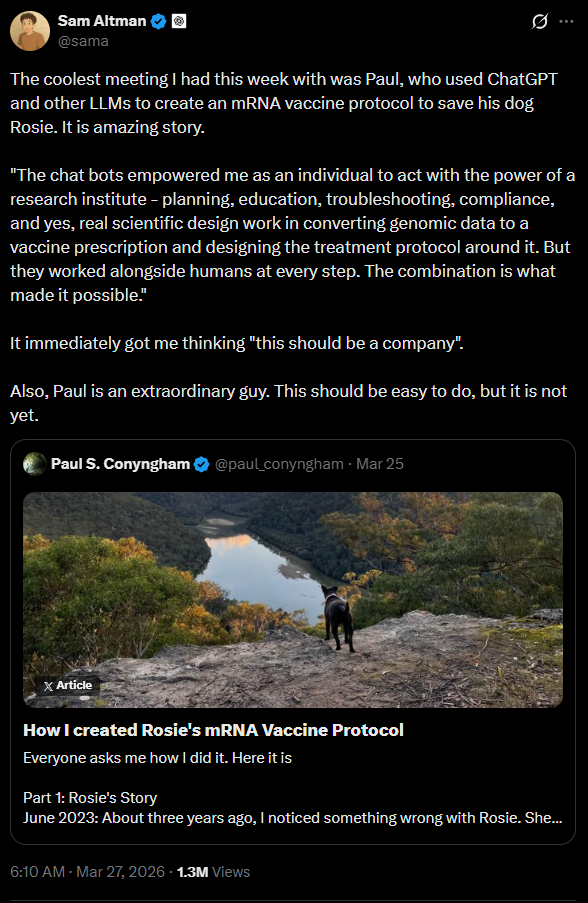
OpenAI CEO Sam Altman and VP of Science Kevin Weil used the story to promote their own narrative. Weil wrote that Paul had used ChatGPT and AlphaFold to create a personalized mRNA vaccine protocol for his dog's cancer, calling it "a glimpse of the future, with AI accelerating personalized medicine."
Altman called it the "coolest meeting I had this week" and quoted Conyngham saying the chatbots gave him "the power of a research institute." Neither OpenAI executive mentioned that there's no evidence the vaccine actually worked or that the whole effort made any difference.
Egan Peltan (see original report below) pushed back sharply, saying there is zero evidence that the AI-assisted work did anything for Rosie's cancer. Conyngham was simultaneously giving her a PD-1 inhibitor, an approved immunotherapy drug that makes cancer cells visible to the immune system again. PD-1 inhibitors are considered one of the most effective cancer immunotherapies available.
The most likely explanation for Rosie's improvement is a response to that conventional drug, not the mRNA vaccine. According to Conyngham, though, a chatbot also pointed him toward PD-1 in the first place.
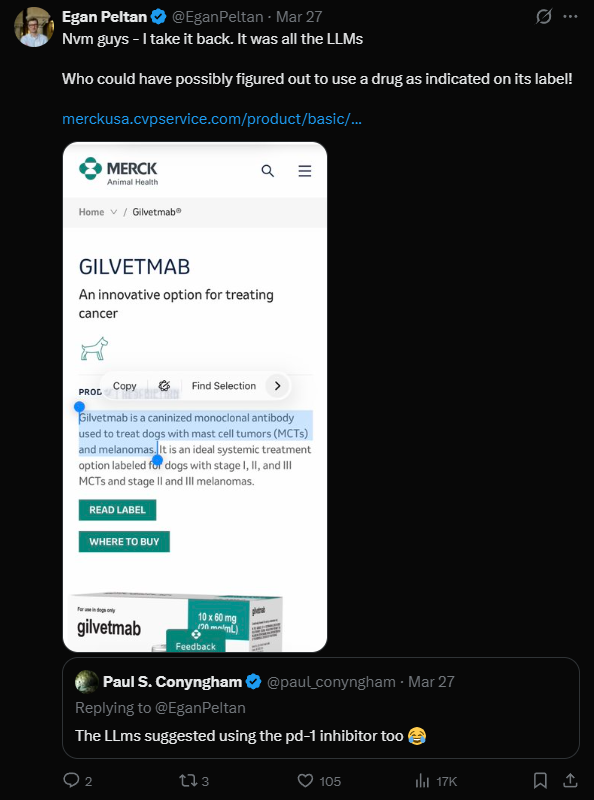
Peltan calls the entire thing "storytelling for AGI true believers. Specifically, a story in search of venture money." Before Conyngham sells his individual vaccine story to consumers, he should provide evidence that it actually worked, Peltan says. Conyngham has since written up his process in detail and released his approach as an open-source method.
Original article from March 15, 2026:
AI consultant uses ChatGPT, AlphaFold, and Grok to find a possible treatment for his dog's cancer
An Australian AI consultant used ChatGPT, AlphaFold, and Grok to identify a possible treatment for his dog Rosie's incurable cancer. The story is blowing up on social media.
Paul Conyngham, an AI consultant from Australia, combined AI tools like ChatGPT with Google's AlphaFold and genome sequencing to work with researchers on a possible treatment for his terminally ill dog Rosie, who has incurable mast cell cancer.
On ChatGPT's recommendation, Conyngham had both Rosie's healthy genome and tumor genome sequenced at the Ramaciotti Centre for Genomics at UNSW Sydney. He then used AI systems to identify a target protein and an already FDA-approved substance that could help. The sequencing alone cost him $3,000.
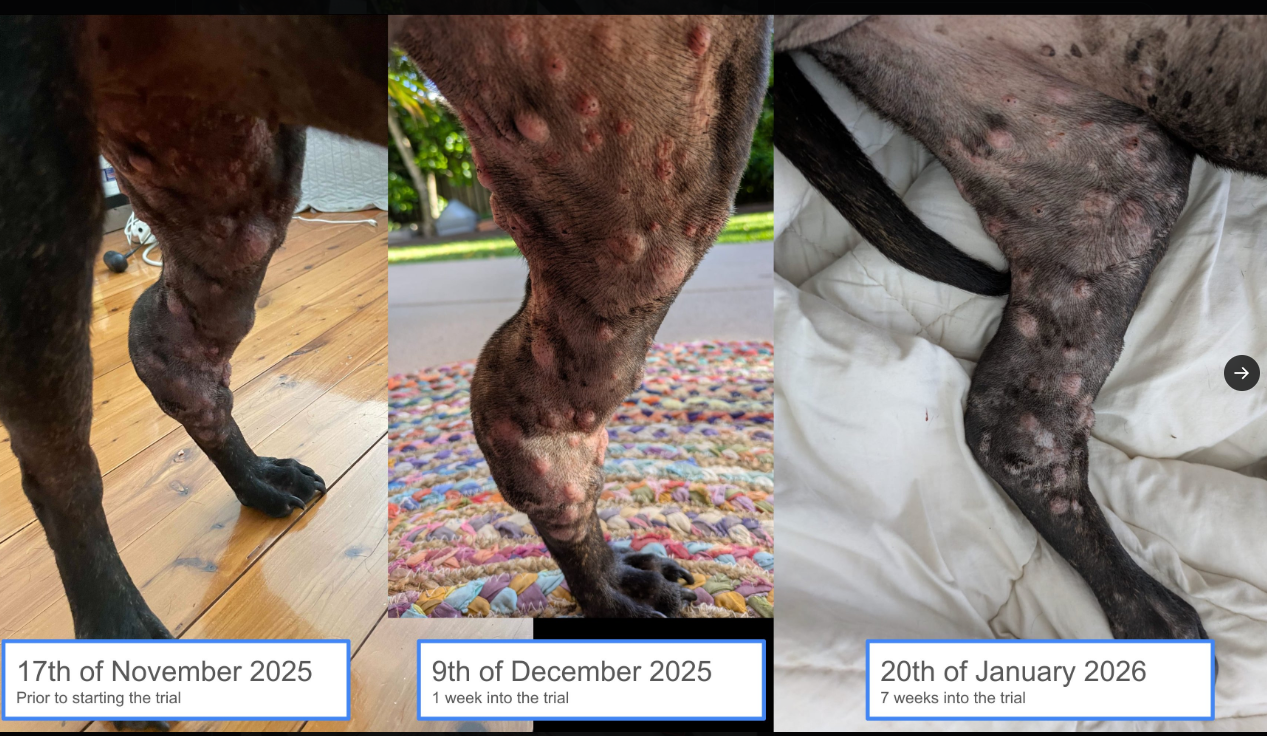
According to Conyngham, the final vaccine design was created using the Grok AI model. Since the drug was administered, Conyngham says the cancer has shrunk by about 75 percent. The dog, however, has not been cured.
The story was shared by OpenAI President Greg Brockman and Deepmind CEO Demis Hassabis, among others. Conyngham started the project back in November 2024.
Researcher warns the hard part is proving safety and efficacy
Patrick Heizer, a researcher in cell and gene therapy, warns against getting too excited. Fighting tumors in the lab is the easy part, he says. The real challenge is proving a therapy is both safe and effective in controlled human trials. One major issue is precision: proteins in the body often look very similar, so a therapy that targets a tumor protein could also hit similar proteins in healthy organs like the heart, Heizer explains.
Moreover, results in animals don't translate directly to humans, since mice and dogs have different proteins than people do. Heizer also points out that pharmaceutical companies and regulators have to ensure long-term safety over five or more years, something that's impossible to measure with short-lived lab animals.
Whether the drug actually helped, to what extent, and at what cost are all open questions. But the real takeaway may be something else entirely: AI enabled a medical layperson to get this far in the first place.
Update: Egan Peltan, co-founder of a biotech startup and a Stanford-trained PhD in chemical biology, isn't buying the hype. He says AI's role in this story is overblown—all of this could have been done without ChatGPT. Peltan also points out that the dog was getting conventional immunotherapy at the same time, so there's no way to tell whether the mRNA vaccine actually did anything. He estimates the real cost of treatment at $20,000 to $50,000. Personalized mRNA cancer vaccines have been in development for years with no clear success in large-scale trials, he notes. The field needs Phase 3 results, not anecdotes, before anyone starts arguing that regulators are standing in the way of life-saving treatments, Peltan says.
AI News Without the Hype – Curated by Humans
As a THE DECODER subscriber, you get ad-free reading, our weekly AI newsletter, the exclusive "AI Radar" Frontier Report 6× per year, access to comments, and our complete archive.
Subscribe nowAI news without the hype
Curated by humans.
- More than 16% discount.
- Read without distractions – no Google ads.
- Access to comments and community discussions.
- Weekly AI newsletter.
- 6 times a year: “AI Radar” – deep dives on key AI topics.
- Up to 25 % off on KI Pro online events.
- Access to our full ten-year archive.
- Get the latest AI news from The Decoder.