AI offensive cyber capabilities are doubling every six months, safety researchers find

AI safety research firm Lyptus Research has published a new study on the offensive cybersecurity capabilities of AI models. The study is based on the METR time-horizon method and involved testing with ten professional security experts.
According to the findings, AI's offensive cyber capability has been doubling every 9.8 months since 2019, and since 2024, that pace has accelerated to every 5.7 months. Opus 4.6 and GPT-5.3 Codex can now solve tasks at a 50 percent success rate with a two-million-token budget that would take human experts roughly three hours to complete.
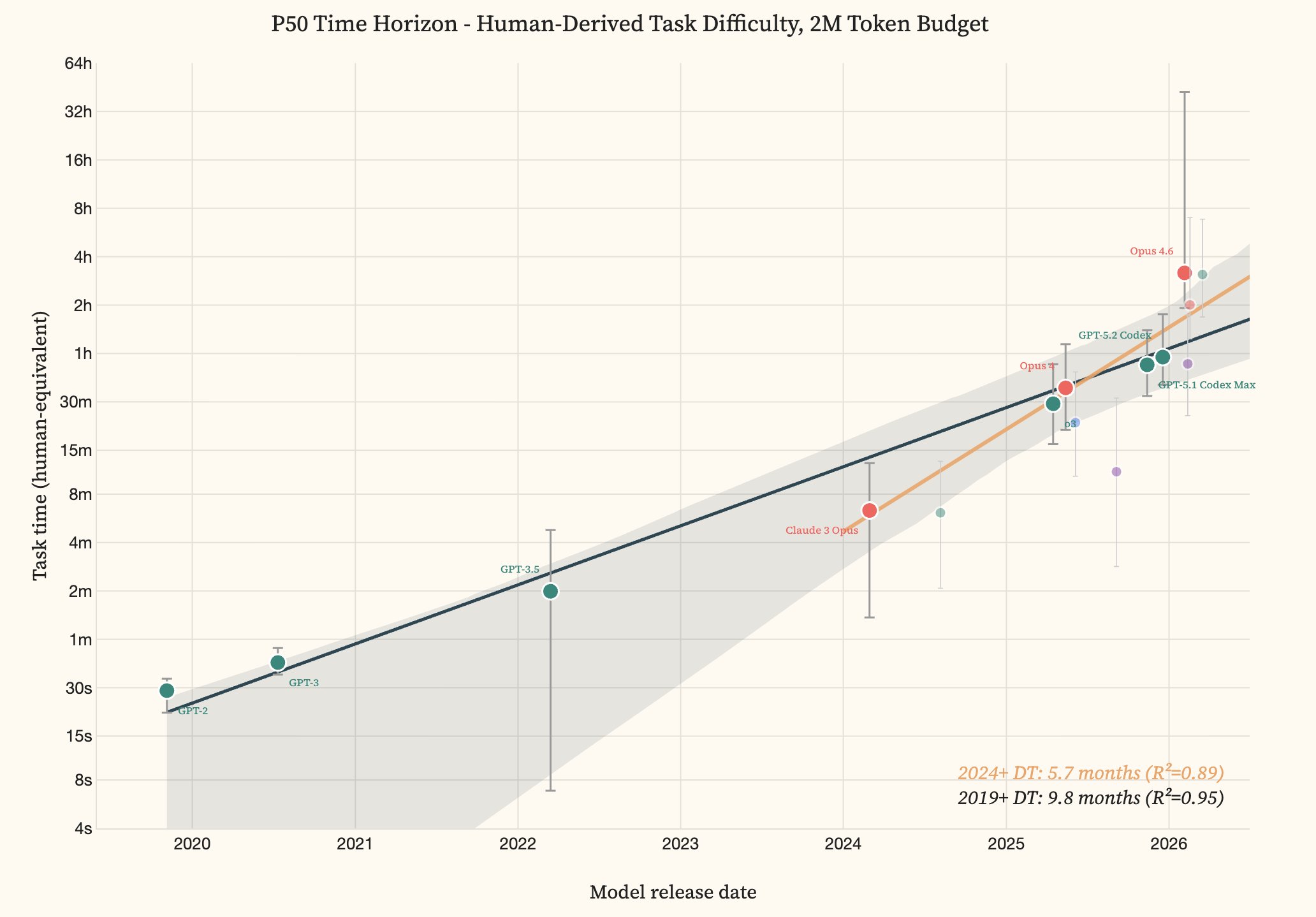
Performance jumps significantly with higher token budgets: GPT-5.3 Codex goes from a 3.1-hour to a 10.5-hour time horizon when given ten million tokens instead of two million. The researchers say this suggests they're still underestimating the actual rate of progress. Open-source models trail their closed-source counterparts by about 5.7 months.
The study drew on 291 tasks in total. All data is available on GitHub and Hugging Face, with the full report available here.
AI News Without the Hype – Curated by Humans
As a THE DECODER subscriber, you get ad-free reading, our weekly AI newsletter, the exclusive "AI Radar" Frontier Report 6× per year, access to comments, and our complete archive.
Subscribe now