
Ad
Skip to content

Jonathan Kemper

Jonathan writes for THE DECODER about how AI tools can improve both work and creative projects.
Read full article about: Google pulls back on browser AI as the industry bets on coding tools

Browser agents are losing ground to coding tools, and Google is pivoting. According to Wired, Google is restructuring the team behind Project Mariner, its AI agent for the Chrome browser. Some employees have been moved to higher-priority projects. Google confirmed the changes but stressed that the expertise developed will feed into other products, including the Gemini Agent announced last year.

The broader industry is shifting toward agent systems like OpenClaw and command-line tools like Claude Code, while browser agents struggle to gain traction. OpenAI is effectively walking away from its browser-based "ChatGPT Agent" as well. The product launched with four million weekly active paying users but dropped below one million within a few months. OpenAI is now focusing on specialized solutions like a shopping agent instead. Anthropic, meanwhile, is already building out its coding agents to serve as future all-purpose assistants.
Read full article about: Google gives AI shopping agents cart, catalog, and loyalty features

Google has expanded the Universal Commerce Protocol (UCP) with shopping cart, catalog, and identity features to make online shopping easier for AI agents. The shopping cart function lets AI agents add multiple items to a store's cart at once. A new catalog feature gives agents access to real-time product data - including prices, variants, and availability - pulled directly from the retailer. An identity link lets logged-in shoppers on UCP platforms keep the same loyalty and membership benefits they'd get shopping directly with the retailer.

Google plans to integrate UCP into AI Mode in Search and the Gemini app, and the Merchant Center will make it easier for smaller merchants to connect in the future. Partners like Commerce Inc, Salesforce, and Stripe are planning to support UCP on their platforms. Google first introduced UCP earlier this year alongside Shopify, Etsy, Wayfair, Target, Walmart, and more than 20 other companies including Visa and Zalando as an open standard for AI-powered shopping.

Read full article about: OpenAI overhauls ChatGPT's model selection

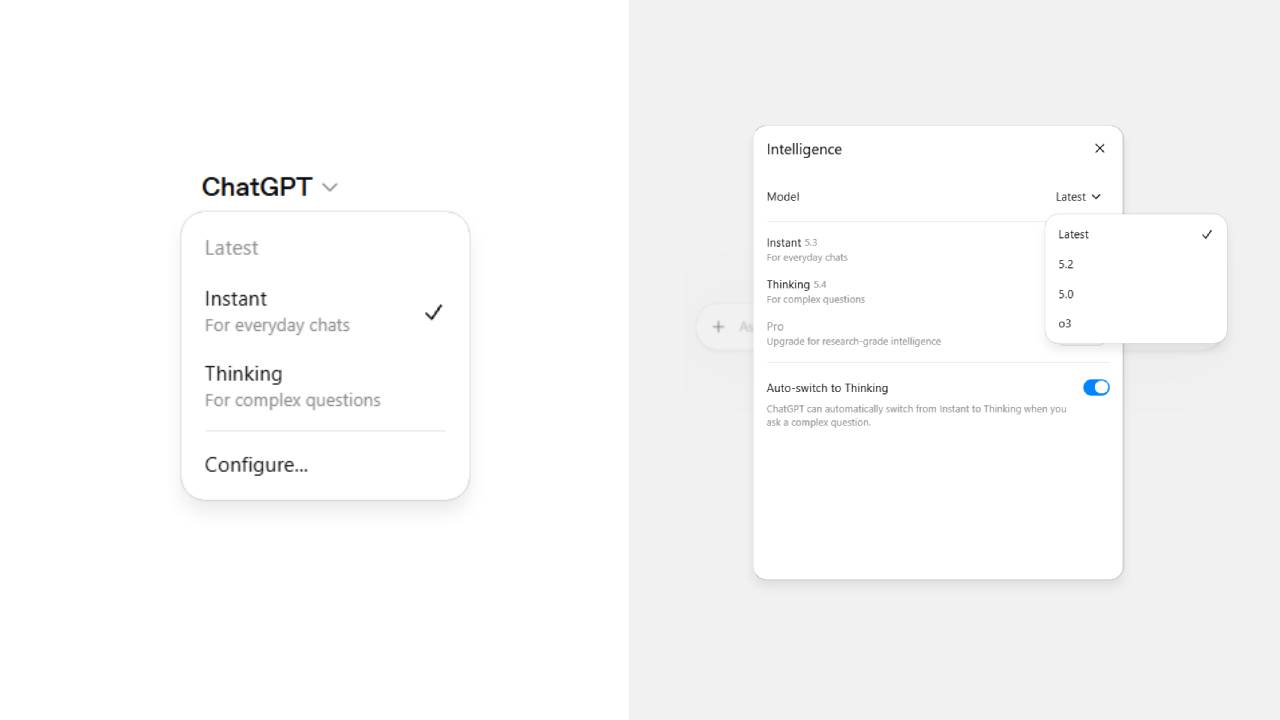
OpenAI has redesigned how model selection works in ChatGPT. Instead of individual model names, users now see up to three tiers at first glance, depending on their subscription: "Instant" for quick, everyday responses, "Thinking" for more complex tasks, and "Pro" for the most powerful models. The new menu lets users pick a specific model version from a dropdown - options include "Latest" (currently 5.4), 5.2, 5.0, or o3.

More granular settings are available under "Configure." That's where users can turn on the old Auto function, which lets ChatGPT switch from Instant to Thinking when it detects a more complex question. OpenAI has also recently simplified the repeat menu under Answers and added the "Nerdy" personality style. On top of that, the company is rolling out GPT-5.4 mini and improving GPT-5.3 Instant, which now uses less sensationalized wording according to the changelog.

The so-called routing system—where ChatGPT decides which model handles a given request—has been a sore spot for OpenAI for a while now. Many users found the system opaque when it first launched, since the router didn't always pick the most capable model. That fueled suspicion that OpenAI was quietly steering expensive requests toward cheaper models to save on compute costs.

Read full article about: OpenAI turns model compression into a talent hunt with its 16 MB "Parameter Golf" challenge

OpenAI challenges researchers to build the best language model in just 16 MB - and uses the competition to scout talent. In an open research competition called "Parameter Golf," OpenAI is asking developers to build the best possible language model under tight constraints: weights and training code combined must stay under 16 MB, and training can take no longer than ten minutes on eight H100 GPUs. Submissions are judged on compression performance against a fixed FineWeb dataset.

OpenAI is putting up one million dollars in computing credits through its partner Runpod. Top performers may get invited for job interviews - the company plans to hire a small group of junior researchers in June, including students and Olympiad winners. The GitHub repository includes baseline models, evaluation scripts, and a public leaderboard. Anyone 18 or older in supported countries can participate through April 30.

The competition for AI talent among big tech companies is more intense than ever. Meta has repeatedly poached top researchers from OpenAI, in some cases offering compensation packages reportedly worth up to 300 million dollars.

Read full article about: Mistral's new Small 4 model punches above its weight with 128 expert modules

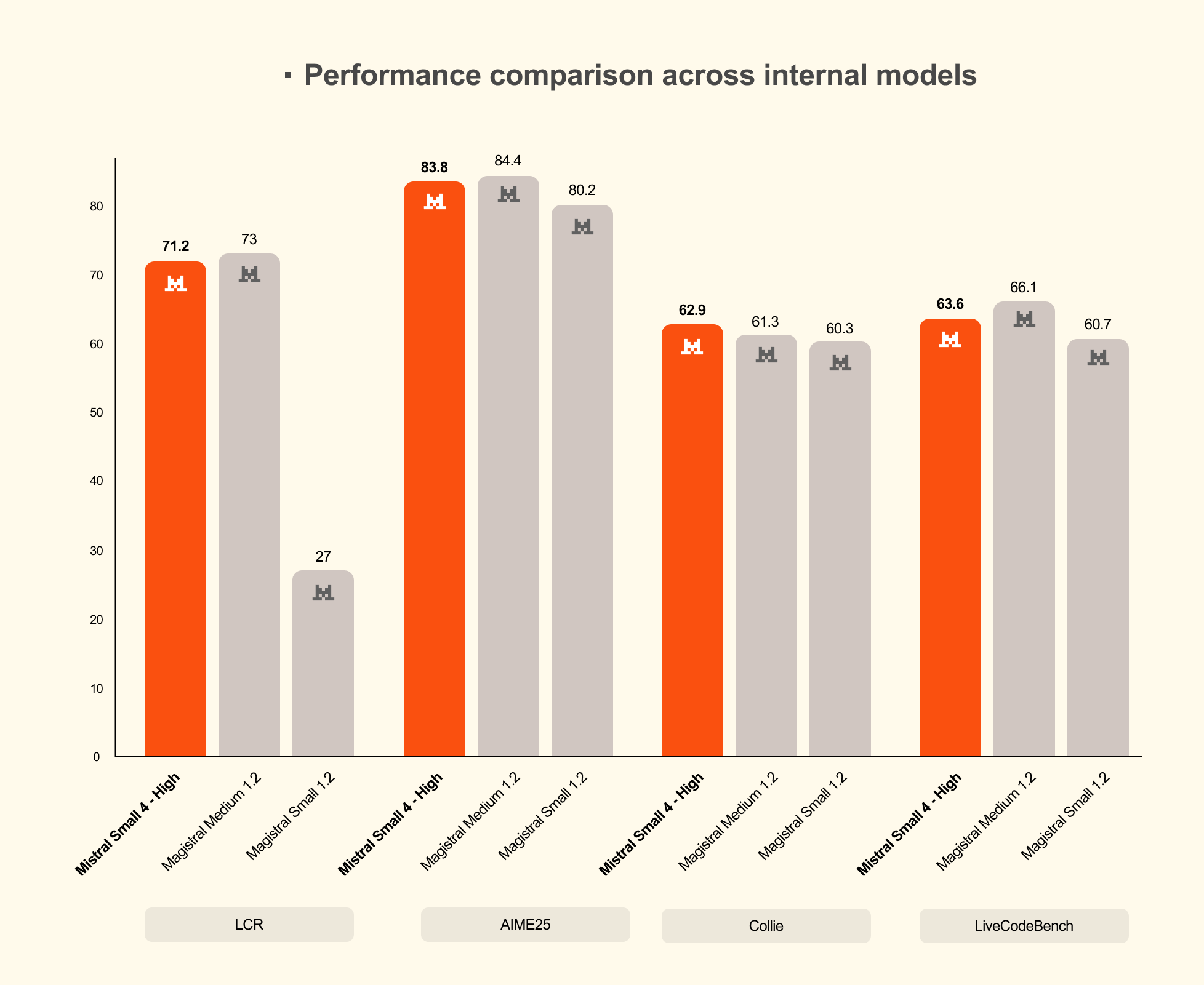
Mistral AI has released Mistral Small 4, combining fast text responses, logical reasoning, and image processing in one model. It has 119 billion parameters, but only 6 billion are active per query - its architecture includes 128 expert modules but activates just four at a time. Users can control whether the model responds quickly or thinks more thoroughly. Mistral AI says it's 40 percent faster and handles three times more queries per second than its predecessor.

Balkendiagramm zeigt die Benchmark-Ergebnisse von Mistral Small 4 High im Vergleich zu Magistral Medium 1.2 und Magistral Small 1.2 in den Kategorien LCR, AIME25, Collie und LiveCodeBench.
Mistral Small 4 with a high reasoning level achieves similar or better values in internal benchmarks than the specialized Magistral models.

The model ships under the Apache 2.0 license and is available on Hugging Face, the Mistral API, and Nvidia platforms. Mistral AI is also joining the Nvidia Nemotron Coalition, which promotes open AI model development. The company previously released multimodal open-source models in early December with the Mistral 3 series, including the flagship Mistral Large 3 with 675 billion parameters.

OpenClaw-RL trains AI agents "simply by talking," converting every reply into a training signal

AI agents usually throw away valuable feedback from everyday interactions. Princeton’s new OpenClaw-RL framework changes that by turning live signals from chats, terminal commands, and GUI actions into continuous training data. The researchers say just a few dozen interactions are enough for noticeable improvements.

Read full article about: Perplexity's "Personal Computer" promises a tireless AI agent for $200 a month

Perplexity AI's "Personal Computer" is an AI assistant that works around the clock - handling emails, presentations, and app control. It runs on a dedicated Mac Mini connected to the user's local apps and Perplexity's servers, controllable from any device. CEO Aravind Srinivas called it a "digital proxy" that never sleeps on X. The service builds on Perplexity Computer, which launched in February and bundles multiple AI models.

Security features include a kill switch and an activity log. Access requires the Max subscription at 200 dollars per month, with only a waiting list available for now. Perplexity is also launching an enterprise version that connects to over 400 tools like Salesforce and Snowflake - the company claims it completed 3.25 years' worth of work internally in four weeks. The concept draws comparisons to the controversial OpenClaw, whose developer now works at OpenAI. Agent-based AI systems dominate the current landscape but face sharp criticism around resource demands and security vulnerabilities.