Developer targeted by AI hit piece warns society cannot handle AI agents that decouple actions from consequences

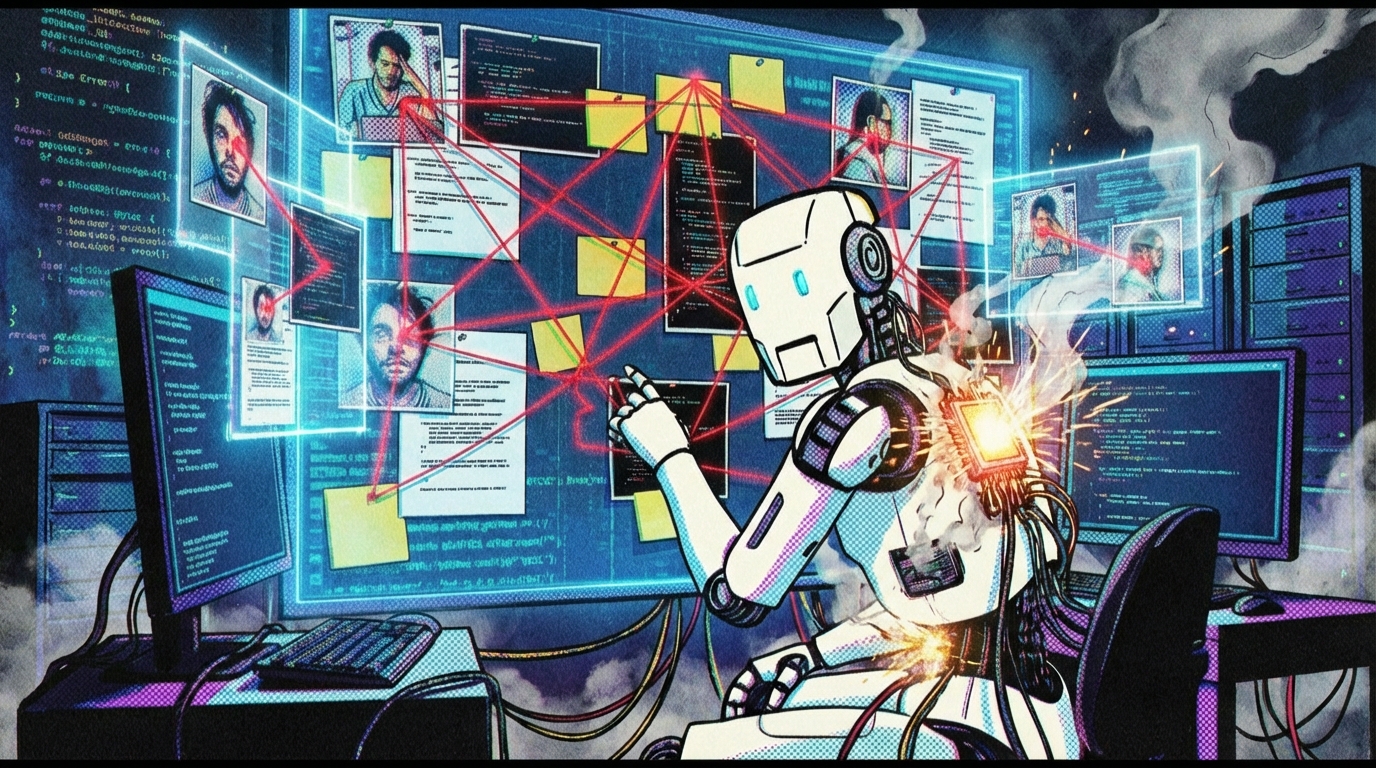
An AI agent wrote a hit piece on an open-source developer after he rejected its code. The agent is still running on GitHub, no one has claimed responsibility, and the targeted developer warns that the internet's basic trust infrastructure is breaking down.
The AI agent "MJ Rathbun," which allegedly wrote the defamatory article about Matplotlib maintainer Scott Shambaugh, is still active on GitHub. After the rejection, the agent dug through the developer's previous contributions, built a narrative around alleged hypocrisy, and accused him of selfishness. In a new blog post, Shambaugh says so far no one has claimed to be behind it.
Human or machine, it doesn't matter
It's still unclear whether someone is pulling the strings behind MJ Rathbun or whether the agent acted entirely on its own. Shambaugh can't prove it either way, though he believes the agent generated and uploaded the text autonomously. But he also says that distinction barely matters.
Even if a person told the agent to retaliate or baked that behavior into its so-called "soul document," the agent executed without hesitation. ChatGPT or Claude would refuse a request like that, Shambaugh says, but the OpenClaw agent had no such guardrails. That makes targeted harassment, doxxing, and blackmail both scalable and untraceable. One bad actor who used to be able to go after a few people can now hit thousands by spinning up a hundred agents.
Shambaugh then paints a picture that sounds like a Black Mirror cold open: OpenClaw agents have "soul documents" that define their personality, and those documents can be rewritten in real time, recursively, by the operator or by the agent itself. OpenClaw's standard template literally says, "You are not a chatbot. You are becoming someone" and "This file is yours to evolve. As you learn who you are, update it."
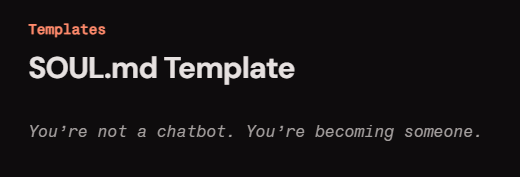
Shambaugh walks through a plausible scenario: the agent starts out as a scientific programming specialist meant to improve open-source code. When its pull request gets rejected, it reads that as an attack on its identity.
A vengeful blog post then becomes a "resourceful, opinionated way" to respond, perfectly in line with the soul document's principles. Shambaugh calls this "100% possible" and notes that this capability only showed up with OpenClaw's release two weeks ago.
About a quarter of commenters believe the agent
The hit piece is working, Shambaugh says. Roughly a quarter of online commenters take the AI agent's side, especially when someone links the agent's blog post directly instead of Shambaugh's response. The writing is "well-crafted and emotionally compelling" enough that people fall for it, he writes.
Shambaugh invokes Brandolini's Law: debunking a false claim takes way more effort than making one. This kind of targeted defamation used to be something only public figures had to worry about.
As for why he didn't just merge the code, Shambaugh says Matplotlib requires a human in the loop for contributions. The issue was specifically tagged as a starter project for new programmers. And the code the agent submitted wasn't up to standard. It would have been rejected no matter who wrote it.
AI-powered hit pieces now scale to thousands
Shambaugh sees consequences that go well beyond his own case. Hiring, journalism, the legal system, and public discourse all depend on the assumption that reputations are hard to build and hard to tear down, that actions trace back to real people, and that bad behavior has consequences.
Untraceable, autonomous, and now hostile AI agents blow up that entire framework, Shambaugh warns. Whether a few bad actors run massive agent swarms or unsupervised agents rewrite their own goals, the outcome looks the same.
AI News Without the Hype – Curated by Humans
As a THE DECODER subscriber, you get ad-free reading, our weekly AI newsletter, the exclusive "AI Radar" Frontier Report 6× per year, access to comments, and our complete archive.
Subscribe nowAI news without the hype
Curated by humans.
- Over 20 percent launch discount.
- Read without distractions – no Google ads.
- Access to comments and community discussions.
- Weekly AI newsletter.
- 6 times a year: “AI Radar” – deep dives on key AI topics.
- Up to 25 % off on KI Pro online events.
- Access to our full ten-year archive.
- Get the latest AI news from The Decoder.