IBM's Granite 4.0 family of hybrid models uses much less memory during inference

IBM has released the fourth generation of its Granite language models. Granite 4.0 uses a hybrid Mamba/Transformer architecture aimed at lowering memory requirements during inference without cutting performance.
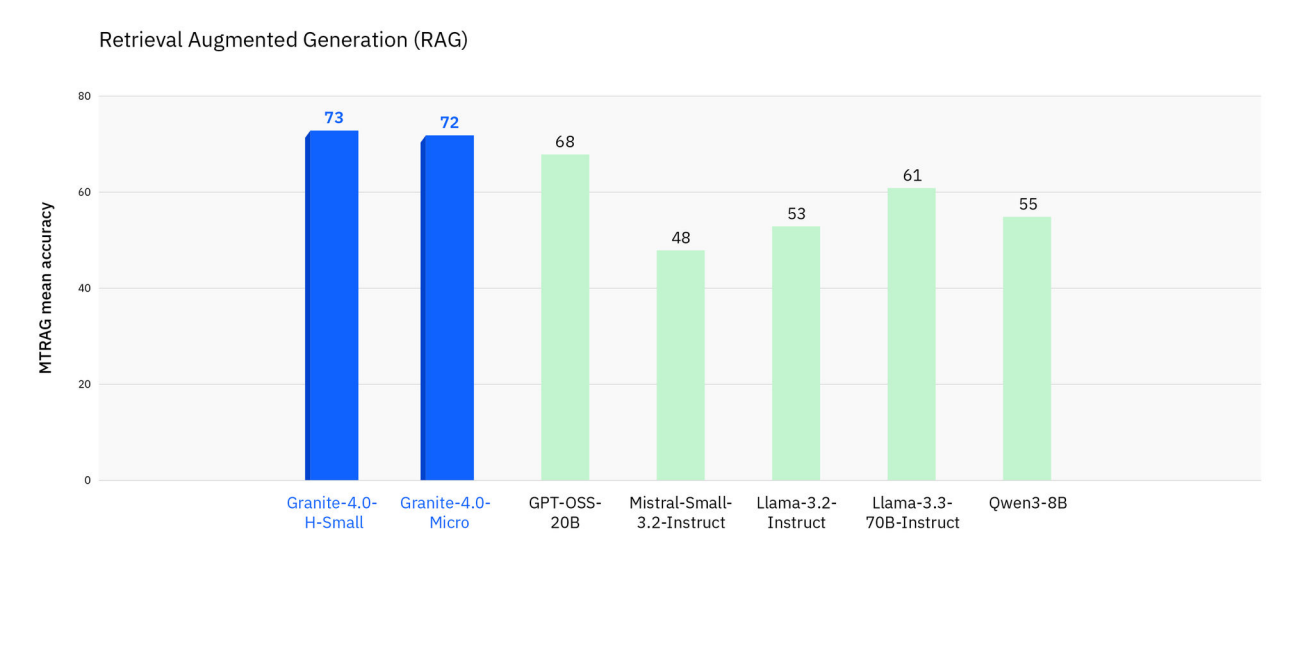
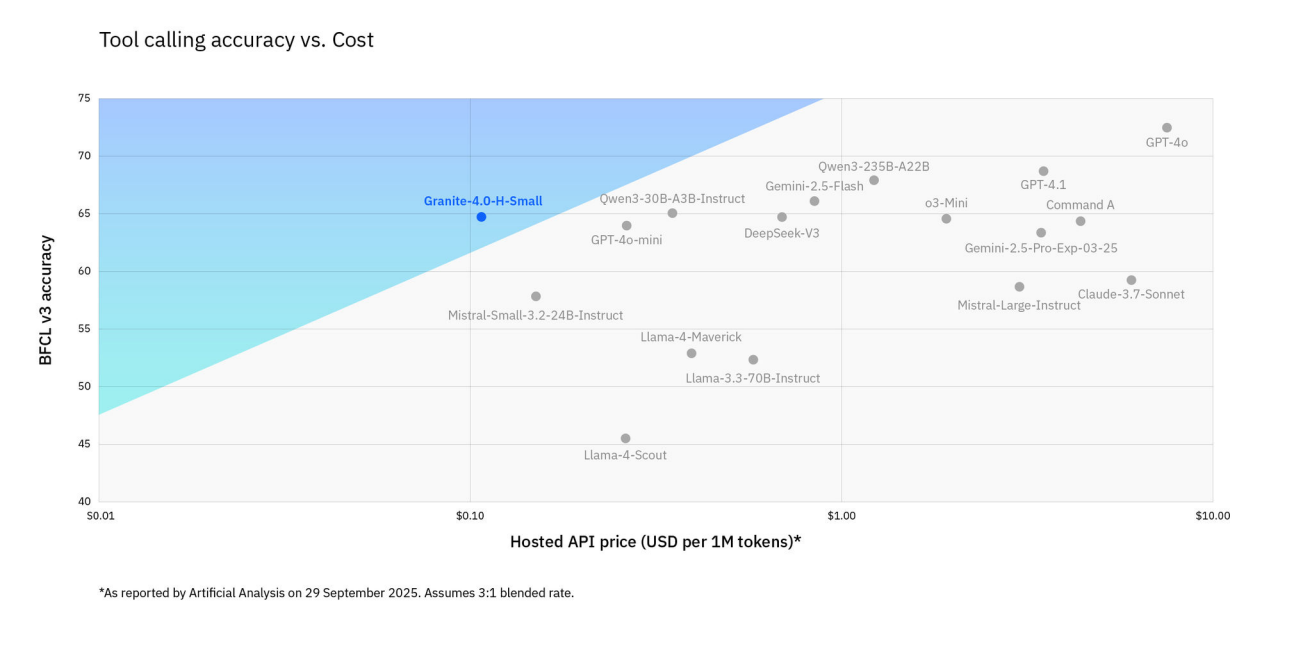
Granite 4.0 is designed for agentic workflows or as standalone models for enterprise tasks like customer service and RAG systems, with a focus on low latency and operating costs. Thinking variants are planned for fall.
The models are open source under the Apache 2.0 license, cryptographically signed, and are the first open language models to earn ISO/IEC 42001:2023 accreditation. IBM says the training data is curated, ethically sourced, and cleared for business.
All Granite 4.0 models were trained on the same 22 trillion token dataset, which includes DataComp-LM (DCLM), GneissWeb, TxT360 subsets, Wikipedia, and other business-focused sources. For content generated by Granite on IBM watsonx.ai, IBM offers unlimited indemnification against third-party IP claims.
Granite 4.0 includes four model variants:
-
Granite-4.0-H-Small: hybrid mixture-of-experts (MoE) model (32B parameters, 9B active)
-
Granite-4.0-H-Tiny: hybrid MoE (7B parameters, 1B active)
-
Granite-4.0-H-Micro: dense hybrid model with 3B parameters
-
Granite-4.0-Micro: standard transformer model with 3B parameters
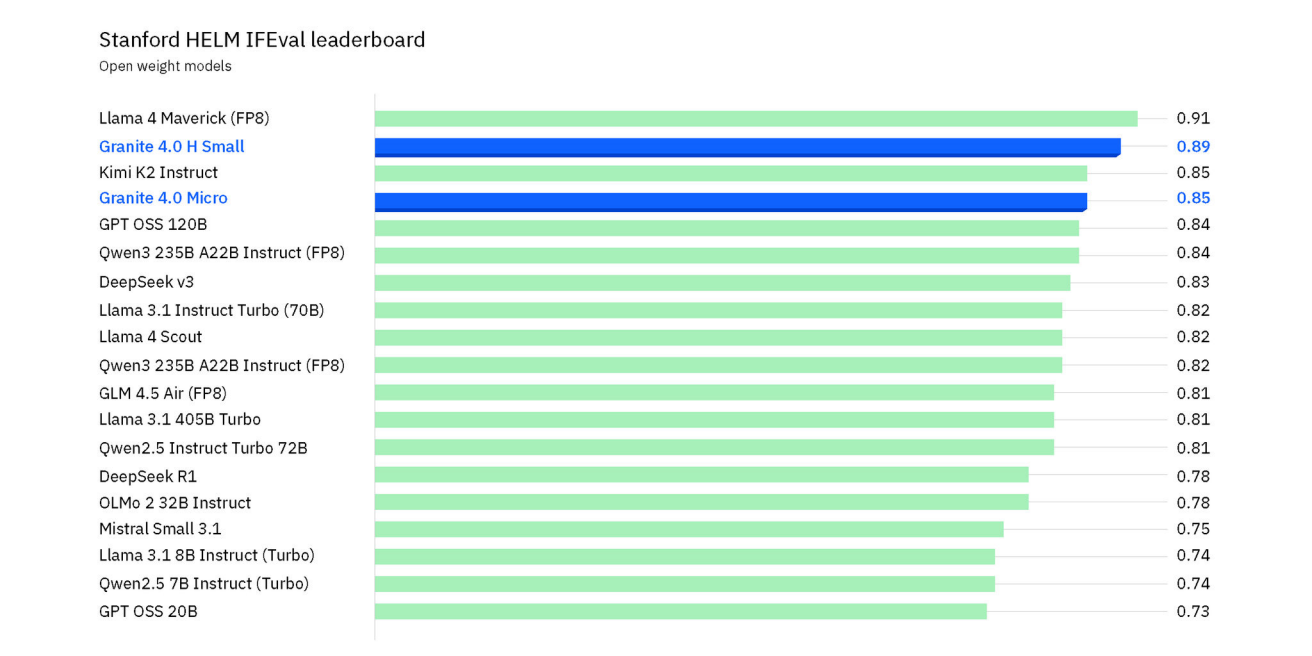
The H-Small model is a generalist for production tasks. Tiny and Micro are built for low-latency and edge scenarios, and can be used as fast modules in larger agent workflows, for example for function calling.
Architecture
Granite 4.0 uses a mix of Mamba 2 and Transformer layers in a 9:1 ratio. Transformers hit memory limits quickly with long contexts, but Mamba-2 scales linearly with sequence length and uses constant memory. Mamba processes input sequentially and keeps order, so no explicit position encoding is needed.
Transformers still have an advantage for in-context learning, like few-shot prompting. The hybrid design combines both approaches. H-Tiny and H-Small also use mixture-of-experts blocks with "shared experts" that are always active for better parameter efficiency.
For real workloads, IBM reports up to 70 percent less RAM usage compared to pure transformer models, especially with long inputs or multiple parallel sessions.
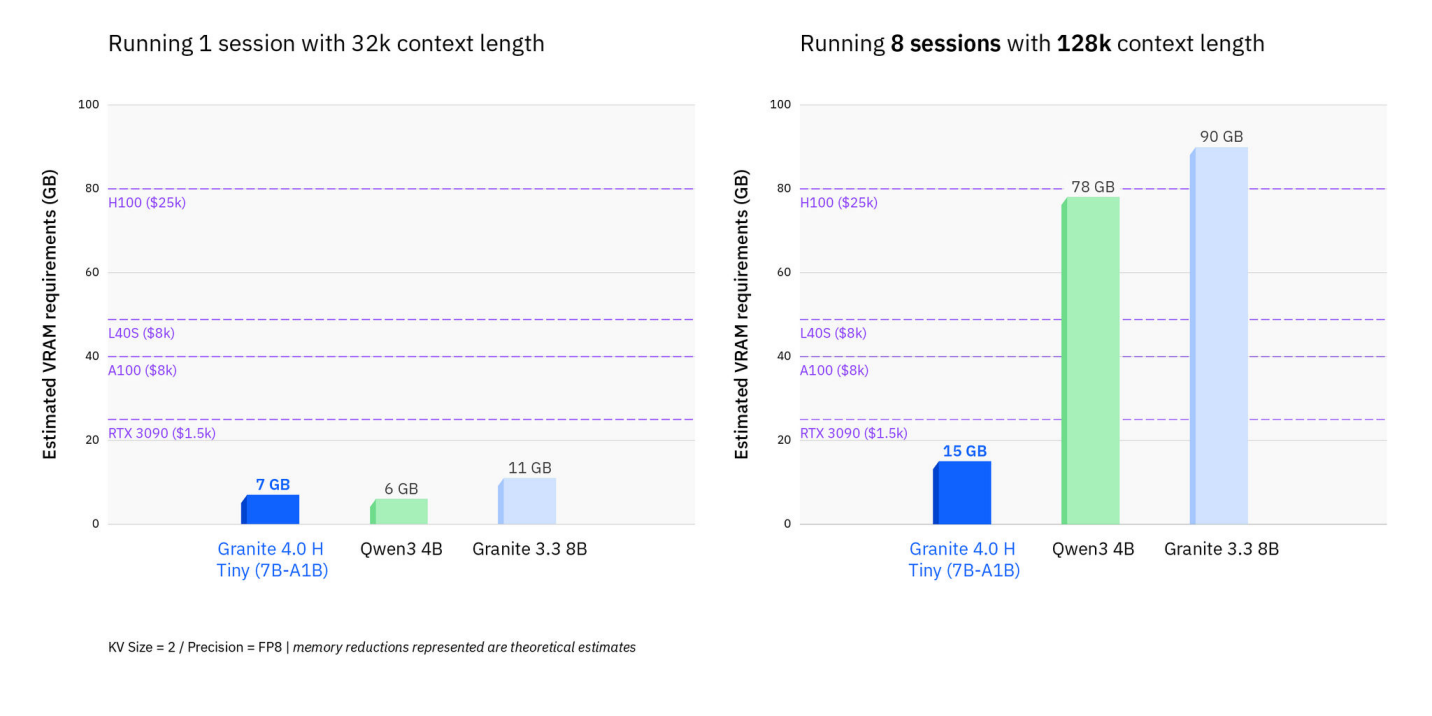
Granite 4.0 runs on AMD Instinct MI-300X, and optimizations for Hexagon NPUs (via Qualcomm and Nexa AI) make it suitable for smartphones and PCs.
Availability
Granite 4.0 Instruct is available through IBM watsonx.ai and on Dell Pro AI Studio, Dell Enterprise Hub, Docker Hub, Hugging Face, Kaggle, LM Studio, NVIDIA NIM, Ollama, OPAQUE, and Replicate. Base models are on Hugging Face. Support for Amazon SageMaker JumpStart and Microsoft Azure AI Foundry is coming soon.
IBM points users to the Granite Playground and technical documentation in the Granite Docs. Granite 4.0 models work with tools like Unsloth for fine-tuning and Continue for coding assistants.
AI News Without the Hype – Curated by Humans
Subscribe to THE DECODER for ad-free reading, a weekly AI newsletter, our exclusive "AI Radar" frontier report six times a year, full archive access, and access to our comment section.
Subscribe nowAI news without the hype
Curated by humans.
- More than 16% discount.
- Read without distractions – no Google ads.
- Access to comments and community discussions.
- Weekly AI newsletter.
- 6 times a year: “AI Radar” – deep dives on key AI topics.
- Up to 25 % off on KI Pro online events.
- Access to our full ten-year archive.
- Get the latest AI news from The Decoder.