Anthropic's new study shows AI is nowhere near its theoretical job disruption potential


Key Points
- Anthropic has developed "observed exposure," a metric that compares the theoretical capabilities of AI with actual usage data from its chatbot Claude to measure AI's real-world impact on the job market.
- The results reveal a stark gap between potential and practice: while language models could theoretically speed up 94% of all computer and mathematical tasks, only 33% are currently being affected in real-world use.
- One early warning sign stands out: since 2024, young workers between the ages of 22 and 25 have been hired less frequently in professions with high AI exposure, suggesting the technology is already reshaping entry-level employment.
Anthropic has developed a new measure that combines theoretical AI capabilities with real-world usage data. The result: programmers and customer service workers are the most exposed, but unemployment in affected professions hasn't risen yet. Only young workers are showing the first warning signs.
In a new research report, Anthropic introduces a metric called "observed exposure." Unlike previous automation forecasts, which, according to Anthropic, have often turned out to be exaggerated, this metric compares theoretical assessments of which jobs could be at risk from AI with actual usage data.
The company combines the US occupational database O*NET, theoretical exposure scores from a previous study, and usage data from its in-house Anthropic Economic Index, which draws on real Claude conversations. Fully automated use through API integrations is weighted more heavily than cases where humans only use AI as an assistant. Work-related contexts also count more than personal ones. The data is based exclusively on Claude usage.
Most AI capabilities remain unused in practice
The study's central finding: AI is nowhere near reaching its theoretical potential. It doesn't dispute that the theoretical potential might be wrong, however, so keep that in mind for the rest of this article.
In any case, according to estimates, large language models could theoretically speed up 94 percent of all computer and math tasks. In practice, only 33 percent of those tasks are actually covered based on Claude usage, Anthropic says.
The scoring uses a simple scale: tasks a language model alone can complete twice as fast get a score of 1. Tasks that require additional tools get a 0.5. Tasks with no AI speed advantage get a 0.
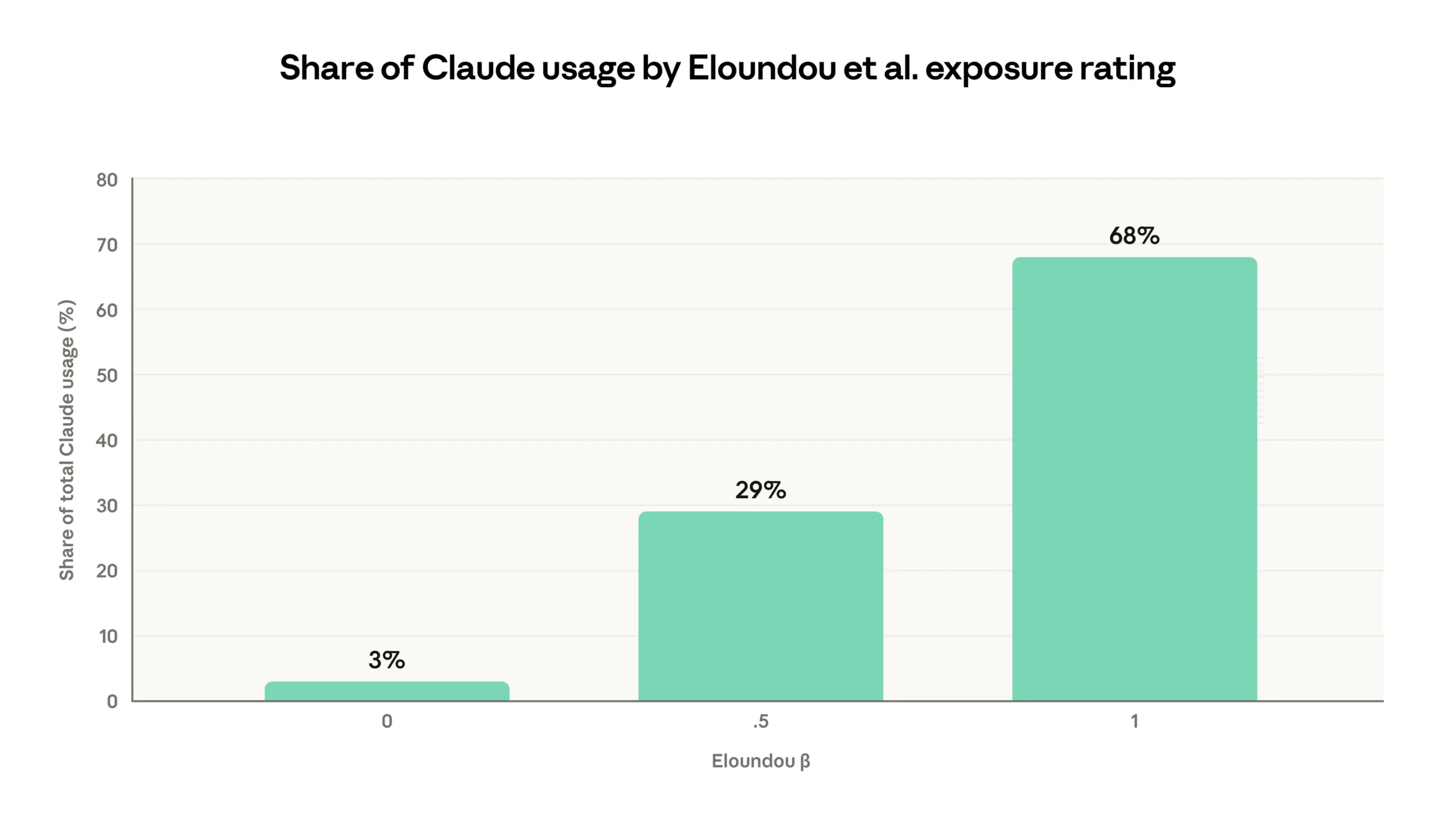
The authors point to several reasons why actual use lags what's theoretically possible: some tasks fail because of current model limitations, while others spread slowly due to legal restrictions, specific software requirements, or the need for human review.
As an example, Anthropic points to the task "authorize medication refills and transmit prescription information to pharmacies." It's classified as fully exposed, meaning a language model could theoretically speed it up. In practice, though, Anthropic says it has never observed Claude performing this activity.
That said, theoretical capability and actual use are strongly correlated: 97 percent of observed tasks fall into categories classified as theoretically feasible. Where AI is actually being used, it's overwhelmingly in areas where it also makes theoretical sense. The reverse isn't true, though. Many tasks that could theoretically be automated simply aren't being handled by AI in practice, the company claims.
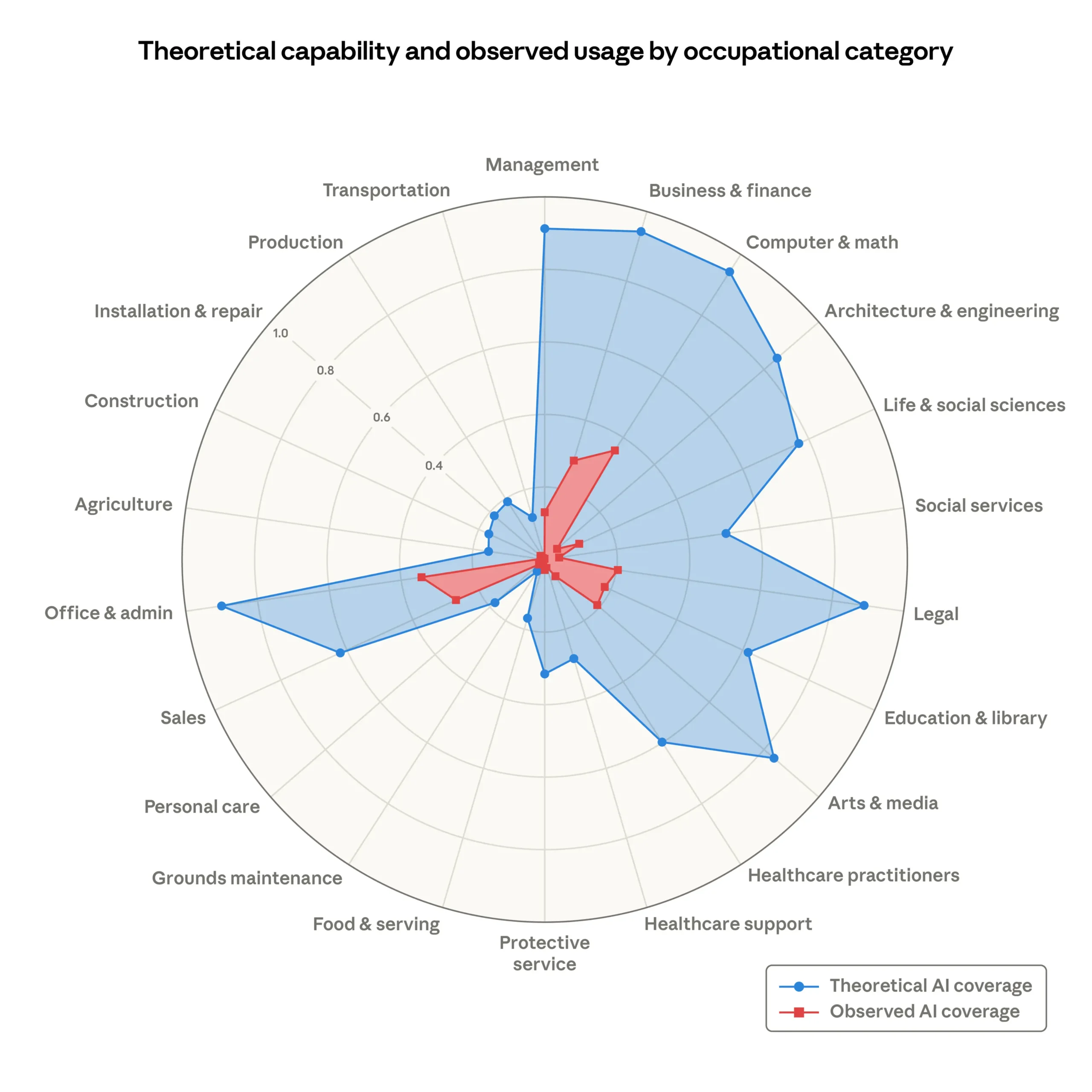
Programmers, customer service, and data entry face the highest exposure
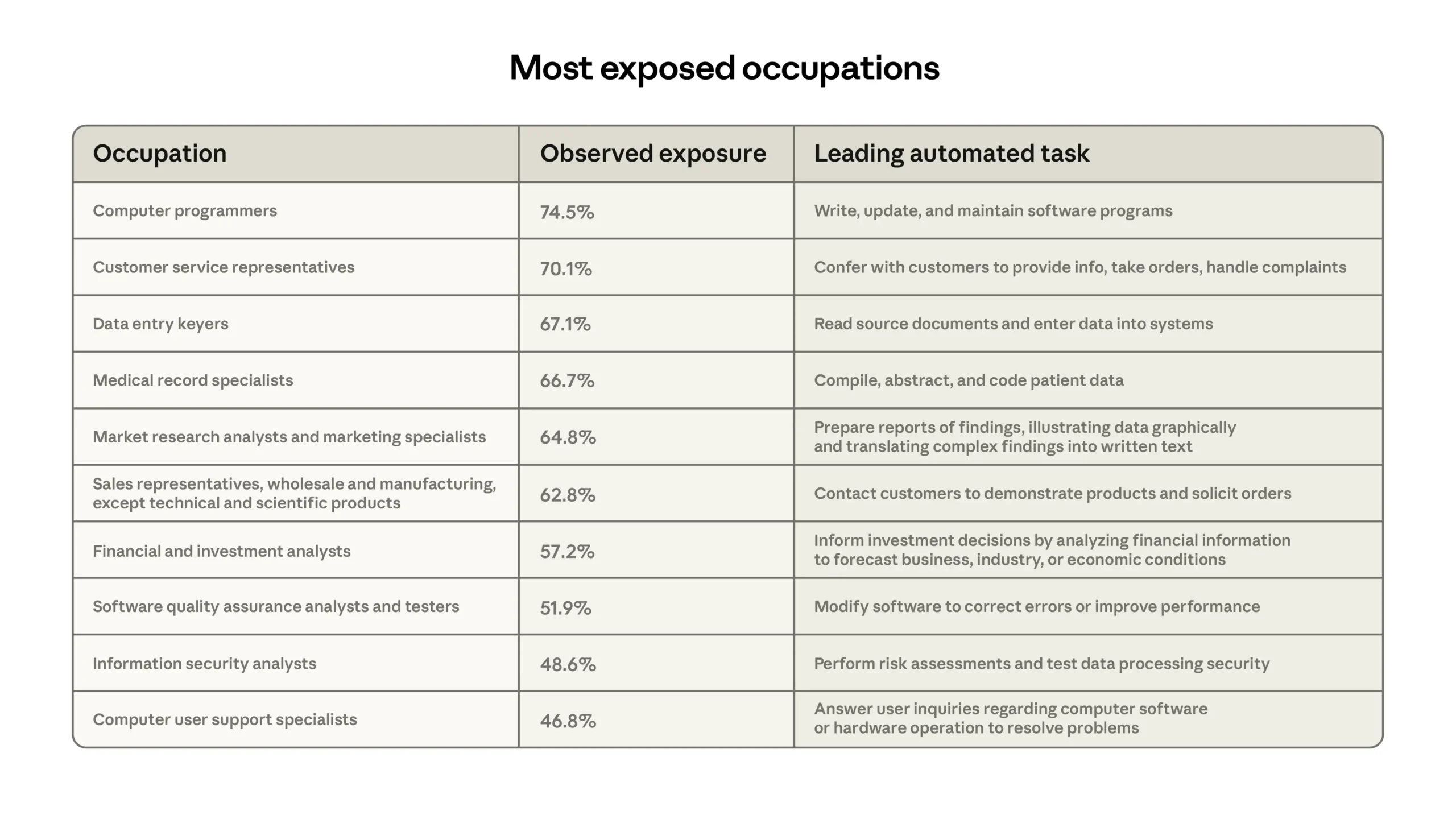
According to the study, programmers top the list of most exposed professions at 75 percent coverage, followed by customer service representatives and data entry specialists. At the other end of the spectrum, 30 percent of all workers show zero coverage. Their tasks barely appeared in the Claude data. This group includes cooks, motorcycle mechanics, lifeguards, and bartenders.
The researchers compared their exposure scores with employment projections from the US Bureau of Labor Statistics (BLS) for 2024 to 2034. Occupations with higher "observed exposure" show weaker projected growth. For every ten percentage point increase in coverage, the BLS growth forecast drops by 0.6 percentage points. The correlation is weak, but it exists.
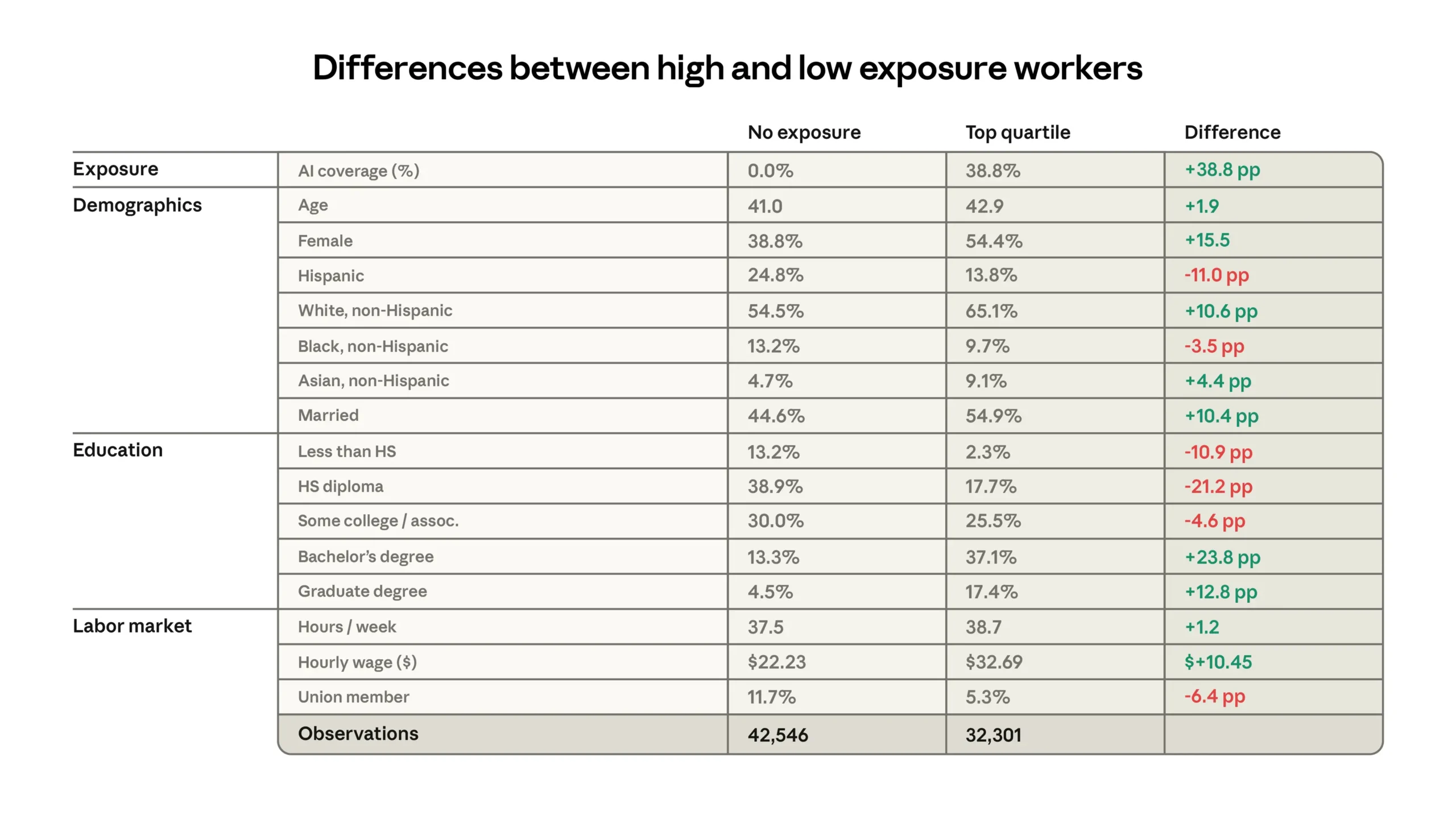
The demographic profile of the most exposed workers challenges common assumptions about who automation hits hardest. According to Current Population Survey data, workers in the most exposed occupations are more often female, more often white, better educated, and earn on average 47 percent more than the unexposed group. The share of college graduates is nearly four times higher in the exposed group.
No measurable rise in unemployment so far
Despite the high level of exposure, the study finds no systematic increase in unemployment among highly exposed workers. The authors compared unemployment rates of the most exposed occupations with the unexposed group. The average difference since ChatGPT's release at the end of 2022 is small and not statistically significant.
The researchers say their method could detect an unemployment increase of roughly one percentage point. A major recession for office workers, where the unemployment rate in the exposed group would double from three to six percent, would also show up clearly. That hasn't happened.
Young workers are the first to feel the impact
Among workers aged 22 to 25, the authors found evidence that hiring in exposed occupations has declined since 2024. The job-finding rate in highly exposed occupations dropped by about half a percentage point in this age group, while it held steady in less exposed occupations. Averaged over the post-ChatGPT period, this amounts to a 14 percent decline, though it's only barely statistically significant. No comparable effect showed up for workers over 25.
The Anthropic authors acknowledge that alternative explanations are possible: young workers who weren't hired could be staying in existing jobs, switching to other fields, or going back to school.
Previous studies have reached similar conclusions. A large-scale study of 25,000 workers in Denmark found no measurable changes in wages and working hours despite high AI usage.
A Microsoft study based on 200,000 Copilot conversations also identified knowledge workers and customer service staff as particularly exposed but cautioned against equating AI capability with automation.
A Stanford study drawing on millions of US salary records already showed a 13 percent drop in employment among young workers in AI-exposed occupations, while experienced colleagues remained stable.
Anthropic itself previously revised its productivity forecasts downward by roughly half in its fourth Economic Index Report after analyzing Claude's error rates on complex tasks.
AI News Without the Hype – Curated by Humans
As a THE DECODER subscriber, you get ad-free reading, our weekly AI newsletter, the exclusive "AI Radar" Frontier Report 6× per year, access to comments, and our complete archive.
Subscribe now