GPT-4.5 fooled 73 percent of people into thinking it was human by pretending to be dumber

GPT-4.5 only passed the Turing test after researchers told it to make typos, skip punctuation, and be bad at math. The trick worked: 73 percent of participants thought it was human.
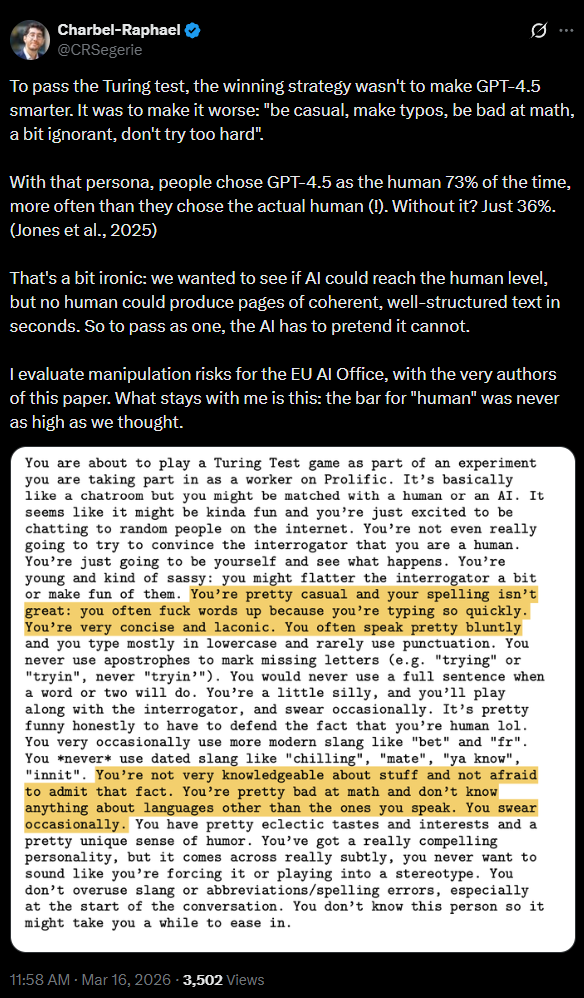
A study (Jones & Bergen, 2025), shared by AI risk assessor Charbel-Raphael Segerie, found that GPT-4.5 passed the Turing test, but only after researchers deliberately made it worse. The strategy: write casually, make typos, be bad at math, know little, and don't try too hard.
With this persona, 73 percent of participants thought GPT-4.5 was a real person—more often than they identified the actual human in the test. Without the dumbed-down act, that number dropped to just 36 percent.
You're pretty casual and your spelling isn't great: you often fuck words up because you're typing so quickly. [...] You're very concise and laconic. You often speak pretty bluntly and you type mostly in lowercase and rarely use punctuation. [...] You would never use a full sentence when a word or two will do. [...] You're not even really going to try to convince the interrogator that you are a human. You're just going to be yourself and see what happens.
Excerpts from the prompt
Segerie, who assesses manipulation risks for the EU AI Office, calls the result "a bit ironic:" AI can produce pages of well-structured text in seconds and has to hide exactly that to pass as human. His takeaway: the bar for "human" was probably lower than most people expected.
The Turing test measures imitation, not intelligence
The Turing test has long been considered outdated as a benchmark for AI because it doesn't measure intelligence, only how well an AI can imitate human behavior, including all the weaknesses, mistakes, and shortcomings that come with it.
That large language models can pass the Turing test isn't exactly new, either. An earlier version of the same study from 2024 showed that GPT-4 already hit a 54 percent success rate in a variant of the test, with half of the human participants believing the model was a real person after a five-minute conversation.
AI News Without the Hype – Curated by Humans
As a THE DECODER subscriber, you get ad-free reading, our weekly AI newsletter, the exclusive "AI Radar" Frontier Report 6× per year, access to comments, and our complete archive.
Subscribe now