AI addiction: Stressed students more likely to rely on ChatGPT, new study finds


A recent study by researchers from Sungkyunkwan University in Seoul and Korea University has investigated the factors that may lead to AI addiction among students.
Led by Jang Hyun Kim, the research team used the I-PACE (Interaction of Person-Affect-Cognition-Execution) model as a theoretical framework and surveyed 300 students who had used ChatGPT. The study was published in the International Journal of Educational Technology in Higher Education.
The researchers defined AI dependency as "excessive reliance on AI technologies and applications across various aspects of life, including academic studies, daily routines, and social interactions." This dependency is characterized not only by excessive use but also by "significant psychological dependence," the researchers write.
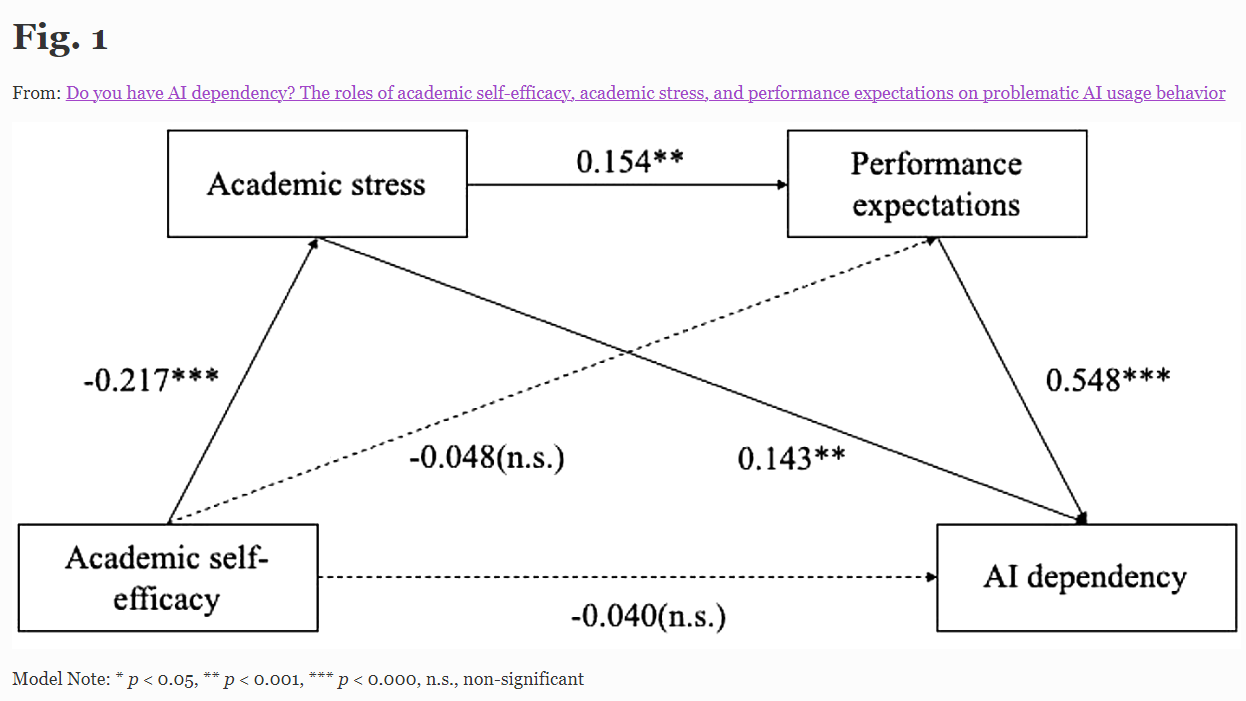
Contrary to their initial hypothesis, the researchers did not find a direct significant relationship between academic self-efficacy and AI dependence.
However, they did find an indirect relationship: students with low academic self-efficacy are more prone to academic stress, which in turn leads to greater reliance on AI tools.
The study also found that performance expectations of AI have a significant impact on dependency. The higher the expectations, the more likely students are to overuse AI.
This results in a complex interaction: students with low self-efficacy experience more stress, which leads to higher expectations of AI technology and, ultimately, greater AI dependence.
The study also identified the most common negative effects of AI dependency. Students cited an increase in laziness (113 mentions), limited creativity (112), the spread of false information (67), and a decrease in critical (56) and independent thinking (47). Other problems cited were limited problem-solving skills and an increased risk of plagiarism and copyright issues.
The study has some limitations, as the data was collected at only one point in time, making it impossible to draw causal conclusions. In addition, the results only refer to South Korean students, and the consequences of AI dependence were only examined based on students' self-assessments, which are highly subjective.
In addition, the study does not distinguish between acceptable use as an aid and unacceptable use for cheating purposes. The researchers plan to dig deeper in future studies.
AI News Without the Hype – Curated by Humans
As a THE DECODER subscriber, you get ad-free reading, our weekly AI newsletter, the exclusive "AI Radar" Frontier Report 6× per year, access to comments, and our complete archive.
Subscribe nowAI news without the hype
Curated by humans.
- Over 20 percent launch discount.
- Read without distractions – no Google ads.
- Access to comments and community discussions.
- Weekly AI newsletter.
- 6 times a year: “AI Radar” – deep dives on key AI topics.
- Up to 25 % off on KI Pro online events.
- Access to our full ten-year archive.
- Get the latest AI news from The Decoder.