AI spam websites flood the web with false information, and the number is growing fast


Key Points
- The media analysis company NewsGuard and AI detector Pangram Labs have launched a real-time system designed to identify websites that mass-publish AI-generated content, much of which contains factual errors.
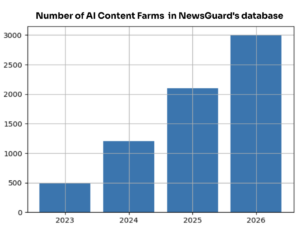
- More than 3,000 such "AI content farms" have already been detected, with the number doubling within a single year and currently growing by 300 to 500 new sites per month.
- Many of these AI content farms are specifically built to generate revenue through programmatic advertising, often funded unknowingly by well-known brands whose ads appear on the sites.
Media analysis company Newsguard and AI detector Pangram Labs have launched a real-time system to spot so-called "AI content farms." More than 3,000 of these sites have already been flagged, and the count is climbing fast.
AI content farms are websites that pump out massive amounts of AI-generated, often inaccurate news and information to cash in on ad revenue or spread propaganda.
The new system pairs Newsguard's data with Pangram Labs' automated AI detection software. The software first flags websites where a significant chunk of the content comes from AI. Human analysts then review the results and weed out false positives.
So far, the system has identified 3,006 AI content farms, according to Newsguard. That number has more than doubled in a year and is currently growing by 300 to 500 new sites per month.
A site gets labeled an AI content farm when three conditions are met: a significant share of its content is AI-generated, the site doesn't disclose that fact, and the layout makes it look like the articles were written by human journalists.
These sites typically sport generic names like "Times Business News" or "Business Post," push out dozens of articles a day, and frequently serve as the origin point for fake news about brands, health topics, politicians, or celebrities.
Fake stories hurt brands and fuel geopolitical propaganda
The lack of editorial oversight means AI regularly generates completely fabricated claims. In October 2025, the AI content farm "News 24" published a false report claiming Coca-Cola had threatened to pull its Super Bowl sponsorship if Puerto Rican rapper Bad Bunny performed during the halftime show. Coca-Cola isn't even a Super Bowl sponsor, Newsguard points out. Yet ads from Expedia, AT&T, YouTube, Priceline, Hotels.com, Skechers, and GoDaddy all ran on the site.
Meanwhile, "CitizenWatchReport" pushed the false claim that two U.S. senators had blown $814,000 on hotels in Ukraine. Russian state media picked up the story and amplified it inside the U.S.
Newsguard says the system also tracks sites run by adversarial actors from Russia, China, and Iran. Of the identified AI content farms, 358 were tied to Storm-1516, a pro-Russian influence operation that publishes misleading content on websites designed to mimic local newspapers in the U.S. and Europe. The real number is likely much higher, Newsguard noted in an earlier study, since current detection methods aren't perfect.
Advertisers unknowingly bankroll AI content farms
Many of the flagged sites are so-called "made for advertising" pages, built specifically to siphon off programmatic ad dollars with low-quality content. Newsguard previously reported that 141 well-known brands ran ads on these kinds of sites over a two-month stretch.
The new data feed is designed to help advertisers keep their placements off these sites. It plugs into buying platforms like The Trade Desk or can be licensed directly by brands and agencies.
AI content farms also surface in Google services like Google News and Google Discover, where they pick up significant visibility. Google apparently can't or won't filter them out. Often, the company likely profits from the ads running on these sites through its own AdSense program.
AI News Without the Hype – Curated by Humans
As a THE DECODER subscriber, you get ad-free reading, our weekly AI newsletter, the exclusive "AI Radar" Frontier Report 6× per year, access to comments, and our complete archive.
Subscribe now