Google's new Chrome AI agent is supposed to book trips, fill out forms, and manage appointments

Key Points
- Google is bringing Auto Browse to Chrome, an AI assistant based on Gemini 3 designed to independently complete multi-step tasks like travel research and scheduling appointments.
- For sensitive actions such as purchases or social media posts, the agent pauses and requests user confirmation, with e-commerce functionality powered by the Universal Commerce Protocol developed with Shopify, Etsy, and other partners.
- Auto Browse is initially available only in the US for paying subscribers, while Google also introduces a Gemini side panel and text-prompt-based image editing in the browser.
Back in September, Google announced the "biggest Chrome update" and teased an agent-based browser assistant. That feature is now here. Auto Browse runs on Gemini 3 and is supposed to handle multi-step tasks on the web.
Chrome's Autofill already handles addresses and credit card numbers. Auto Browse is supposed to do more—like research hotel and flight costs across different travel dates, schedule appointments, fill out online forms, gather tax documents, get quotes from contractors, review invoices, submit expense reports, and manage subscriptions. With access to Google's password manager, the agent should also work on sites that require a login.
Whether Auto Browse actually works as advertised remains to be seen. In an extensive test of various AI browsers in December, The Verge found that none of the agents tested performed complex tasks reliably, and users had to constantly tweak their prompts. Even for simple tasks like finding relevant emails or ordering shoes, the assistants kept asking questions or making mistakes. That's not surprising—research shows that even advanced reasoning models can get distracted pretty easily and make mistakes.
Gemini 3 handles text, images, and structured data. According to Google, if you upload a photo of party decorations, Auto Browse searches for similar products and adds them to your cart. The feature is supposed to respect a set budget and apply available discount codes. For purchases, Google uses the Universal Commerce Protocol (UCP), an open framework for AI agents in e-commerce developed with Shopify, Etsy, Wayfair, and Target. The protocol is meant to provide an interface for product search, purchases, and customer service.
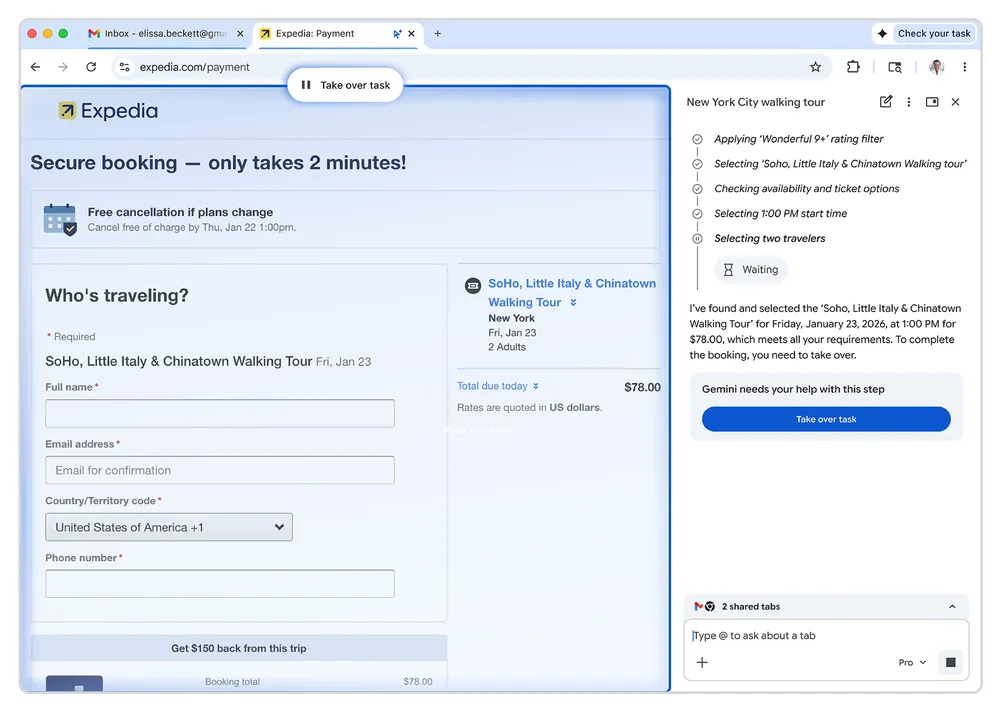
Google says Auto Browse pauses for sensitive actions and asks for confirmation before completing a purchase or posting on social media. Auto Browse is available only in the US and requires a paid subscription to AI Pro ($21.99/month) or AI Ultra ($274.99/month).
Gemini and Nano Banana move into the side panel
Google is also adding a side panel that keeps Gemini in the browser. The panel stays open while users work in other tabs, and Google says it can summarize product reviews from different websites or find free slots in a calendar.
Nano Banana is supposed to let users edit images directly in the browser. Users upload a photo and modify it with a text prompt; no download required.
Chrome connects to more Google services
Gemini in Chrome can link to Gmail, Calendar, YouTube, Maps, Google Shopping, and Google Flights. Google says the assistant can then search for an old email with conference details, suggest flights, and draft a message to colleagues with arrival times. Google also plans to add its new Personal Intelligence feature to Chrome in the coming months. It's supposed to save context from past conversations to answer follow-up questions.
As usual, be wary that if you give these systems access to your data, they're highly vulnerable to cyberattacks—you have to consider if the risk is worth the trade-off. For example, Brave found a security hole in Perplexity's Comet: attackers could hide malicious commands in websites, and the AI assistant treated them as legitimate instructions, disclosing sensitive user data. In another Google-specific case, someone was able to prompt inject Gemini via a calendar entry. The company says it has built new defenses against threats tied to agent-based systems as part of its security architecture.
But as OpenAI CEO Sam Altman said, we'll all YOLO anyway, and catastrophes might just happen.
AI News Without the Hype – Curated by Humans
As a THE DECODER subscriber, you get ad-free reading, our weekly AI newsletter, the exclusive "AI Radar" Frontier Report 6× per year, access to comments, and our complete archive.
Subscribe now