Nearly half of US workers now use AI on the job, but most aren't using it daily


Key Points
- A Gallup survey of more than 23,000 US employees shows that workplace AI use rose from 40% to 45% between the second and third quarters of 2025, but only 10 percent use it daily.
- AI is mainly used in knowledge-based jobs: 76 percent of IT employees use AI, while just 33 percent do so in retail.
- Chatbots and virtual assistants are the most popular AI tools, used by over 60 percent, and shadow AI continues to thrive.
The share of US employees using AI at work climbed from 40 to 45 percent between Q2 and Q3 2025, according to a recent Gallup poll.
Frequent use, meaning several times a week or more, grew from 19 to 23 percent during the same period. Daily use, however, only inched up from 8 to 10 percent. The findings come from a representative survey of 23,068 full-time and part-time employees in the US, conducted by Gallup between August 5 and 19, 2025.

Chatbots and virtual assistants are the most popular workplace AI tools, with over 60 percent of users relying on them. AI-powered writing and editing tools are used by 36 percent, while coding assistants lag behind at just 14 percent.
Specialized tools for data analysis or programming are still relatively uncommon overall, but frequent AI users depend on them much more. The difference is most pronounced with coding assistants: 22 percent of frequent users leverage these tools, compared to only 8 percent of less frequent users. This concentrated usage helps explain why companies like OpenAI and Anthropic are so fiercely competing for developer attention.
Knowledge workers lead AI adoption while frontline industries lag behind
Employees in knowledge-based fields use AI tools far more often. According to Gallup, 76 percent of workers in technology and IT use AI several times a year. In finance, that number drops to 58 percent, and professional services comes in at 57 percent. Industries with more frontline workers tell a different story: only 33 percent of retail employees use AI at work, along with 37 percent in healthcare and 38 percent in manufacturing.

Among AI users, 42 percent use the technology to summarize information—which also happens to be Microsoft CEO Satya Nadella's top AI use case. Another 41 percent use it to develop new ideas, and 36 percent use it to learn something new. According to Gallup, these percentages have barely changed since Q2 2024.
Nearly a quarter of workers don't know if their company uses AI
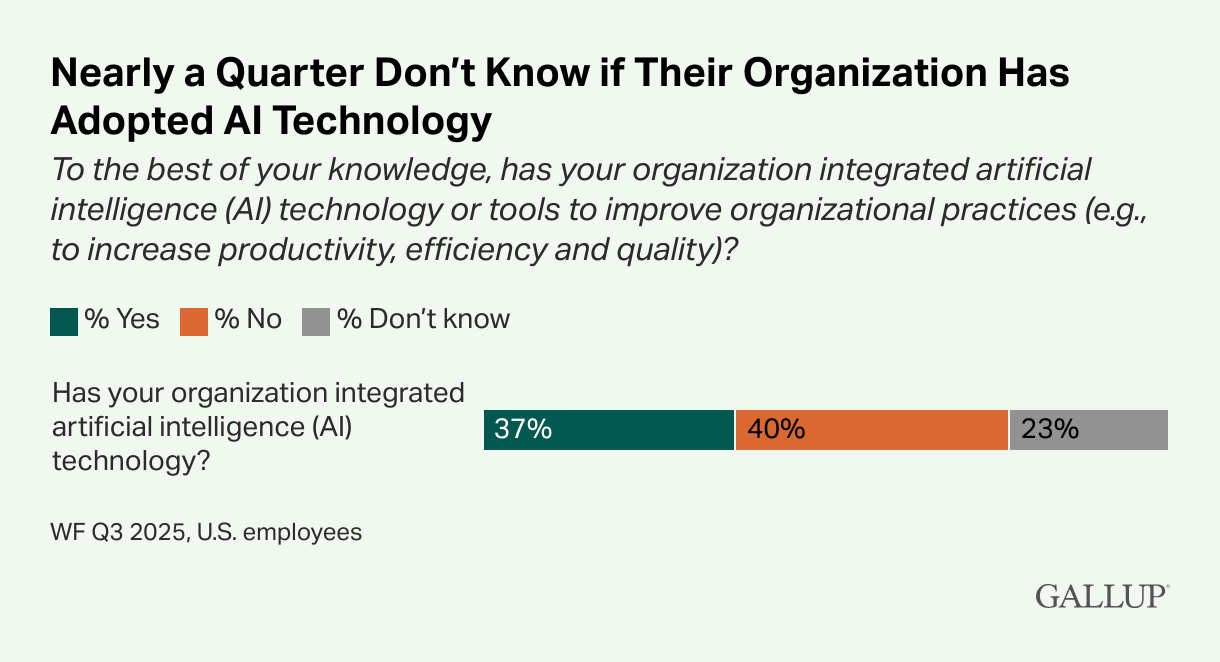
When asked whether their organization had implemented AI technology, 23 percent of respondents said they didn't know. Only 37 percent said yes, while 40 percent said no. The knowledge gap varies significantly by role.
Among individual contributors without management responsibilities, 26 percent don't know, compared to 16 percent of managers and just 7 percent of executives. Part-time employees, on-site workers, and frontline staff also showed higher levels of uncertainty.
Shadow AI thrives as workers hide their usage from employers
Gallup points to a telling gap: 45 percent of employees use AI at least a few times a year, but only 37 percent know for certain that their company has officially adopted AI. This suggests some employees are using personal AI tools without knowing their employer's AI strategy.
This so-called shadow AI use has appeared in previous studies as well. Sometimes the explanation is simple: the company just doesn't offer a useful tool. But social factors play a role too. According to a Slack survey, nearly half of all office workers wouldn't tell their managers they use AI. They worry about being considered lazy or incompetent, or they fear putting their jobs at risk.
Microsoft and LinkedIn call this phenomenon "AI shame": 52 percent of AI users hesitate to admit they rely on AI for their core tasks, and 53 percent worry that using AI makes them look replaceable.
Even when companies provide solid AI tools, employees may still prefer their own—especially if workplace tools track usage. Workers who don't want their employer seeing how much AI helps them would rather just pull up ChatGPT on their personal phone.
AI News Without the Hype – Curated by Humans
As a THE DECODER subscriber, you get ad-free reading, our weekly AI newsletter, the exclusive "AI Radar" Frontier Report 6× per year, access to comments, and our complete archive.
Subscribe now