New study disrupts the narrative that ChatGPT's launch triggered a job decline


A large-scale analysis of millions of LinkedIn profiles and unemployment data shows that job prospects in AI-exposed occupations started declining in early 2022, months before ChatGPT's November release.
The public narrative around generative AI and jobs is simple: ChatGPT launched in November 2022, and since then, prospects have worsened for workers whose tasks could be handled by language models. A new study by researchers from several US universities challenges this timeline.
The research team, led by Morgan Frank from the University of Pittsburgh, analyzed three large datasets: monthly unemployment insurance data from the US Department of Labor, 10.6 million LinkedIn profiles, and 3 million university curricula. They found that labor market problems for AI-exposed professions began in early 2022, months before ChatGPT launched.
Unemployment risk started climbing in spring 2022
The study found that unemployment risk in LLM-exposed occupations like computer and math jobs was typically 20 to 80 percent lower than in less exposed fields like construction. This gap actually widened during the pandemic years of 2020 and 2021, likely because these workers could more easily shift to remote work.
That trend reversed at the start of 2022. Unemployment risk in the most exposed occupational groups began rising, and computer and math occupations got hit hardest. The uptick started before ChatGPT launched and leveled off afterward. If the chatbot had been the primary cause, you'd expect it to accelerate, not flatten.
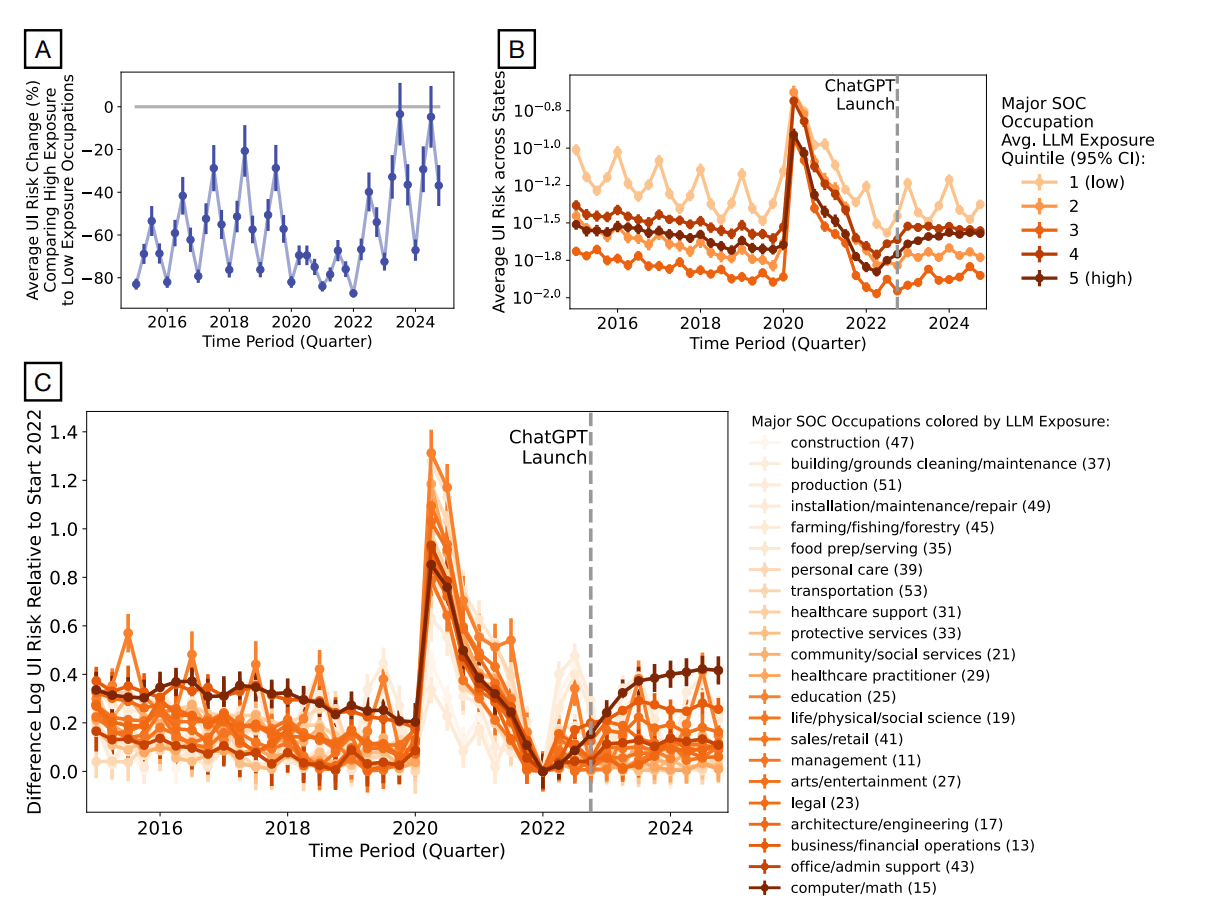
The researchers note that some US states, including California, Washington, and Alaska, did show post-launch increases. In those cases, LLM adoption could have played a role.
Recent graduates felt the shift earlier than expected
LinkedIn profile analysis reveals a similar pattern for young professionals. Graduates from 2021 onward were less likely to land LLM-exposed jobs than earlier cohorts, but these gaps opened up before the end of 2022.
Before ChatGPT launched, graduates whose first job was in an exposed field found work faster on average than their peers. After the launch, that flipped: graduates from the 2023 and 2024 cohorts entering exposed fields took longer to find jobs.
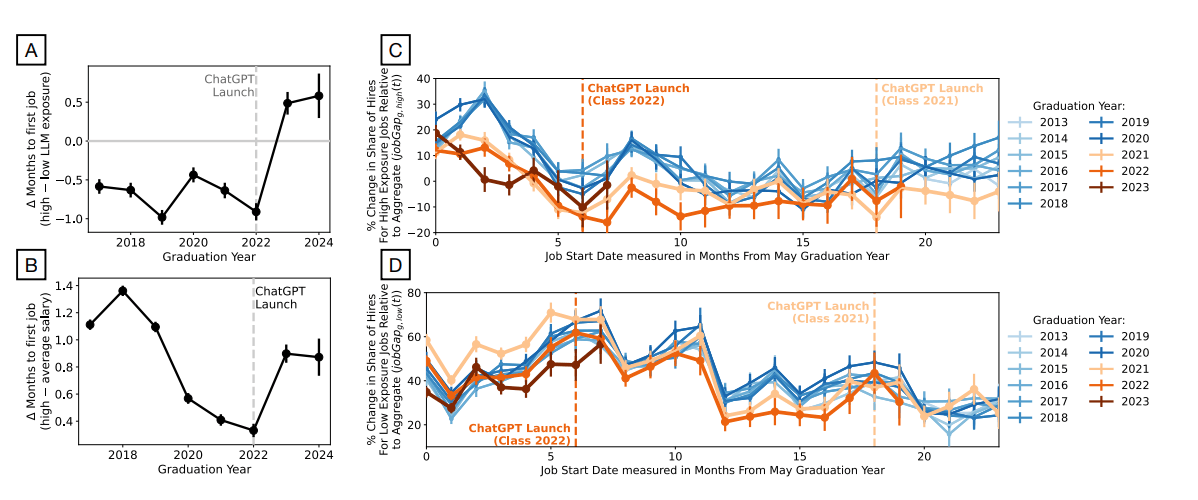
The researchers emphasize that conditions worsened for the 2021 and 2022 cohorts months before ChatGPT's release. This suggests other factors may explain the weaker prospects in these fields, like the Federal Reserve's monetary tightening in 2022/2023, declining job postings for software developers, or a correction following pandemic-era hiring surges.
AI-exposed skills still pay off
The researchers also analyzed university curricula to determine how much each degree focused on skills that LLMs could theoretically handle, like writing, programming, and information research and synthesis. If ChatGPT really made these skills redundant, graduates who specialized in them should have worse job prospects after the launch. What they'd studied could now be replaced by AI.
The opposite happened. Graduates whose studies emphasized these "AI-exposed" skills earned higher starting salaries after ChatGPT launched and found jobs faster. If anything, these skills seem to be in greater demand, possibly because employers need people who can use LLMs effectively, evaluate their output, or work alongside them.
It's also possible that AI adoption simply hasn't progressed far enough to displace these workers. Either way, the researchers warn against removing AI-exposed skills from degree programs.
ChatGPT's launch doesn't cleanly measure AI's labor market impact
The study acknowledges several limitations. Salary data relies on a machine learning model and couldn't be verified against actual wages. The curriculum analysis uses data from before 2020 and doesn't capture how programs responded to ChatGPT. The study also doesn't establish causal effects of LLMs on job market outcomes.
Still, the researchers reach a clear conclusion: the ChatGPT launch shouldn't be treated as a "clean natural experiment" for AI's labor market effects. Studies that blame post-2022 job market weakness primarily on LLMs risk confusing AI adoption with simultaneous macroeconomic shifts.
Recently, Anthropic CEO Dario Amodei warned that AI could eliminate half of all entry-level office positions. Statements like this fuel the perception that generative AI is directly responsible for job losses. This new study suggests reality is more complex and that macroeconomic factors may play a bigger role than previously thought.
Amodei and Google DeepMind CEO Demis Hassabis recently said at the World Economic Forum in Davos that they're already seeing cuts in junior positions at their own companies. Both predicted these effects will hit the broader economy harder by 2026.
AI News Without the Hype – Curated by Humans
As a THE DECODER subscriber, you get ad-free reading, our weekly AI newsletter, the exclusive "AI Radar" Frontier Report 6× per year, access to comments, and our complete archive.
Subscribe nowAI news without the hype
Curated by humans.
- Over 20 percent launch discount.
- Read without distractions – no Google ads.
- Access to comments and community discussions.
- Weekly AI newsletter.
- 6 times a year: “AI Radar” – deep dives on key AI topics.
- Up to 25 % off on KI Pro online events.
- Access to our full ten-year archive.
- Get the latest AI news from The Decoder.