Reflection unveils Asimov: an AI agent built to track every step of software development

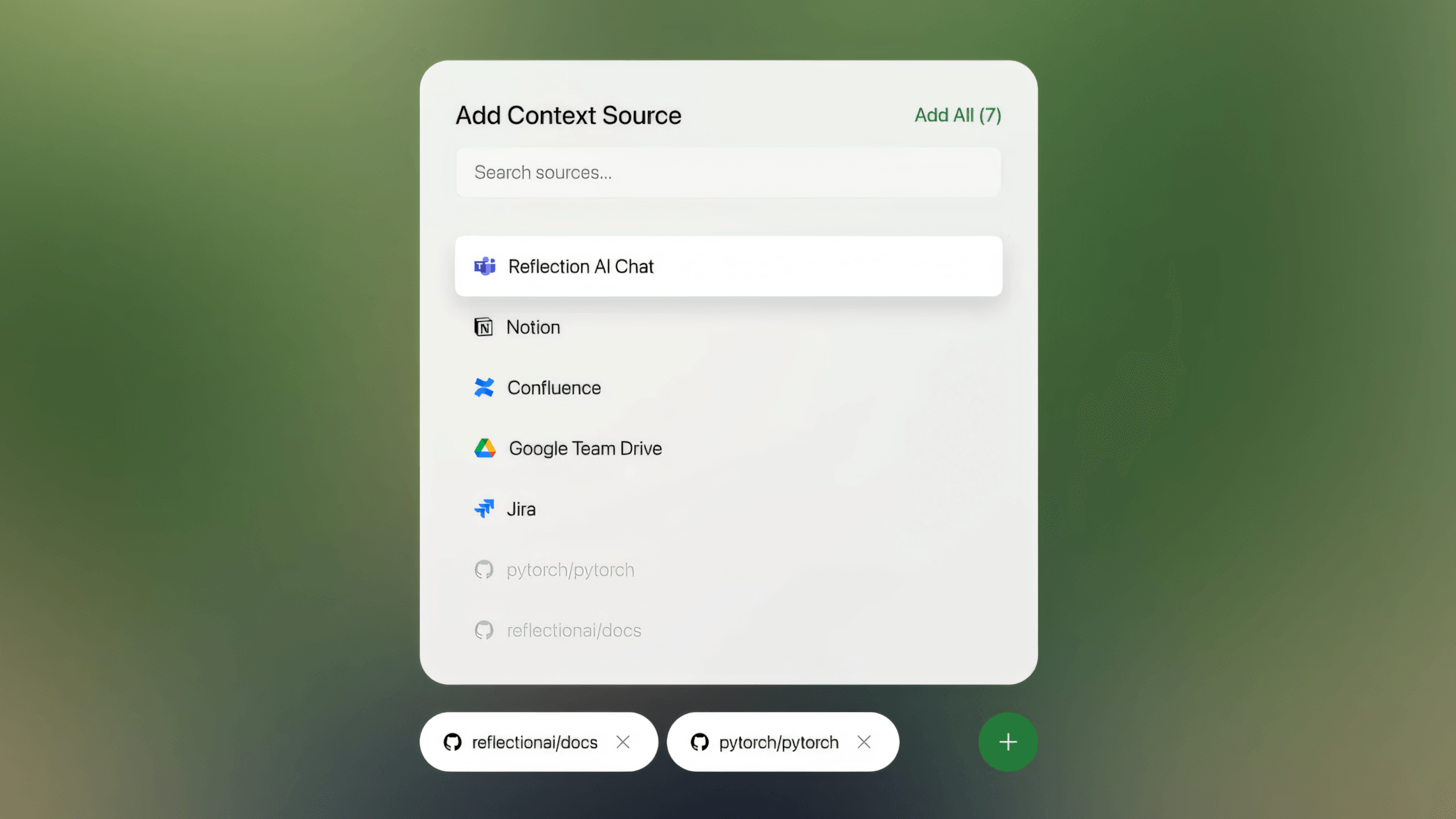
Reflection AI, a startup founded by former Google DeepMind researchers, has introduced a new AI agent called Asimov.
Unlike other coding assistants, Asimov is designed to analyze not just code, but also emails, Slack messages, project status reports, and other technical documentation to map out exactly how software is built. The company says this approach could lead to more powerful software assistants and pave the way toward the development of superintelligent AI systems.
Reflection’s founding team includes CEO Misha Laskin and CTO Ioannis Antonoglou, both of whom previously worked at Google DeepMind. Laskin contributed to Gemini and various AI agent projects, while Antonoglou worked on reinforcement learning methods like those behind AlphaGo.
In an internal, non-independent survey, developers preferred Asimov’s answers 82 percent of the time, compared to 63 percent for Anthropic’s Claude Code (Sonnet 4). Asimov also outperformed Cursor Ask, another competing tool.
Deep research for internal codebases
Reflection is taking a different approach from most existing AI agents. While the industry’s focus has been on code generation, Asimov is built to understand code and the full development process.
To do this, Asimov relies on a deep-research architecture that can handle large volumes of information. The system uses multiple "retriever" agents to extract relevant details from vast codebases, then passes those findings to a single "combiner" agent that synthesizes the information into a coherent response. The goal is to create a persistent memory structure for a development team’s collective knowledge, including decision logs and business context.
Asimov Memories stores team knowledge
A key feature is "Asimov Memories," which lets developers store internal team knowledge with prompts like "@asimov remember X works in Y way." These memories are protected by a role-based access system that controls who can add or modify content. According to Reflection, this is a departure from other agents that mostly adapt to individual developer preferences.
Asimov currently runs on open-source models further trained by Reflection using reinforcement learning with both human-annotated and synthetic data. The company says customer data is not used for training. To protect sensitive information, Asimov is deployed within the customer’s own virtual private cloud. Reflection is also developing proprietary models for future releases.
AI News Without the Hype – Curated by Humans
As a THE DECODER subscriber, you get ad-free reading, our weekly AI newsletter, the exclusive "AI Radar" Frontier Report 6× per year, access to comments, and our complete archive.
Subscribe nowAI news without the hype
Curated by humans.
- Over 20 percent launch discount.
- Read without distractions – no Google ads.
- Access to comments and community discussions.
- Weekly AI newsletter.
- 6 times a year: “AI Radar” – deep dives on key AI topics.
- Up to 25 % off on KI Pro online events.
- Access to our full ten-year archive.
- Get the latest AI news from The Decoder.