Suno investor admits she ditched Spotify for AI music, accidentally undermining the company's fair use defense


Suno investor C.C. Gong told X she barely uses Spotify anymore, accidentally undermining Suno's legal defense by admitting AI music directly competes with human-made music.
Suno has hit $300 million in annualized revenue with two million paying subscribers, all in less than two years, according to co-founder Mikey Shulman. "Suno lets everyone actively participate in music culture creation, bringing to life the music that’s inside millions of people," Shulman wrote on X.
But the company is also fighting a legal battle with parts of the music industry over training its generator on copyrighted music without permission. Shulman's defense boils down to a familiar argument: learning from data isn't copyright infringement. It's the same fair use playbook other AI companies use. The core claim is that the use of data is transformative, producing something new that doesn't compete with the original.
Suno's own investor undercuts the company's fair use defense
That "doesn't compete" part is exactly what Suno investor C.C. Gong from Menlo Ventures just blew up. In a post on X, she said she had moved most of her music listening from Spotify to Suno because she was sick of the same recycled recommendations. If everyone can create music, the catalog becomes infinite and the experience more personal, she argued. Instead of fighting over mainstream hits, AI unlocks an "ever-expanding long tail."
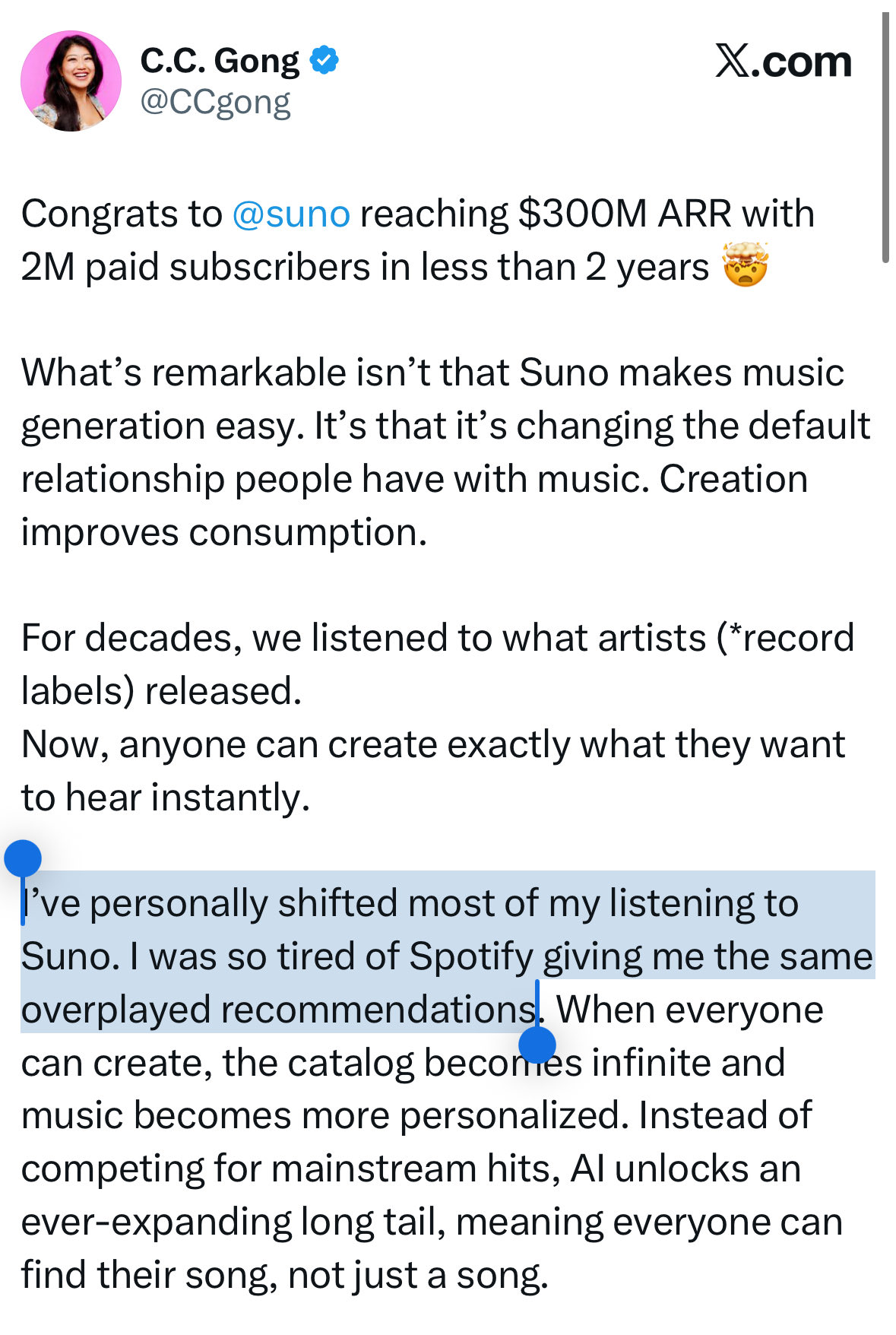
In other words, Gong essentially admitted that AI generated music is replacing, or at least reducing, the consumption of human-made music. One of the key tests for fair use is whether the new product harms the market for the original work. Gong's post suggests exactly that and could undermine Suno's position in the ongoing lawsuit. She quietly deleted it after AI copyright expert Ed Newton-Rex flagged the misstep.
No court is going to hinge a ruling on one investor's social media post, obviously. Proving this kind of substitution at scale requires hard data, and that's notoriously tough to pin down. But Gong's candid take offers a revealing look at how the money behind AI music companies, and likely similar ventures, actually thinks about their bets.
AI News Without the Hype – Curated by Humans
As a THE DECODER subscriber, you get ad-free reading, our weekly AI newsletter, the exclusive "AI Radar" Frontier Report 6× per year, access to comments, and our complete archive.
Subscribe nowAI news without the hype
Curated by humans.
- More than 16% discount.
- Read without distractions – no Google ads.
- Access to comments and community discussions.
- Weekly AI newsletter.
- 6 times a year: “AI Radar” – deep dives on key AI topics.
- Up to 25 % off on KI Pro online events.
- Access to our full ten-year archive.
- Get the latest AI news from The Decoder.