UAE leads with 64% AI adoption rate, leaving the US and Europe far behind, Microsoft says


Key Points
- Around 16.3 percent of the world's population now uses generative AI tools, according to a report by the Microsoft AI Economy Institute. The divide between industrialized and developing nations is growing: usage in industrialized countries climbed to an average of 24.7 percent, while developing countries reached only 14.1 percent.
- South Korea saw the strongest growth of any country, jumping to 30.7 percent. The surge stems from a new national AI law, improved Korean language capabilities in AI models, and a viral moment involving Ghibli-style AI-generated images.
- China's Deepseek model is gaining traction in underserved regions: it holds 89 percent market share in China, and usage in Africa runs two to four times higher than elsewhere. Microsoft views open-source AI as a geopolitical tool.
Global use of generative AI continues to rise, but the gap between developed and developing countries is widening. Even within the top ranks, significant differences emerge. South Korea records the strongest growth, while China's Deepseek gains ground in Africa.
Roughly one in six people worldwide now uses generative AI tools. This is according to a report by the Microsoft AI Economy Institute analyzing global AI diffusion in the second half of 2025. The adoption rate rose from 15.1 percent to 16.3 percent of the world's population.
Yet behind this growth lies increasing inequality: In developed countries, adoption grew by 1.8 percentage points to 24.7 percent, while developing and emerging economies increased by only 1.0 percentage points to 14.1 percent. The gap between both regions thus widened from 9.8 to 10.6 percentage points.
According to Microsoft, all ten countries with the strongest growth are high-income economies. The benefits of AI technology are spreading, but not equally. "AI's benefits are expanding, but they are not expanding equally," the report states.
Significant Gaps Even at the Top
The United Arab Emirates extended its lead and reached an adoption rate of 64 percent, followed by Singapore at 60.9 percent. Both countries form a league of their own: the gap to third-placed Norway at 46.4 percent is already nearly 18 percentage points.
The following European countries lag even further behind. Ireland reaches 44.6 percent, France 44 percent, and Spain 41.8 percent. Between the leader UAE and sixth-placed Spain lies a gap of over 22 percentage points, despite both countries ranking among the leading nations. The rankings suggest a proximity that does not exist upon closer examination of the numbers.

The United States dropped from rank 23 to rank 24, despite leading in AI infrastructure and frontier model development. With an adoption rate of 28.3 percent, it trails far behind smaller, more highly digitized economies. The report concludes that "leadership in innovation and infrastructure, while critical, does not by themselves lead to broad AI adoption."
Germany ranks 21st with an adoption rate of 28.6 percent.
South Korea's Remarkable Rise
South Korea recorded the most significant change: the country climbed from rank 25 to rank 18, posting the strongest growth of any nation at 4.8 percentage points. The adoption rate rose to 30.7 percent, with total growth since October 2024 exceeding 80 percent according to Microsoft. South Korea is now the second-largest market for paid ChatGPT subscribers worldwide.
The report identifies three drivers for this surge: First, the government enacted the AI Basic Act in September 2025 and established a National AI Strategy Committee. The government also announced investments of 1.2 billion US dollars in AI education.
Second, the language capabilities of large language models in Korean improved dramatically. While GPT-3.5 scored only 16 points on the Korean College Scholastic Ability Test (CSAT), GPT-4o achieved 75 and GPT-5 reached a perfect 100. "For Korean-speaking users, GPT-4o was the turning point, making everyday tasks practical and reliable with large language models for the first time," the report states.
Third, a viral cultural moment in April 2025 triggered a user surge: Ghibli-style images generated with ChatGPT spread across Korean platforms and introduced millions of first-time users to the technology. OpenAI subsequently opened an office in Seoul.
Deepseek Gains Ground in Africa and Sanctioned Countries
One of the unexpected developments of the year, according to the report, was the rise of Deepseek. The Chinese company released its model under an open-source MIT license and offers a completely free chatbot, removing both financial and technical barriers.
Deepseek achieved its strongest adoption in countries underserved by Western AI platforms or subject to access restrictions: China records a market share of 89 percent, Belarus 56 percent, Cuba 49 percent, and Russia 43 percent. In Africa, Deepseek usage is two to four times higher than in other regions, according to Microsoft.
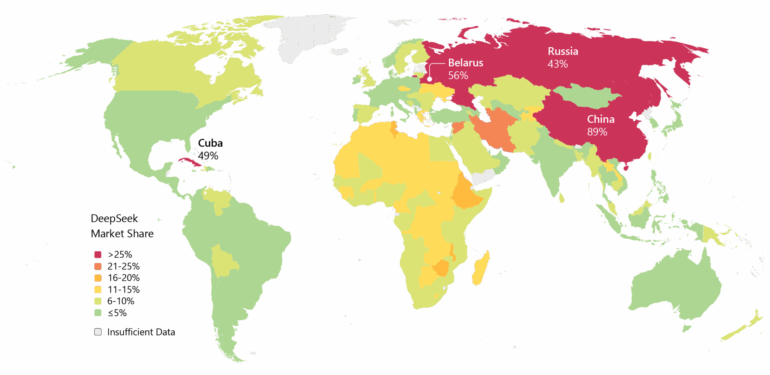
The report attributes this to strategic partnerships with companies like Huawei, which actively promote and integrate the model into telecommunications services in African markets. Microsoft describes this as an example of how open-source AI can function as a geopolitical instrument, extending Chinese influence in regions where Western platforms cannot easily operate.
Trust as an Underestimated Factor
The report emphasizes that the UAE did not achieve its lead by accident. As early as 2017, five years before the ChatGPT breakthrough, the country appointed the world's first Minister of State for Artificial Intelligence and adopted a national AI strategy covering nine priority sectors. When the current wave of generative AI arrived, the population was already familiar with the technology.
According to the 2025 Edelman Trust Barometer, 67 percent of the population in the UAE trusts AI technology, compared to only 32 percent in the United States. This trust gap of 35 percentage points represents one of the largest measurable differences in technology perception between countries.
Microsoft acknowledges that no single metric is perfect. The data is based on aggregated and anonymized telemetry data from the company, adjusted for operating system market share, internet penetration, and population figures. Details of the methodology used can be found in an accompanying paper.
The report's central conclusion: the next wave of AI users may not come from traditional technology hubs but from developing and emerging economies, enabled by open-source models. The challenge, according to Microsoft, is "ensuring that innovation spreads in ways that help narrow divides rather than deepen them."
AI News Without the Hype – Curated by Humans
As a THE DECODER subscriber, you get ad-free reading, our weekly AI newsletter, the exclusive "AI Radar" Frontier Report 6× per year, access to comments, and our complete archive.
Subscribe now