OpenAI claims generative AI saves knowledge workers 40 to 80 minutes a day

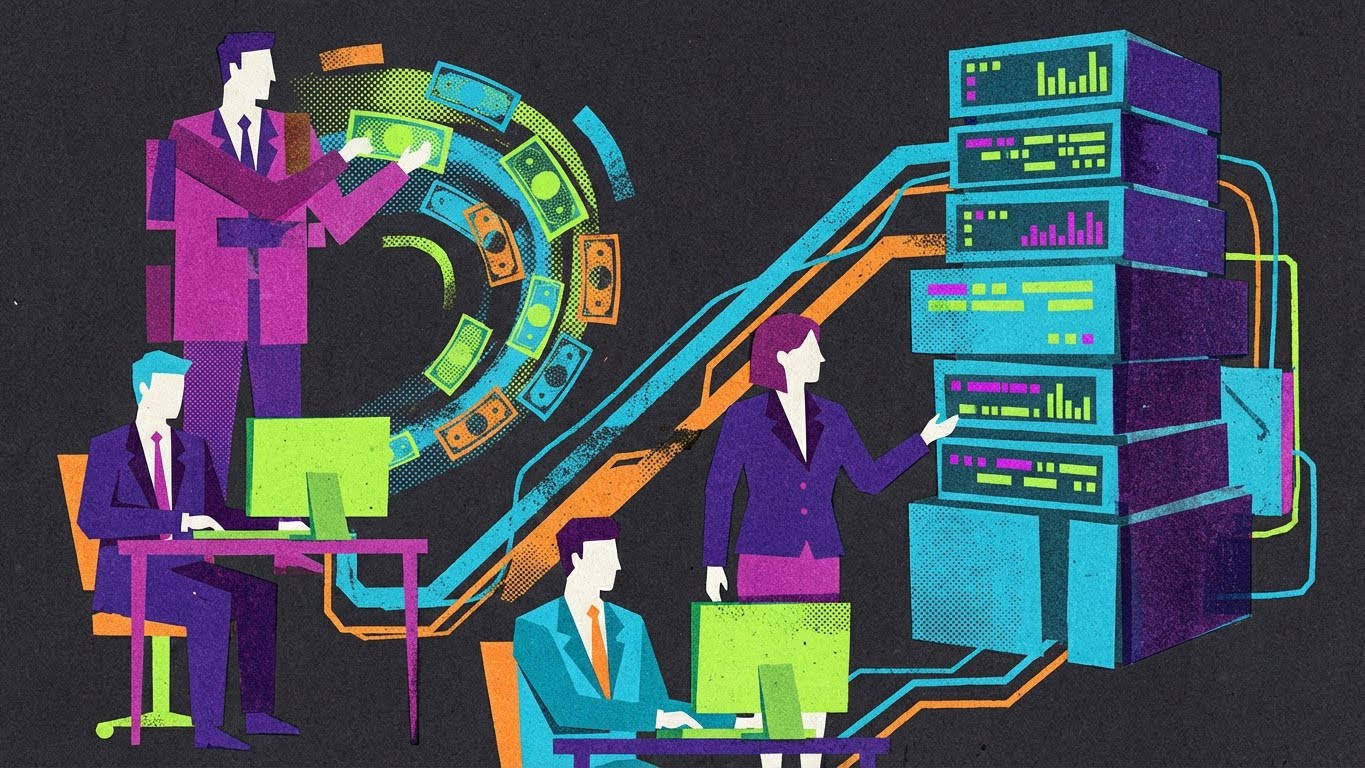
OpenAI's new enterprise report paints a rosy picture of AI productivity gains.
According to OpenAI's "State of Enterprise AI 2025" report, ChatGPT Enterprise users save an average of 40 to 60 minutes per active workday. Workers in data science, engineering, and communications report even bigger gains, up to 80 minutes daily.
75 percent of surveyed workers said AI improved either the speed or quality of their work. The impact varies by role: 87 percent of IT workers report faster problem-solving, 85 percent of marketing and product teams say they execute campaigns faster, and 73 percent of engineers say they ship code more quickly.
The analysis draws on anonymized usage data from OpenAI's enterprise products and a survey of 9,000 employees across nearly 100 companies, all of them paying OpenAI customers.
The more you use, the more you save
Time savings depend on how broadly workers use AI. Those who apply it to around seven different task types report five times more time savings than users who stick to just four task types. Heavy users also tap into advanced features like deep research and reasoning models more often.
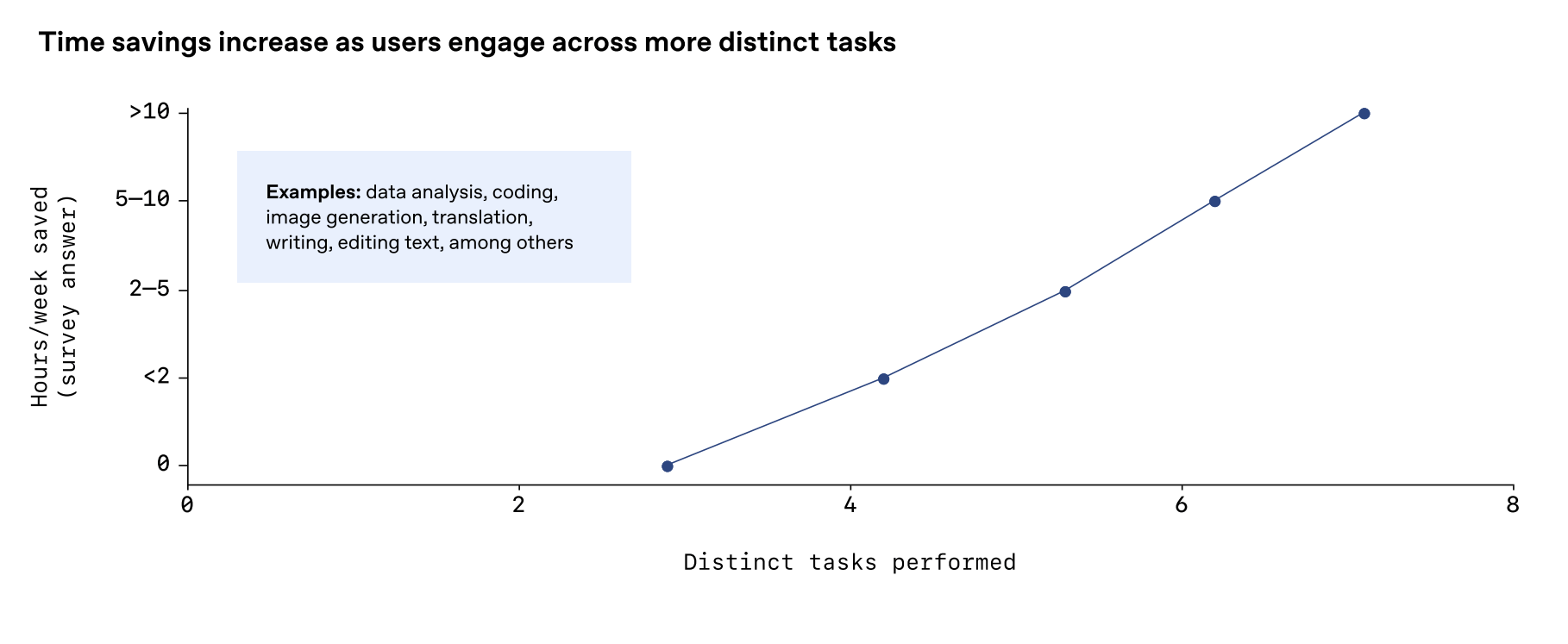
75 percent of users also say they can now handle tasks they couldn't do before—things like programming support, code review, spreadsheet analysis, automation, and building technical tools. Users saving more than ten hours per week consume eight times more credits than those reporting no time savings.
Enterprise adoption keeps climbing
Message volume on ChatGPT Enterprise has grown eightfold since November 2024, while Enterprise seats increased ninefold year-over-year. Average reasoning token consumption per organization jumped 320-fold, which OpenAI says indicates increased use of advanced AI models that think longer and generate more tokens. Whether token consumption actually measures AI success is debatable.
Growth varies by sector. The median industry grew more than sixfold year-over-year. Technology leads with 11x growth, followed by healthcare (8x) and manufacturing (7x). By total customer count, Professional Services, Finance, and Technology have the most ChatGPT Enterprise users.
Weekly users of custom GPTs and projects increased 19-fold. About 20 percent of all enterprise messages now go through a custom GPT or project. API usage patterns differ by industry: tech companies mainly build customer-facing applications like in-app assistants, professional services firms focus on coding and developer tools, and financial companies often start with customer support. International growth has outpaced the US overall, according to OpenAI.
| Country | Business customer growth (Nov. 2024 to Nov. 2025) |
|---|---|
| Australia | 187% |
| Brazil | 161% |
| Netherlands | 153% |
| France | 146% |
| Canada | 144% |
| Global average | 143% |
| USA | 142% |
| Germany | 138% |
| United Kingdom | 133% |
| Japan | 130% |
The UK and Germany rank among the largest ChatGPT Enterprise markets outside the US by customer count. By message volume, Germany and Japan are among the most active.
Big gap between power users and everyone else
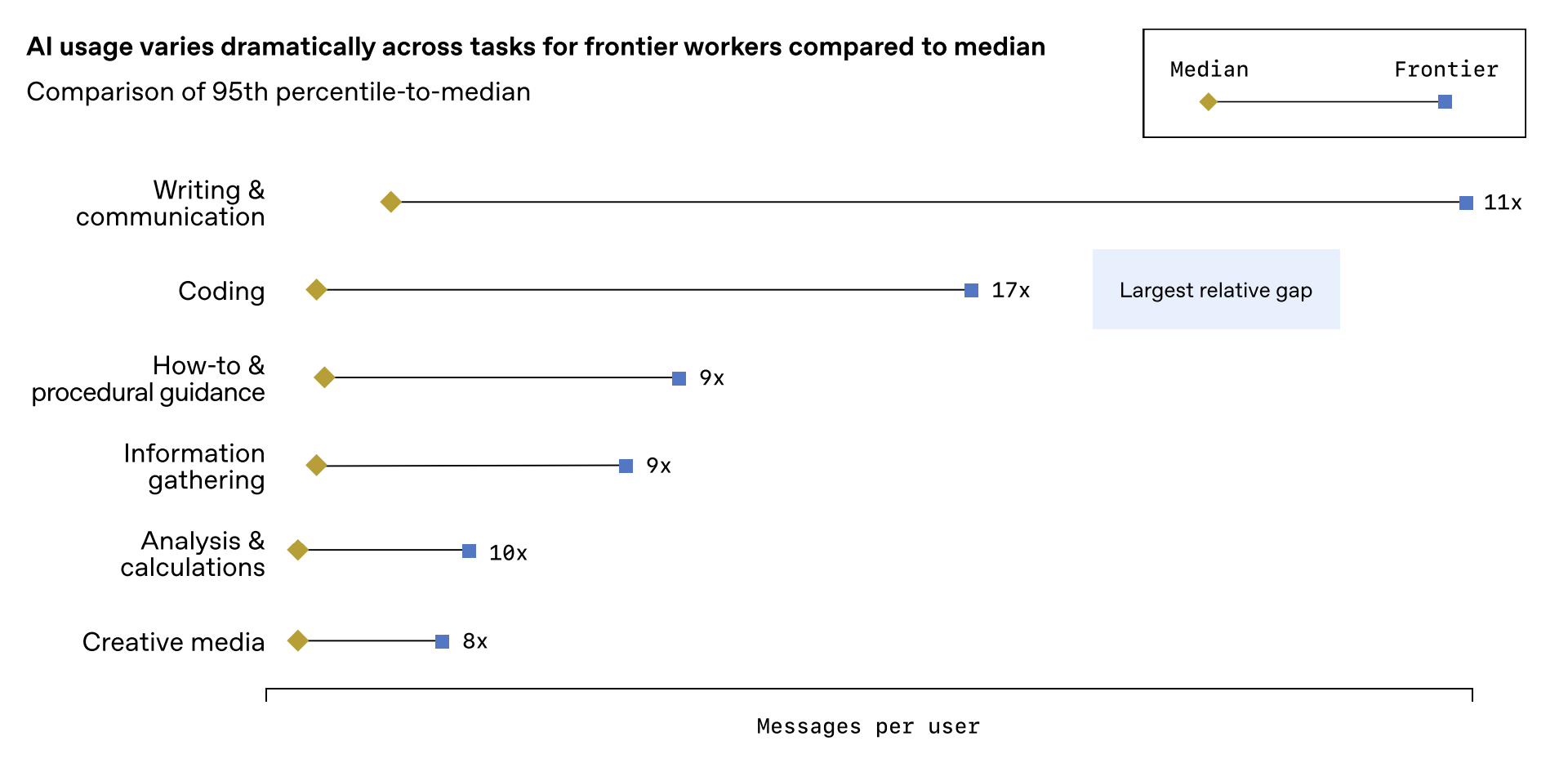
The report highlights stark differences in usage intensity. So-called frontier workers, the top 5 percent by adoption, send six times more messages than the median user. For coding tasks, that gap widens to 17 times. The pattern holds at the company level: top organizations generate roughly twice as many messages per seat as the median company and seven times more messages to GPTs.
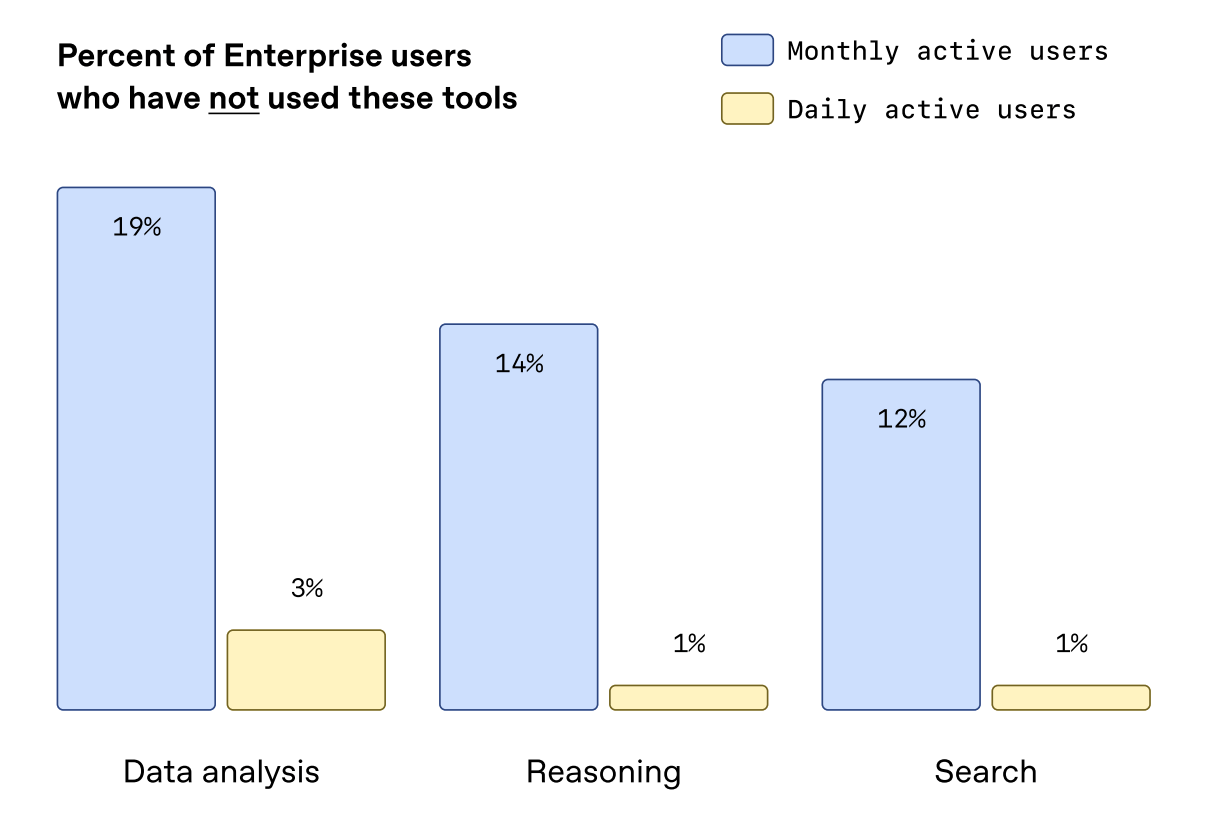
Many active users still haven't explored advanced features. Among monthly active users, 19 percent have never tried data analysis, 14 percent have never used reasoning, and 12 percent have never touched the search function. For daily active users, these numbers drop to between one and three percent.
AI News Without the Hype – Curated by Humans
As a THE DECODER subscriber, you get ad-free reading, our weekly AI newsletter, the exclusive "AI Radar" Frontier Report 6× per year, access to comments, and our complete archive.
Subscribe nowAI news without the hype
Curated by humans.
- More than 16% discount.
- Read without distractions – no Google ads.
- Access to comments and community discussions.
- Weekly AI newsletter.
- 6 times a year: “AI Radar” – deep dives on key AI topics.
- Up to 25 % off on KI Pro online events.
- Access to our full ten-year archive.
- Get the latest AI news from The Decoder.