OpenAI launches healthcare product line, signs up major US hospitals


Key Points
- OpenAI has introduced "OpenAI for Healthcare," a HIPAA-compliant version of ChatGPT and its API, with partners including Boston Children's Hospital, Memorial Sloan Kettering Cancer Center, and Stanford Medicine Children's Health.
- The platform aims to reduce administrative work for doctors by providing access to medical literature, institutional guidelines, and templates for discharge summaries, patient instructions, and prior authorization support.
- Patient data remains under organizational control with options for data residency, audit logs, and customer-managed encryption keys, while content shared with the system will not be used for model training.
The AI company introduces a healthcare version of its chatbot, promising HIPAA-compliant data handling. Several major US hospitals are already on board.
Shortly after launching ChatGPT Health, OpenAI has announced a new product line called "OpenAI for Healthcare." The package includes ChatGPT for Healthcare along with the OpenAI API, both with support for HIPAA requirements. The company is targeting the US hospital market with this release.
OpenAI lists Boston Children's Hospital, Memorial Sloan Kettering Cancer Center, Stanford Medicine Children's Health, Cedars-Sinai Medical Center, and the University of California, San Francisco as its first partners. Hospital networks like HCA Healthcare, AdventHealth, and Baylor Scott & White Health are also participating. The announcement doesn't specify how extensively these institutions are actually using the products.
Doctors could spend less time on paperwork
ChatGPT for Healthcare is designed to take administrative work off doctors' plates. The system provides access to medical literature with citations, can connect to institutional guidelines, and offers templates for documentation tasks. OpenAI mentions discharge summaries, patient instructions, and prior authorization support as examples.
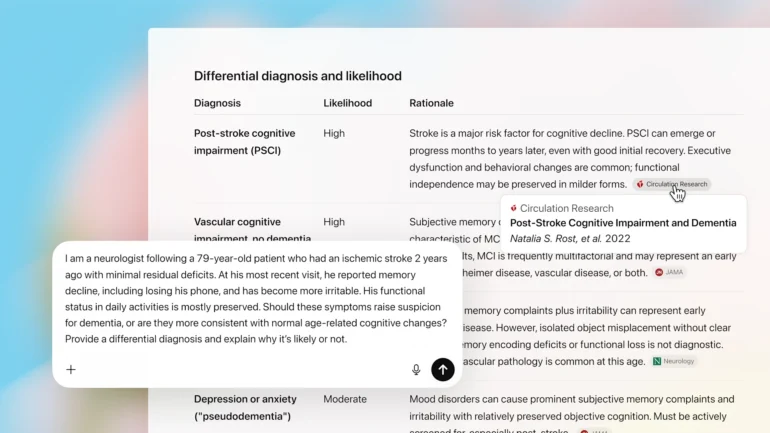
According to the American Medical Association, AI use among US physicians has nearly doubled within a year. Many doctors have been turning to their own tools because their employers weren't rolling out AI quickly enough, OpenAI says.
HIPAA compliance opens the door to the healthcare market
In the US healthcare system, the Health Insurance Portability and Accountability Act (HIPAA) is the key data privacy law. It requires healthcare providers and their business partners to keep patient data strictly confidential. Violations can result in fines reaching millions of dollars. For AI companies, this usually means no HIPAA compliance, no access to hospitals.
OpenAI emphasizes the privacy features of its new platform. Patient data and protected health information stay under the control of each organization. The company offers options for data residency, audit logs, and customer-managed encryption keys. A Business Associate Agreement (BAA) with OpenAI supports HIPAA compliance.
Content shared with ChatGPT for Healthcare won't be used for model training, according to OpenAI.
Beyond the chatbot, OpenAI is offering its API with a healthcare focus. Companies like Abridge, Ambience, and EliseAI are already using it for automated documentation and appointment scheduling, OpenAI says. Developers can request a BAA.
AI News Without the Hype – Curated by Humans
As a THE DECODER subscriber, you get ad-free reading, our weekly AI newsletter, the exclusive "AI Radar" Frontier Report 6× per year, access to comments, and our complete archive.
Subscribe now