Supreme Court AI copyright decision sounds sweeping but actually settles very little

Key Points
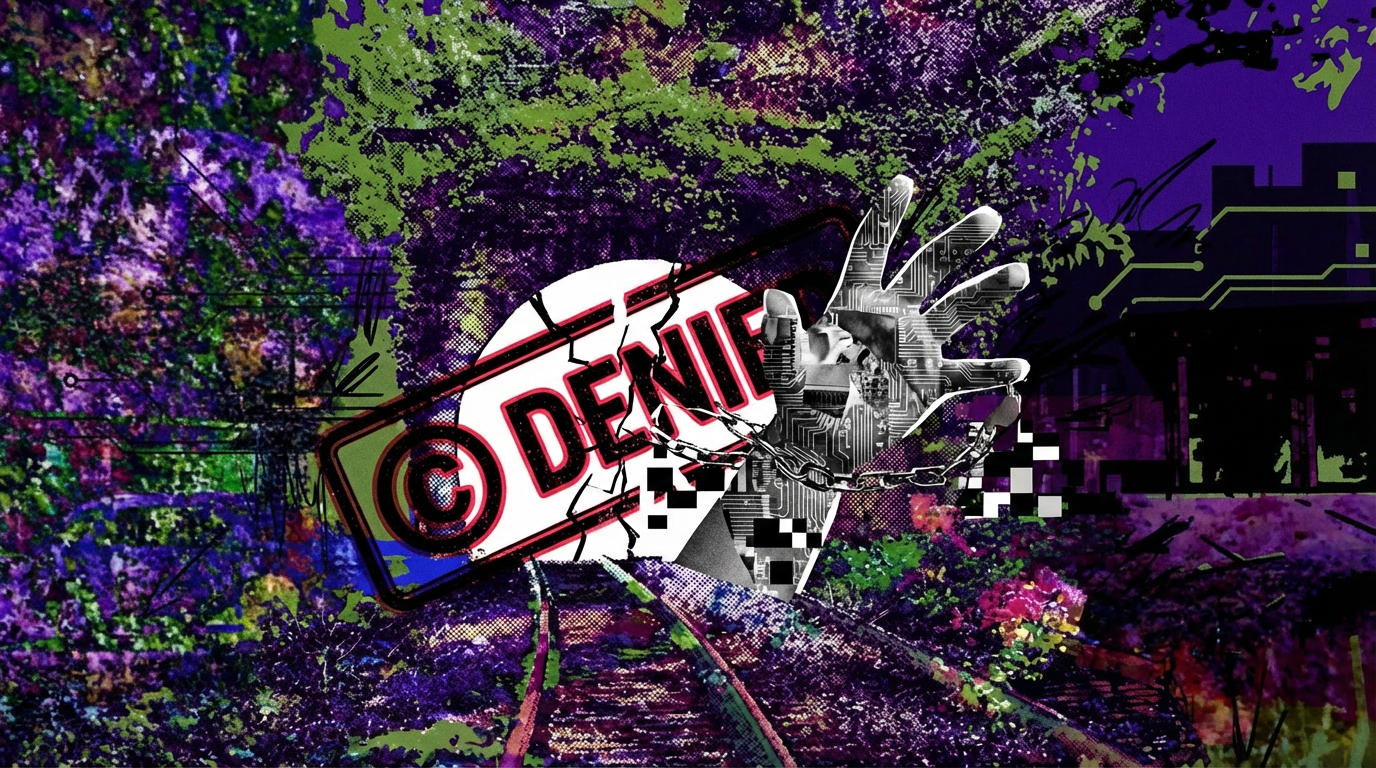
- The US Supreme Court has rejected computer scientist Stephen Thaler's appeal to secure copyright protection for an image generated entirely by his AI system "DABUS" without any human involvement.
- The lower courts' ruling stands: In the US, purely machine-generated art with no human creator cannot receive copyright protection.
- The decision only covers the extreme scenario where the machine itself is named as the creator. The far more consequential question—how much human input is actually required for AI-assisted works to qualify for copyright—remains open.
The US Supreme Court has refused to take up a case about copyright protection for AI-generated art. But the ruling only covers one extreme scenario and leaves the really important question wide open.
On Monday, the US Supreme Court decided not to hear computer scientist Stephen Thaler's appeal. Thaler had sought copyright for an image that his AI system "DABUS" allegedly produced entirely on its own, without any human involvement. With the court's refusal, the lower courts' decision stands: purely machine-generated art with no human creator doesn't qualify for copyright protection in the US.
The case goes back to 2018, when Thaler applied to the US Copyright Office to register the image "A Recent Entrance to Paradise," listing his AI system as the author and himself as just the owner. The office rejected the application in 2022. A federal court in Washington upheld that rejection in 2023, and the Court of Appeals for the District of Columbia Circuit followed suit in 2025. Now the highest court has turned the case away too, meaning it won't get another hearing.
Thaler's fight was about the machine as author
Thaler's lawyers argued before the Supreme Court that the case was of "paramount importance" given the rapid rise of generative AI. Without a hearing, the Copyright Office will have "irreversibly and negatively impacted AI development and use in the creative industry during critically important years," they claimed.
But Thaler's strategy was ideological from the start: he didn't want to secure copyright as a human using an AI tool. He wanted the machine itself recognized as the creator.
Thaler is a member of the "Artificial Inventor Project", a lobby group pushing to get patents granted to AI systems. In a separate patent dispute where he tried to protect AI-generated inventions, the Supreme Court had already refused to hear his case.
This is exactly why the ruling says less than many people think. Judge Beryl A. Howell, who decided the case at the trial level in 2023, explicitly noted that current copyright law is hitting "new frontiers" as artists bring AI into their work. The key question—how much human input is needed when creating an AI work for it to qualify for copyright—was deliberately left unanswered.
So the ruling says nothing about whether someone who uses generative AI as a creative tool can claim copyright on what comes out. Is a well-crafted prompt enough? Or does it take additional work like post-processing or training a specialized model? Those questions will have to be sorted out in future cases.
The US Copyright Office has since put out guidelines that take a pragmatic middle ground: prompts alone don't cut it for copyright protection because they don't give the user enough control over how the AI processes instructions. The office compares prompting to a "throw of the dice." But if a human adds substantial creative elements, feeds in their own works, or makes a creative selection and arrangement of human and AI-generated material, protection can apply. A film, for example, stays protected as a complete work even if it includes AI-generated special effects.
European courts are wrestling with the same questions
Recently, a court in Munich also denied copyright protection for an AI-generated image. But not because generative AI is fundamentally at odds with copyright law. The court ruled that the images in question were too generic and hadn't been reworked.
But the judge explicitly left the door open for copyright to apply when generative AI is part of a creative process with substantial human input. Where exactly the line falls between protected and unprotected AI-assisted work still hasn't been settled on either side of the Atlantic.
AI News Without the Hype – Curated by Humans
As a THE DECODER subscriber, you get ad-free reading, our weekly AI newsletter, the exclusive "AI Radar" Frontier Report 6× per year, access to comments, and our complete archive.
Subscribe now