Anthropic's new data shows AI skill builds over time, and that could widen the inequality gap


The second Anthropic Economic Index analyzes how Claude usage is shifting across the economy. One key finding: the longer people use the AI model, the better their results get. That could widen existing inequalities.
Anthropic has published its fifth Economic Index Report, based on data from February 2026. The company uses a privacy-compliant analysis system to examine how Claude is being used across the economy without revealing the content of individual conversations. The sample covers one million conversations from Claude.ai and Anthropic's first-party API.
Claude usage is spreading out but getting simpler
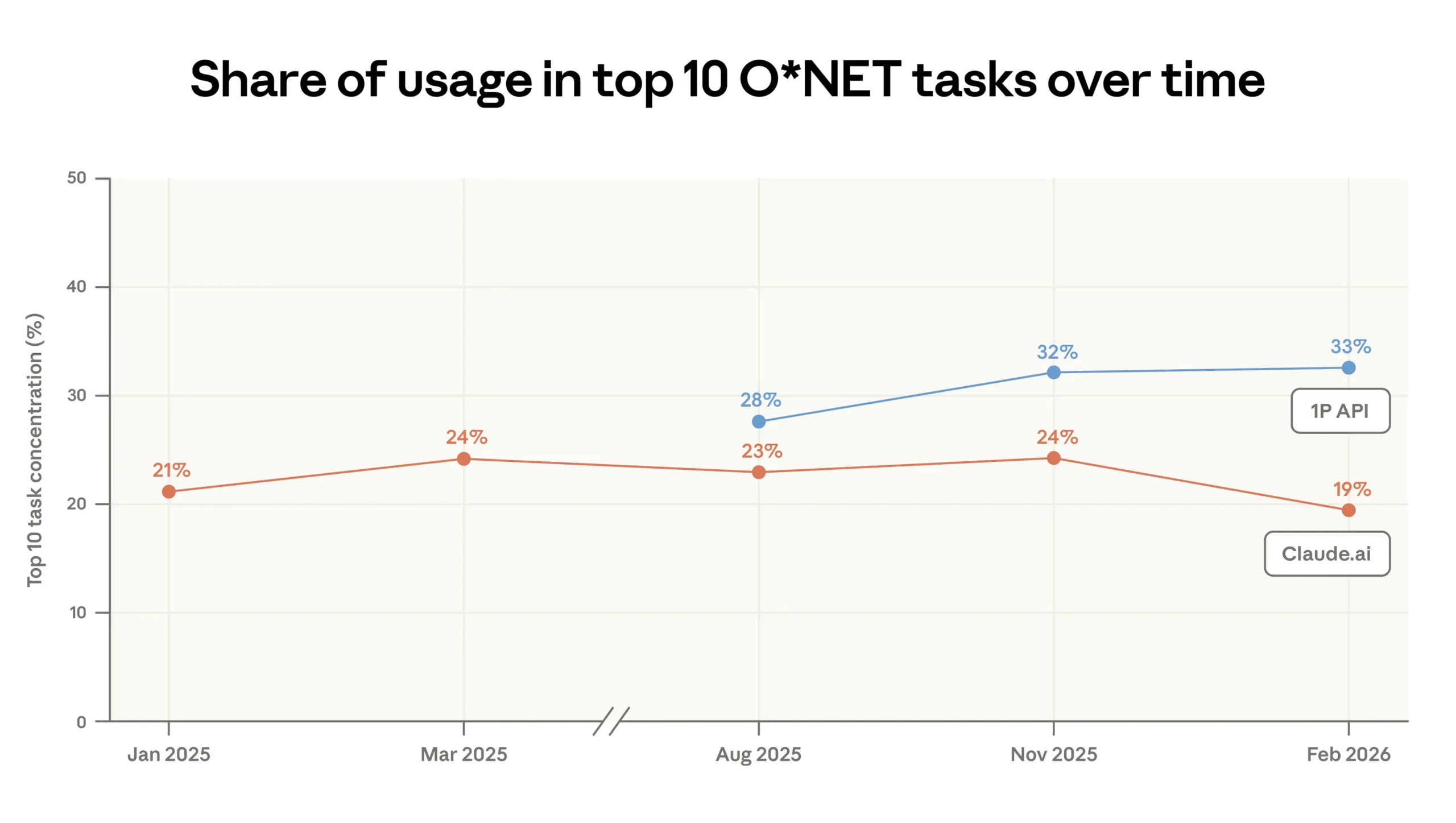
Since the first report in November 2025, usage on Claude.ai has diversified significantly. The ten most common tasks accounted for just 19 percent of traffic in February, down from 24 percent three months earlier. Coding is still the top application at 35%, but it's increasingly shifting to the API, where Claude Code makes up a growing share.
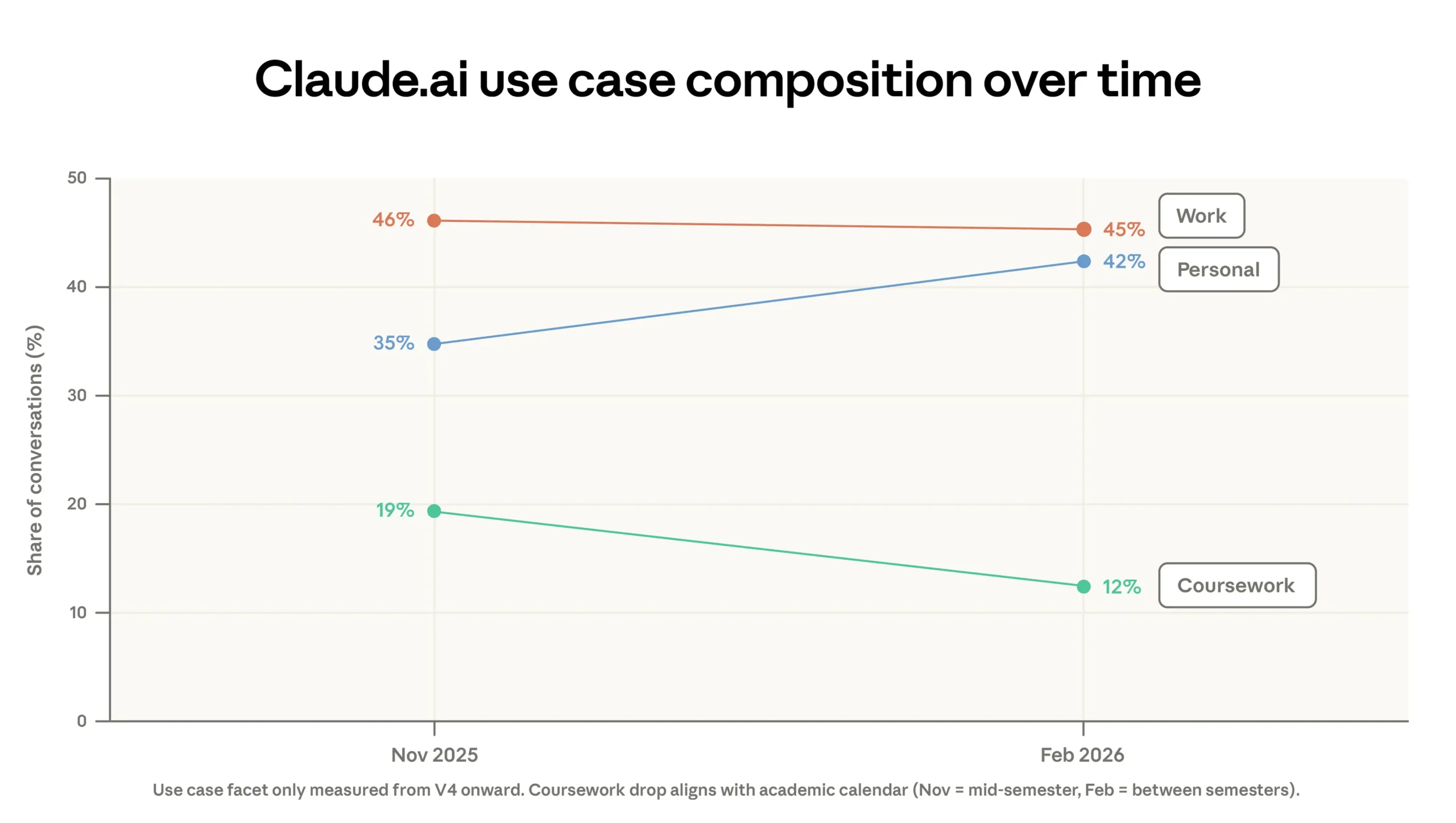
At the same time, the proportion of personal requests rose from 35 to 42 percent. The average economic value of the tasks completed on Claude.ai, measured in terms of the hourly wage of US workers in the associated professions, fell slightly from 49.30 to 47.90 dollars.
According to Anthropic, this corresponds to a typical adoption curve, with early adopters preferring specialized tasks such as programming, while later adopters bring a broader range, including sports scores, product comparisons, and home maintenance questions. Overall, according to the study, around 49 percent of all professions have at least a quarter of their tasks carried out via Claude.
Experienced users collaborate with Claude instead of just giving it orders
The report draws a distinction between automation, where Claude works largely on its own, and augmentation, where humans and the model work together. Augmentation ticked up slightly on Claude.ai.
The gap between experienced and new users is striking. Veterans are 8.7 percentage points less likely to simply hand Claude an instruction and far more likely to iterate on tasks. They use Claude 7 percentage points more often for professional purposes and bring more complex requests to the table.
At the top end of the experience scale, the report finds activities like AI research, Git operations, and manuscript revision. Newcomers, by contrast, tend to ask for haikus, sports scores, or party food suggestions.
AI skill improves with practice
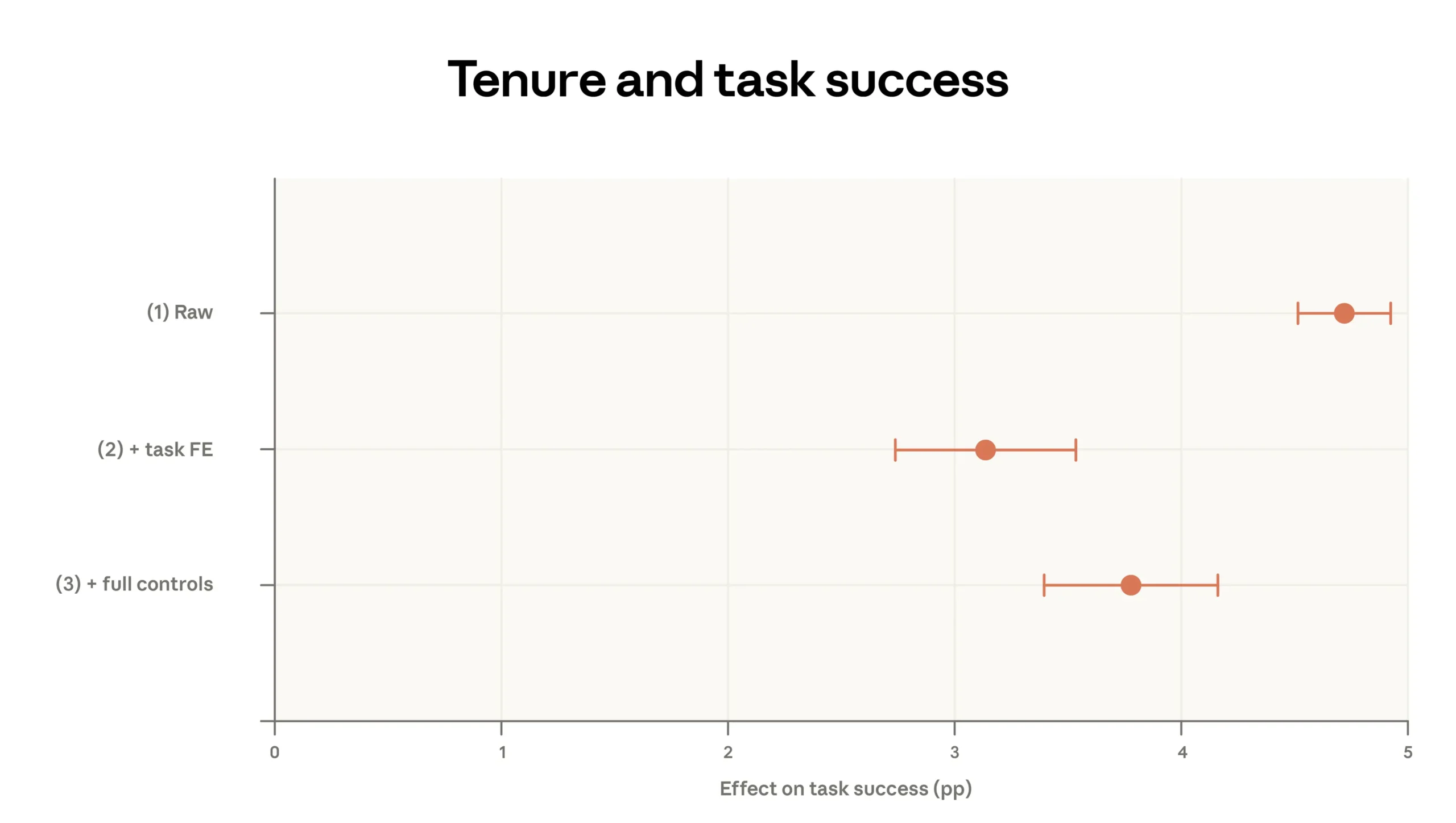
Even after statistically controlling for task type, model choice, use case, and country of origin, the effect holds up. Experienced users see a success rate roughly 4 percentage points higher than newcomers working on the same task. In other words, getting good results from AI platforms is a skill that improves with practice.
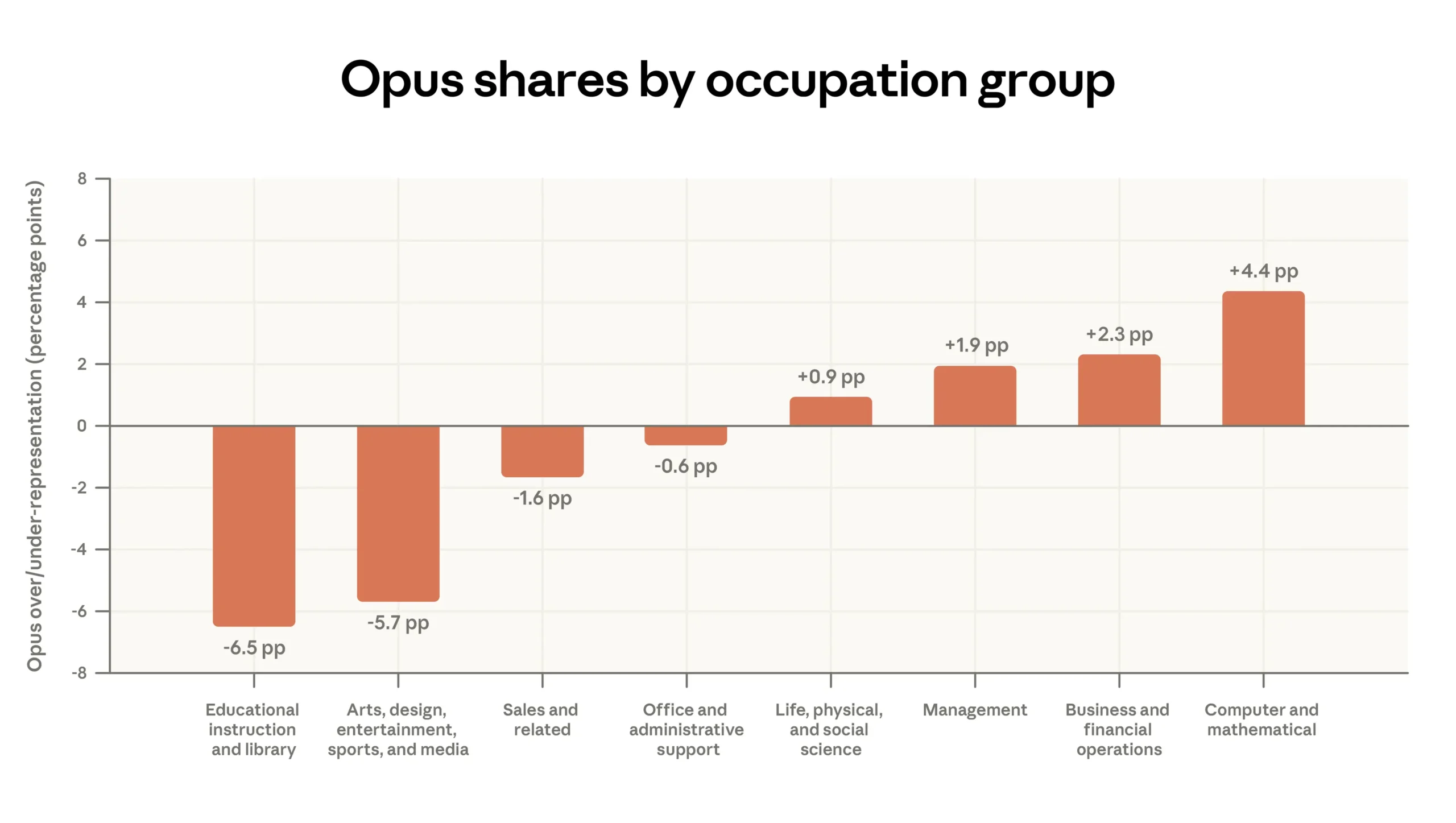
For the first time, the report also looks at which models people pick. Paying Claude.ai users gravitate toward Opus, the most capable option, specifically for complex work. For coding, 55 percent choose Opus; for educational tasks, only 45 percent do. API users react even more strongly to task complexity in their model choice—roughly twice as much—which makes sense given that the API audience skews more technical than the average Claude web user.
The authors acknowledge that cohort effects are likely at play. Early adopters were probably more tech-savvy from the start, and people still using Claude after a year have likely zeroed in on tasks where the model works especially well.
Sales automation and financial trading are surging through the API
In the API, the report flags two workflow categories that have at least doubled their share since November. The first is sales and customer outreach automation: B2B lead qualification, cold-call email generation, that kind of thing. The second is automated trading operations, including market monitoring and specific investment recommendations.
Within the U.S., usage is still converging across states, but more slowly than before. Anthropic now estimates it will take 5 to 9 years for usage per person to level out between states, up from the earlier projection of 2 to 5 years. Internationally, the gap is actually widening. The 20 countries with the highest usage per person now account for 48 percent of population-adjusted traffic, up from 45 percent in the previous report.
Early adopters risk widening the inequality gap
The report points to the economic concept of "skill-biased technological change." Early adopters working on technically demanding tasks get more out of their interactions with Claude and benefit the most, while also being the group most exposed to AI-driven disruption.
The authors close with a labor market warning: if using AI effectively is a skill that builds over time, the advantages of early adoption could become self-reinforcing. The data from the report is available on Hugging Face.
In the previous Economic Index report in January, Anthropic measured Claude success rates systematically for the first time and ended up revising its productivity forecasts for the U.S. economy significantly downward. The first Economic Index from February 2025 found that AI assists humans more often than it replaces their work, and that 36 percent of all occupations already use AI for at least a quarter of their tasks.
AI News Without the Hype – Curated by Humans
As a THE DECODER subscriber, you get ad-free reading, our weekly AI newsletter, the exclusive "AI Radar" Frontier Report 6× per year, access to comments, and our complete archive.
Subscribe nowAI news without the hype
Curated by humans.
- Over 20 percent launch discount.
- Read without distractions – no Google ads.
- Access to comments and community discussions.
- Weekly AI newsletter.
- 6 times a year: “AI Radar” – deep dives on key AI topics.
- Up to 25 % off on KI Pro online events.
- Access to our full ten-year archive.
- Get the latest AI news from The Decoder.