Mistral AI has released Mistral Small 4, combining fast text responses, logical reasoning, and image processing in one model. It has 119 billion parameters, but only 6 billion are active per query - its architecture includes 128 expert modules but activates just four at a time. Users can control whether the model responds quickly or thinks more thoroughly. Mistral AI says it's 40 percent faster and handles three times more queries per second than its predecessor.
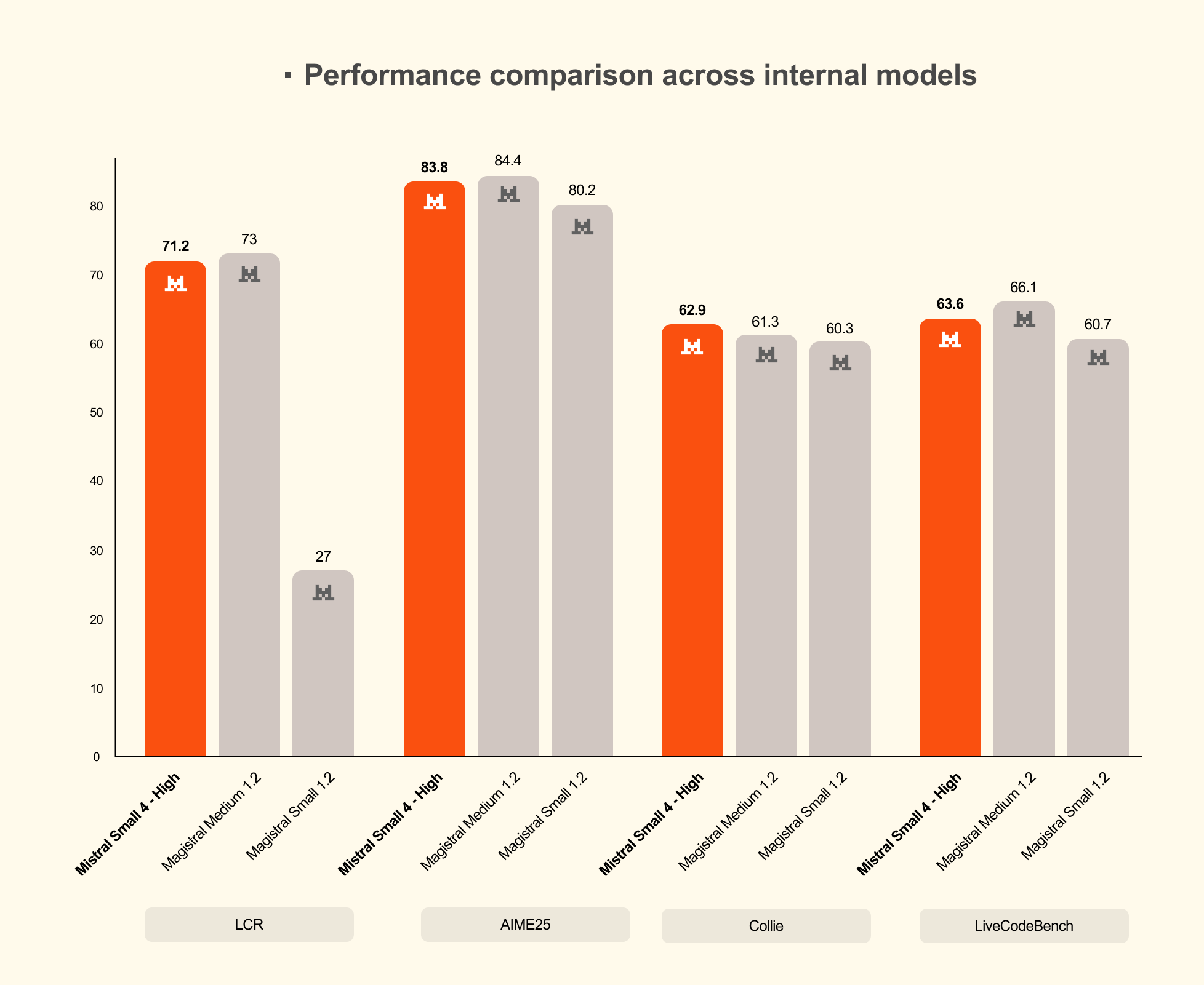
Mistral Small 4 with a high reasoning level achieves similar or better values in internal benchmarks than the specialized Magistral models.
The model ships under the Apache 2.0 license and is available on Hugging Face, the Mistral API, and Nvidia platforms. Mistral AI is also joining the Nvidia Nemotron Coalition, which promotes open AI model development. The company previously released multimodal open-source models in early December with the Mistral 3 series, including the flagship Mistral Large 3 with 675 billion parameters.
OpenAI's biggest problem may not be building AI but getting companies to actually use it beyond ChatGPT
OpenAI is pushing to get its AI into large companies faster through sales, partnerships, and capital. A 10-billion-dollar joint venture and a new deployment arm show where the real challenge lies: getting the technology integrated into actual company workflows.
OpenAI's own wellbeing advisors warned against erotic mode, called it a "sexy suicide coach"
OpenAI’s wellbeing advisory board reportedly voted unanimously against the company’s planned Adult Mode for ChatGPT. Internally, the company is struggling with an error-prone age detection system and unresolved safety issues.
Alibaba is merging its AI operations into a new business unit called "Alibaba Token Hub" (ATH), led directly by CEO Eddie Wu, Bloomberg reports. The unit brings together the research team behind the Qwen models, the consumer app division, the communication platform DingTalk, and Quark-branded devices like smart glasses.
The goal is to speed up collaboration between research, product development, and sales - and to better monetize AI across the company. The name "Token Hub" is a direct nod to the billing units used in the AI business.
According to insiders, Alibaba also plans to unveil an AI agent for enterprise customers later this week. The agent runs on Qwen and will gradually be integrated with Taobao and Alipay. The restructuring follows the surprise departure of Qwen research lead Junyang Lin in early March.
According to Bloomberg, Chinese AI providers have a harder time making money from AI than Western competitors like OpenAI, largely because Chinese users are reluctant to pay for software subscriptions.
Meta has signed a contract worth up to $27 billion with Dutch cloud provider Nebius for AI infrastructure. The deal runs for five years and includes $12 billion for dedicated capacity across multiple locations and up to $15 billion for additional available computing power, according to CNBC.
Nebius says it will operate one of the first major installations of Nvidia's latest AI chips, called Vera Rubin. Nebius founder and CEO Arkady Volozh described the deal as an expansion of the company's existing partnership with Meta, aimed at accelerating the growth of its AI cloud business. Nebius shares jumped 14 percent in pre-market trading after the announcement.