Google plans to invest about 5.5 billion euros (around $6 billion) in Germany by 2029, with most of the funding going to new data centers and expanded office space. The company will build a new data center near Frankfurt and expand another facility in the same area. Munich, Frankfurt, and Berlin are also slated for new or larger office spaces.
Google says these projects will support around 9,000 jobs per year and contribute over 1 billion euros annually to Germany’s economic output. German Finance Minister Lars Klingbeil described the move as "investments for future jobs in Germany" and emphasized the need to boost private investment alongside public funds. "This is exactly what we need right now," Klingbeil said. According to Google, these investments are part of its long-term strategy for Europe.
OpenAI CEO Sam Altman believes that AI will eventually master poetry, reaching what he calls a "10 out of 10" human level. Still, he thinks this achievement won't resonate with most people. Altman argues that what gives art its value is its human origin. Even if an AI writes a technically flawless poem, it will likely be missing a genuine emotional core.
Altman draws a parallel to chess: although machines now consistently outperform people, players still prefer to compete against other humans. The fun comes from measuring yourself against another person, not a computer. Watching two AIs play is just not that interesting for most viewers.
Altman has said before that as AI-generated text and images become more common, people will start to value content from real humans even more. "My directional bet would be that human-created, human-endorsed, human-curated content all goes up in value dramatically," Altman said.
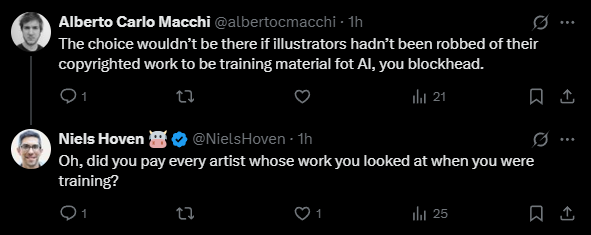
Entrepreneur Niels Hoven has released an alphabet book featuring nearly 1,000 illustrations made with AI. Hoven says producing this many images by hand would have been too complicated and expensive for human artists. With each illustration taking about two hours, he estimates the project would have cost around $50,000. The use of AI instead drew criticism on social media and in Amazon reviews.
Hoven addressed the criticism, explaining that without AI, a hardcover edition would have cost about $200. Thanks to generative AI, the book is now available as a free PDF and as a $30 hardcover, with all proceeds going to Amazon for printing and shipping. Hoven says he earns nothing from sales. He maintains the book couldn't have been made without AI, and that its main purpose is to help children learn to read. Still, the project doubles as advertising for Hoven's company, which offers a related learning app.