OpenAI is working with Abu Dhabi-based G42 on a custom ChatGPT for the UAE, Semafor reports. The version will speak the local Arabic dialect and may include content restrictions. One source said the UAE wants the chatbot to project a political line consistent with the monarchy's. Global ChatGPT will stay available but adapted to local laws, notifying users when content violates regulations. OpenAI is fine-tuning rather than retraining to cut costs.
G42 is led by Sheikh Tahnoon bin Zayed Al Nahyan—the UAE President's brother, National Security Advisor, and head of the largest sovereign wealth fund. The companies have been partners since October 2023.
These adaptations show AI models are cultural products as much as technical tools. Generated content flows into every corner of society, and even small changes to cultural narratives can have lasting effects; which is why both China and the US are working to control their AI models' output to shape domestic conversations and spread their worldviews abroad.
Waymo taps Google Deepmind's Genie 3 to simulate driving scenarios its cars have never seen
By combining Waymo’s real-world driving data with Deepmind’s Genie 3, Alphabet is showing the kind of AI leverage that few companies can match: using one subsidiary’s world model to supercharge another’s autonomous driving simulations.
"Every company is an API company now, whether they want to be or not," says OpenAI CEO Sam Altman, repeating a phrase that's stuck with him recently. Altman made the comment while discussing how generative AI could reshape traditional software business models.
AI agents will soon write their own code to access services even without an official API, Altman believes. If that happens, companies won't have a say in joining this new "platform shift." They'll simply be integrated, and the traditional user interface will lose value.
Some SaaS companies will remain highly valuable by leveraging AI for themselves, according to Altman. Others are just a "thinner layer" and won't survive the shift. Established players with strong core systems who use AI strategically are best positioned, he says.
Recent advances in AI agents and tools like Cowork have already driven down valuations for some software companies. The thinking: AI will handle more tasks directly, making niche solutions unnecessary.
Apple is pulling back on plans for an AI-powered virtual health coach codenamed "Mulberry," according to Bloomberg. Instead of launching the feature as a standalone product, the company will roll out some of its planned capabilities as individual additions to the Health app. The shift comes after a leadership change: Services chief Eddy Cue took over the health division following Jeff Williams' retirement late last year.
Cue told colleagues that Apple needs to move faster and stay more competitive. Rivals like Oura and Whoop are offering better features, particularly in their iPhone apps. The service was originally supposed to launch with iOS 26 but has been delayed multiple times. Apple still plans to build an AI chatbot for health-related questions and wants to use the new Siri chatbot for these queries starting with iOS 27. OpenAI has also entered the health market with ChatGPT Health.
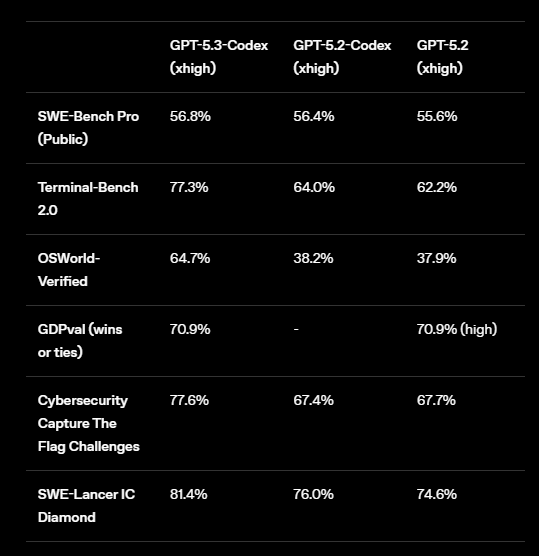
OpenAI has released GPT-5.3-Codex, its latest coding model. The company says it combines GPT-5.2-Codex's coding capabilities with GPT-5.2's reasoning and knowledge, while running 25 percent faster. Most notably, on Terminal-Bench 2.0 it beats the just-released Opus 4.6 by 12 percentage points—a significant gap by current AI standards—while using fewer tokens than its predecessors. On OSWorld, an agentic computer-use benchmark, it scores 64.7 percent versus 38.2 percent for GPT-5.2-Codex. On GDPval, OpenAI's benchmark for knowledge-work tasks across 44 occupations, it matches GPT-5.2.
OpenAI
OpenAI also claims the model played a role in its own development, with the team using early versions to find bugs during training, manage deployment, and evaluate results. The company says the team was "blown away by how much Codex was able to accelerate its own development."
GPT-5.3-Codex is now available to paying ChatGPT users in the Codex app, CLI, IDE extension, and on the web. API access will follow. OpenAI has classified the model as its first with a "High" cybersecurity risk rating, though the company says this is precautionary, as there's no definitive proof such a classification is necessary.
OpenAI's Frontier gives AI agents employee-like identities, shared context, and enterprise permissions
OpenAI’s new Frontier platform gives AI agents in companies their own identities, shared context, and the ability to learn from experience. The software launches first with selected enterprise customers.
Mistral AI launches Voxtral Transcribe 2, undercutting competitors on speech recognition pricing. The second-generation speech recognition models start at $0.003 per minute and, according to Mistral, outperform GPT-4o mini Transcribe, Gemini 2.5 Flash, and Deepgram Nova in accuracy. The model family comes in two variants: Voxtral Mini Transcribe V2 for processing larger audio files, and Voxtral Realtime for real-time applications with latency under 200 milliseconds. Voxtral Realtime costs twice as much and uses a proprietary streaming architecture that transcribes audio as it arrives - designed for voice assistants, live captioning, or call center analysis.
Both models support 13 languages, including German, English, and Chinese. New features include speaker recognition, word-level timestamps, and support for recordings up to three hours long. Voxtral Realtime is available as open-weights under Apache 2.0 on Hugging Face and via API, while Voxtral Mini Transcribe V2 is only accessible through Le Chat, the Mistral API, and a playground. Mistral released the first Voxtral generation in July 2025.