DiffusionAvatars generates realistic 3D avatars

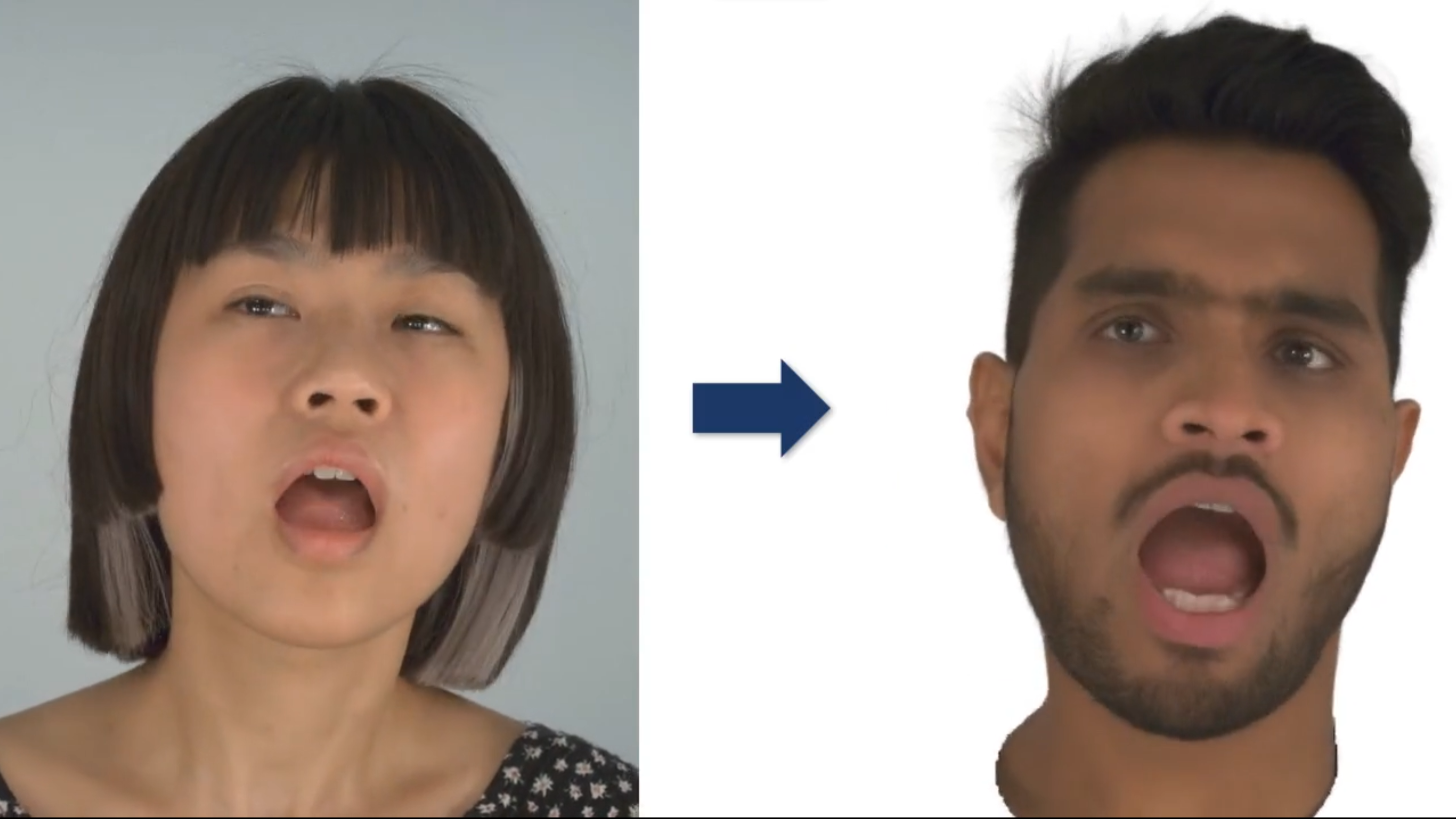
Researchers at the Technical University of Munich have developed DiffusionAvatars, a method for creating high-quality 3D avatars with realistic facial expressions.
The system was trained using RGB videos and 3D meshes of human heads. After training, the system is able to animate avatars both by taking animations from the input videos and by generating facial expressions via a simple control.
DiffusionAvatars combines the image synthesis capabilities of 2D diffusion models with the consistency of 3D neural networks. For the latter, DiffusionAvatars uses so-called "Neural Parametric Head Models" (NPHM) to predict the geometry of the human head. According to the team, these models provide better geometry data than conventional 3D neural models.
DiffusionAvatars has applications in XR and more
According to the team, DiffusionAvatars generates temporally consistent and visually appealing videos for new poses and facial expressions of a person, outperforming existing approaches.
The technology could be used in several areas in the future, including VR/AR applications, immersive videoconferencing, games, film animation, language learning, and virtual assistants. Companies such as Meta and Apple are also researching AI-generated realistic avatars.
However the technology has its limits: DiffusionAvatars currently incorporates lighting into the generated images and offers no control over exposure characteristics. This is a problem for avatars in realistic environments. In addition, the current architecture is still computationally intensive and therefore not yet suitable for real-time applications.
More information can be found on the DiffusionAvatars project page.
AI News Without the Hype – Curated by Humans
As a THE DECODER subscriber, you get ad-free reading, our weekly AI newsletter, the exclusive "AI Radar" Frontier Report 6× per year, access to comments, and our complete archive.
Subscribe nowAI news without the hype
Curated by humans.
- Over 20 percent launch discount.
- Read without distractions – no Google ads.
- Access to comments and community discussions.
- Weekly AI newsletter.
- 6 times a year: “AI Radar” – deep dives on key AI topics.
- Up to 25 % off on KI Pro online events.
- Access to our full ten-year archive.
- Get the latest AI news from The Decoder.