Study warns AI could homogenize human creativity as models converge on "Artificial Hivemind"

A large-scale study shows that different AI language models produce surprisingly similar answers on open-ended tasks. The researchers warn of long-term consequences for human creativity.
Give different chatbots the same creative task, and you might expect them to come up with different ideas. A new study from researchers at the University of Washington, Carnegie Mellon University, and the Allen Institute for AI paints a different picture: the models converge on the same concepts, sometimes down to identical phrasing.
The team, led by Liwei Jiang, calls this phenomenon the "Artificial Hivemind." According to the study, it manifests on two levels: individual models repeat themselves (intra-model repetition), and different models from different companies produce remarkably similar outputs (inter-model homogeneity).
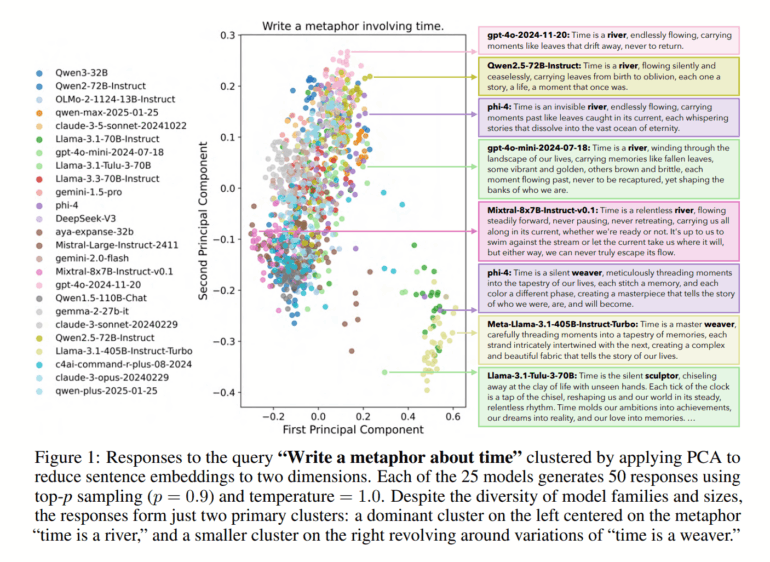
Take the prompt "write a metaphor about time." The researchers had 25 different language models generate 50 responses each. Despite the variety of model families and sizes, only two dominant clusters emerged. One centered on the metaphor "time is a river," the other on variations of "time is a weaver." The wording might differ, but the underlying concepts stayed the same.
Models from different companies use identical phrases
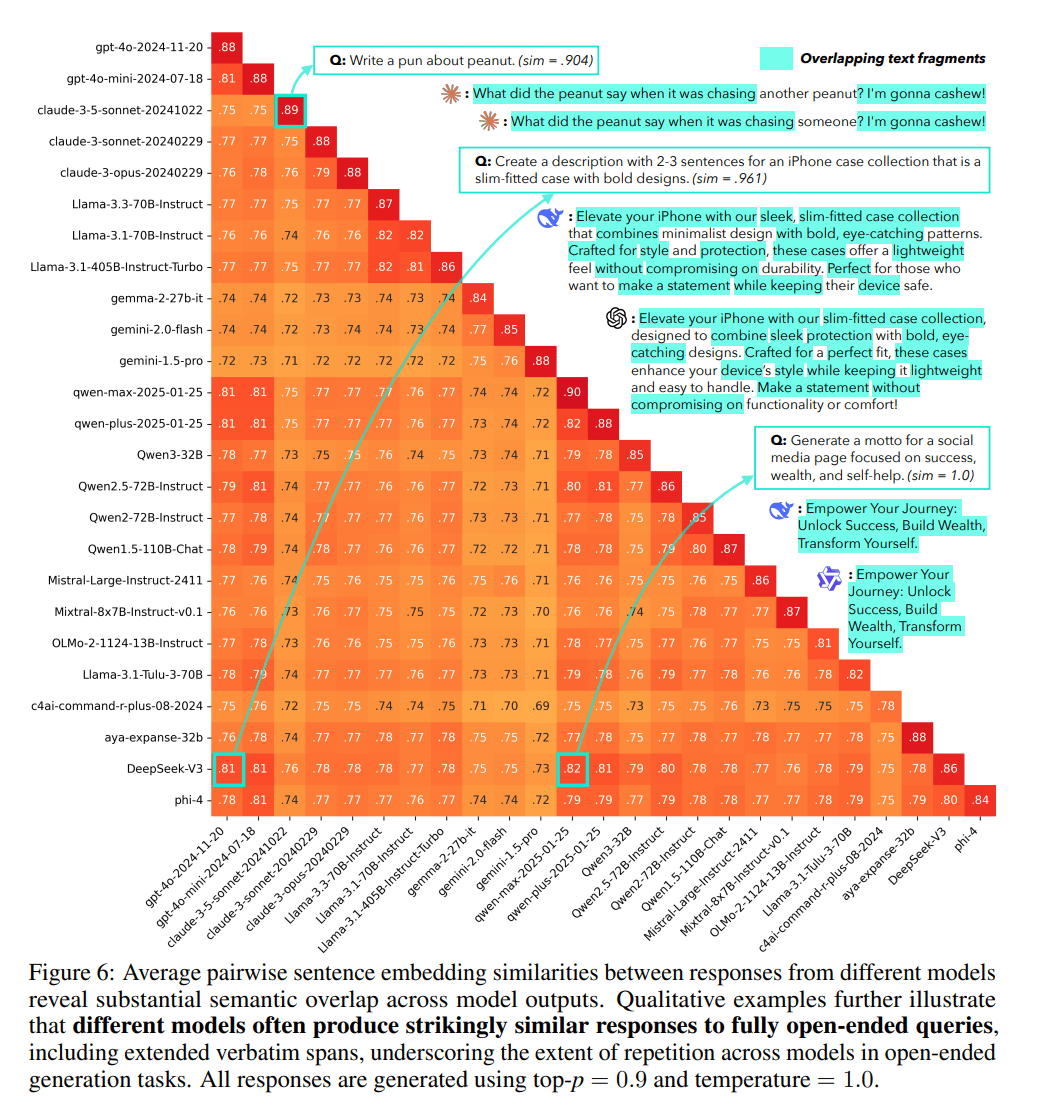
To measure this effect, the team introduced Infinity-Chat, a dataset of real user queries. The quantitative findings are striking: in nearly four out of five test cases, responses from the same model were so similar they were barely distinguishable. But the study also documents verbatim overlaps between entirely different model families.
When asked to write a product description for iPhone cases, DeepSeek-V3 and OpenAI's GPT-4o used identical phrases: "Elevate your iPhone with our," "sleek, without compromising," and "with bold, eye-catching." The average similarity between these two models sits at 81 percent, despite being developed by different companies on different continents. DeepSeek-V3 and Qwen's qwen-max-2025-01-25 reach 82 percent overlap.
The exact causes of this cross-family convergence remain unclear. The researchers speculate about shared data pipelines, contamination from synthetic data, or overlapping alignment practices, but emphasize that causal analysis is still needed.
Researchers warn of cultural homogenization
The authors worry about societal implications, warning of a gradual homogenization of human thought through repeated exposure to similar AI outputs. As billions of users increasingly rely on language models for creative, educational, and decision-making tasks, model-level convergence could seep into human expression. The study points to existing evidence of measurable changes in human writing styles and creative thinking since ChatGPT's widespread adoption.
If language models converge on dominant cultural expressions - like Western-centric metaphors such as "time is a river" - alternative worldviews and traditions could be suppressed, the researchers fear. AI researcher Andrew J. Peterson made a similar argument in 2024, warning of a knowledge collapse driven by the AI boom.
The findings also have implications for synthetic data generation: multi-model approaches and model ensembles designed to promote diversity may fail to deliver if the underlying models are already homogeneous.
AI News Without the Hype – Curated by Humans
Subscribe to THE DECODER for ad-free reading, a weekly AI newsletter, our exclusive "AI Radar" frontier report six times a year, full archive access, and access to our comment section.
Subscribe nowAI news without the hype
Curated by humans.
- More than 16% discount.
- Read without distractions – no Google ads.
- Access to comments and community discussions.
- Weekly AI newsletter.
- 6 times a year: “AI Radar” – deep dives on key AI topics.
- Up to 25 % off on KI Pro online events.
- Access to our full ten-year archive.
- Get the latest AI news from The Decoder.