Thousands of procurement documents show how China's army wants to weaponize AI

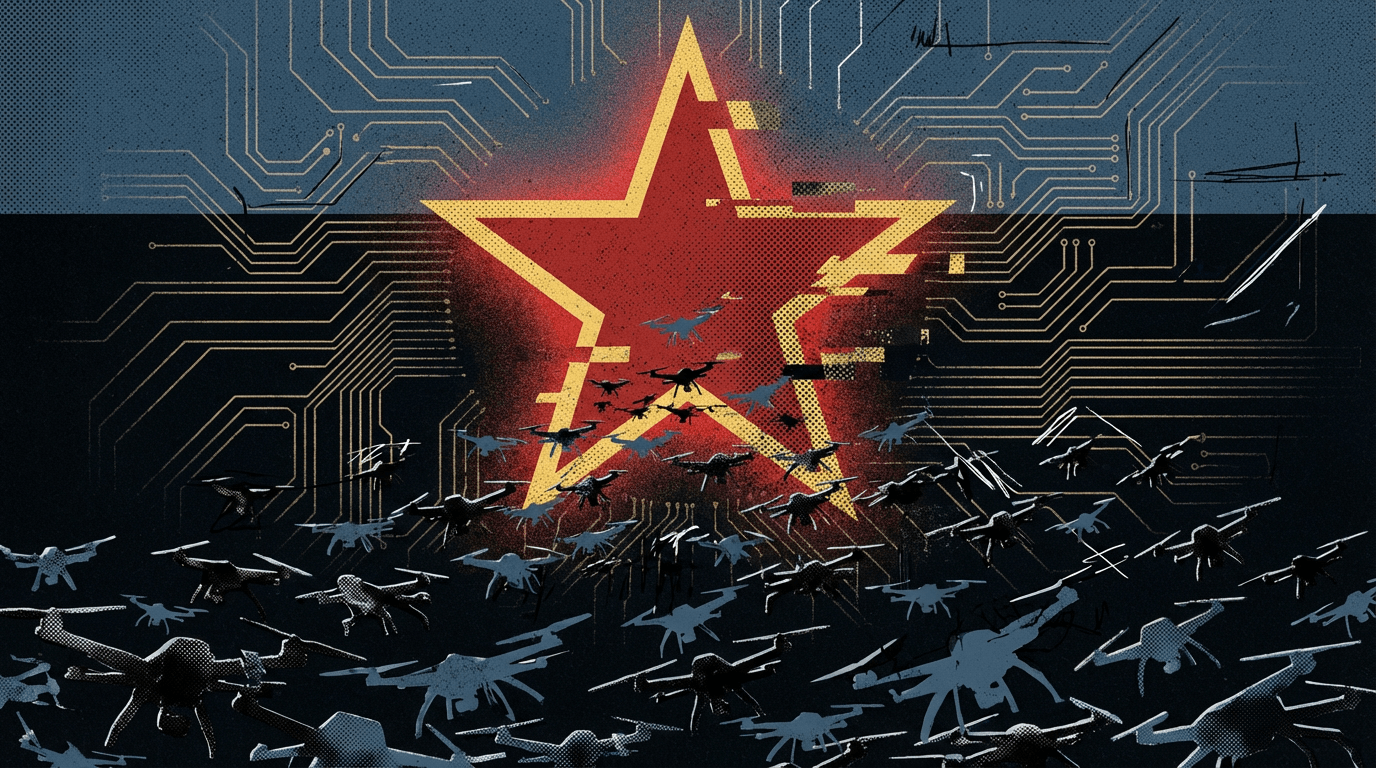
Researchers at Georgetown University have analyzed thousands of procurement requests from China's People's Liberation Army. The documents reveal how broadly Beijing is already experimenting with military AI, from drone swarms and deepfake tools to autonomous decision-making systems.
At China's military parade in September 2025, the spotlight wasn't on tanks or marching troops. Instead, the focus was on unmanned ground vehicles, underwater and aerial drones, and autonomous combat aircraft designed to fly alongside piloted jets. Three researchers at Georgetown University's Center for Security and Emerging Technology (CSET) have now laid out in Foreign Affairs what's behind this display.
Sam Bresnick, Emelia S. Probasco, and Cole McFaul analyzed thousands of publicly available procurement requests from the People's Liberation Army (PLA) over the past three years. According to their findings, the PLA is testing AI systems for unmanned combat vehicles, cyber defense, ship tracking, target acquisition on land, at sea, and in space, as well as deepfake-powered disinformation. The breadth of these experiments and the pace of testing are remarkable, the authors say.
Drone swarms, robot dogs, and a distrustful general staff
China's military modernization follows three overlapping phases, according to the researchers: mechanization, digital networking of platforms and sensors, and finally intelligent warfare - using AI to automate operations and decision-making. China has already made significant progress on the first two phases. The procurement documents now show the PLA is pushing into the third phase with considerable urgency.
Specifically, the documents reveal that China's military is developing swarms of aerial drones capable of independently identifying, tracking, and coordinating attacks on targets. There are also requirements for robot dogs and humanoid robots. In space, the PLA is working on algorithms for satellite warfare and small robots designed to latch onto enemy satellites and disable them. Underwater, Beijing is investing in autonomous vehicles and sensor networks with the long-term goal of tracking U.S. submarines worldwide.
There are also efforts around AI-powered decision support. China's political and military leadership doesn't trust its own chain of command and fears being overwhelmed in a fast-moving conflict, the authors write. AI decision systems are meant to anticipate an adversary's movements and compensate for the PLA's limited combat experience. PLA officers and soldiers are already using AI systems to simulate virtual battlefields and model enemy behavior.
Cognitive warfare: deepfakes as weapons
In information operations, the PLA's ambitions go well beyond conventional cyber defense. Several procurement documents explicitly call for deepfake technologies, according to the researchers. The military views AI-generated images, videos, and audio as effective tools for shaping public opinion and manipulating how adversaries perceive situations and make decisions during conflicts.
While U.S. initiatives in AI-assisted decision-making tend to focus on planning and force management - such as Palantir's Maven Smart System or the Indo-Pacific Command's Joint Fires Network - the PLA is also developing systems designed to track international news, identify the political views of foreign populations, predict social unrest, and manipulate adversary perceptions.
Rapid experimentation instead of waiting for breakthroughs
Beijing isn't waiting for technological breakthroughs, the researchers say. Instead, it's experimenting with what's available and betting that incremental gains will compound over time. Many of the documents reviewed include short development timelines that allow for fast, relatively low-cost testing. Subsidies, tax incentives, and other benefits are used to encourage civilian tech firms to repurpose their products for military use. This civil-military fusion lets the PLA tap into China's strengths in areas like smart manufacturing, robotics, and battery technology.
Some of these approaches mirror U.S. programs like the Pentagon's Replicator Initiative or the CJADC2 concept. The authors describe a "cycle of iterative technological change" in which Washington and Beijing are ratcheting each other up. The outcome of this competition depends on which side can develop and scale new capabilities faster. Technological advantages may be hard-won but short-lived.
Over-automation as an escalation risk
The Georgetown researchers flag a fundamental risk: while the U.S. military requires "appropriate levels of human judgment" from experienced personnel, the PLA may be tempted to use AI decision systems as a substitute for its weak and inexperienced officer corps. Over-reliance on computer-generated analysis could lead to misreadings of military and diplomatic signals and flawed battlefield decisions.
There's an additional problem. Since some AI decision systems rely on publicly available data, militaries could be tempted to deliberately manipulate the information environment - flooding social media with false signals or disrupting commercial satellite imagery providers, for example. These attacks aim to deceive an adversary's AI tools and could trigger unintended escalation.
At the same time, the path to intelligent warfare isn't without obstacles. The war in Ukraine has shown that developing autonomous drones is one thing - deploying them effectively on contested battlefields is another. The PLA has limited combat experience and lacks many of the datasets needed for military AI training, such as classified imagery of military platforms or electromagnetic signatures of various radar and weapons systems.
Washington's AI paradox
The authors see the U.S. in a paradoxical position. On one hand, the American military still holds advantages in computing power, technical talent, and operational experience. On the other, Washington recently classified AI company Anthropic as a supply chain risk, effectively cutting a leading frontier AI provider off from government collaboration. The researchers call this concerning: national security requires expanding these partnerships, not "dramatic public confrontations."
The U.S. procurement process has long moved at a "glacial pace." The 2026 National Defense Authorization Act includes reforms, and Defense Secretary Pete Hegseth has directed the Pentagon to take a "wartime approach" toward internal blockers. But procurement reform alone isn't enough. The Pentagon needs to build closer relationships with frontier AI labs - not just licensing technology, but embedding field engineers and data scientists. It also needs new standards for dealing with AI-powered deception and diplomatic channels to establish norms for the responsible use of military AI.
Beijing's third phase of military modernization is well underway, the researchers conclude. Even if individual AI systems fail, the rapid pace of experimentation will accelerate learning and improvement. China is positioning itself to keep the gap with the U.S. military narrow.
AI News Without the Hype – Curated by Humans
Subscribe to THE DECODER for ad-free reading, a weekly AI newsletter, our exclusive "AI Radar" frontier report six times a year, full archive access, and access to our comment section.
Subscribe nowAI news without the hype
Curated by humans.
- More than 16% discount.
- Read without distractions – no Google ads.
- Access to comments and community discussions.
- Weekly AI newsletter.
- 6 times a year: “AI Radar” – deep dives on key AI topics.
- Up to 25 % off on KI Pro online events.
- Access to our full ten-year archive.
- Get the latest AI news from The Decoder.