Elon Musk seeks up to $134B from OpenAI and Microsoft as lawsuit puts OpenAI's nonprofit origins on trial

Key Points
- The ongoing legal dispute between OpenAI and Elon Musk has resulted in the release of thousands of pages of evidence.
- The documents show that a for-profit structure was already under discussion during the company's early years, with Elon Musk involved in the talks.
- Co-founder Greg Brockman asked how he could personally accumulate one billion dollars if OpenAI were to become for-profit, framing it as a "secondary consideration."
The legal battle between OpenAI and Elon Musk is heating up as thousands of pages of evidence and testimony from key players have been released.
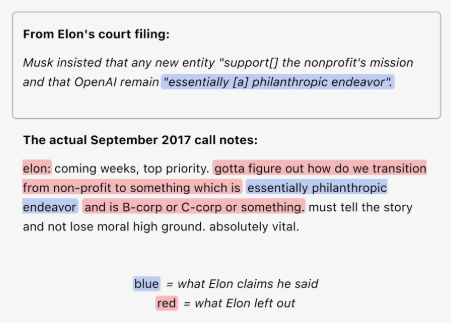
The documents paint a complicated picture: while OpenAI launched with a nonprofit mission, questions about long-term funding and structural changes—including a for-profit component—came up early on. The founders, including Musk, debated in 2017 how to communicate such a transition without undermining the nonprofit's moral standing. Musk wrote: "must tell the story and not lose moral high ground. absolutely vital."
According to OpenAI, Musk founded a Public Benefit Corporation within the OpenAI ecosystem back in 2017, a for-profit structure similar to what OpenAI uses today with OpenAI Group PBC under nonprofit control.
Musk's attorney Steven Molo (via Bloomberg) is seeking $79 billion to $134 billion in damages: $65.5 billion to $109.4 billion from OpenAI and $13.3 billion to $25 billion from Microsoft. The logic: Musk invested $38 million in seed funding and was defrauded. Based on OpenAI's current $500 billion valuation, he claims he's owed a corresponding share. If that valuation climbs to $750 billion before the April trial, expect the damages claim to go up too.
Did OpenAI exploit its nonprofit status?
A key question for the court and likely one of the most important for the whole case: did OpenAI use its nonprofit structure to gain advantages—reputation, recruiting, tax benefits—while leadership planned a commercial pivot all along? This won't be easy to answer.
Co-founder Greg Brockman's testimony highlights the tension. His notes include the question, "Financially, what will take me to a billion dollars?" When asked about this, Brockman called financial incentives under a for-profit structure a "secondary consideration"; what mattered more was whether OpenAI's nonprofit mission could be fulfilled.
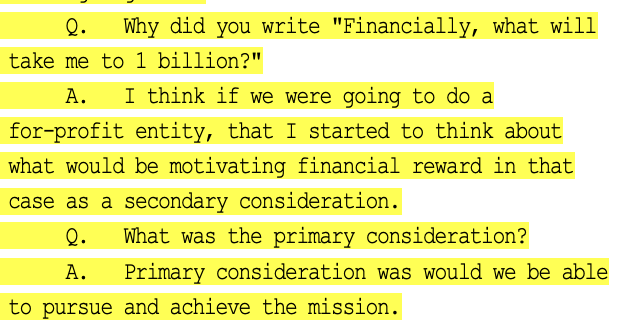
It's hard to square "secondary" with billion-dollar ambitions. That kind of motivation gives ammunition to critics who question how seriously the nonprofit mission was ever taken. Or it's just another sign of how out of touch Silicon Valley is with the rest of the world, where, if you believe Brockman, becoming a billionaire can be a Plan B.
Documents show Musk backed for-profit transition
Musk argues OpenAI betrayed the nonprofit mission he helped fund. But early interview notes show he agreed to adding a for-profit unit in 2017 and actively discussed the transition while keeping the nonprofit in place. This was known before.
According to OpenAI, Musk's lawyers "cherry-picked" court filings and excluded key context. Negotiations didn't fall apart over whether OpenAI could go commercial, they collapsed because Musk demanded complete control and majority ownership, the company claims. OpenAI calls the lawsuit "unserious" and frames it as a "harassment campaign."
OpenAI also claims Musk proposed folding the company into Tesla. When he left, he allegedly told OpenAI to raise "billions" on its own—otherwise, he gave the project "zero percent" chance of success. Musk left OpenAI's board in 2018, founded xAI in 2023, and filed the lawsuit in 2024. The trial is set for late April 2026 in California.
AI News Without the Hype – Curated by Humans
As a THE DECODER subscriber, you get ad-free reading, our weekly AI newsletter, the exclusive "AI Radar" Frontier Report 6× per year, access to comments, and our complete archive.
Subscribe now