OpenAI and Oracle have decided not to expand their data center site in Abilene, Texas, beyond the planned 1.2 gigawatts. Oracle has leased eight buildings at the location for OpenAI, designed to house around 400,000 Nvidia Blackwell chips, but only two have been completed so far.
Oracle had pushed to get OpenAI into six more buildings, but both sides passed because the additional power supply wouldn't be available for at least a year. Instead of expanding the current Blackwell generation, OpenAI plans to buy Nvidia's next-generation Vera Rubin chips for a different data center. According to Bloomberg, Nvidia is now trying to get Meta to fill the vacant space, though those talks are still in the early stages.
OpenAI's compute manager Sachin Katti described the Stargate site as already one of the largest AI data center campuses in the country. "We considered expanding it further, but ultimately chose to put that additional capacity in other locations," Katti writes, adding that OpenAI is currently developing more than half a dozen sites across several US states.
Anthropic's coding tool Claude Code now supports local, scheduled tasks through a new/loopcommand. Users can set up recurring jobs at fixed intervals—minutes, hours, or days—that run in the background as long as Claude Code is active and auto-delete after three days. The feature uses standard cron expressions and the local time zone. One-time natural language reminders like "remind me at 3 PM to push the release branch" are also supported, with up to 50 scheduled tasks per session.
Anthropic developer Thariq Shihipar gives the example of checking error logs every few hours, with Claude Code automatically creating pull requests for fixable bugs. The feature gets especially interesting when connected to other data sources, he says. Claude Code creator Boris Cherny adds use cases like auto-monitoring pull requests with self-fixing or generating morning Slack summaries. A detailed guide is available here.
Google, Amazon, and Microsoft are assuring customers that Anthropic's AI technology will remain available outside of defense projects,CNBC reports, citing company spokespeople. None of the three have issued public statements.
Microsoft said its legal team reviewed the classification and concluded that Anthropic products, including Claude, can stay available through M365, GitHub, and Microsoft's AI Foundry, except for the US Department of War. Google continues offering Claude through Vertex AI, Amazon through Bedrock and GovCloud.
According to the Washington Post, Claude was still used in the recent US attack on Iran despite the designation. The transition to other AI models is expected to take six months, with OpenAI among the new partners.
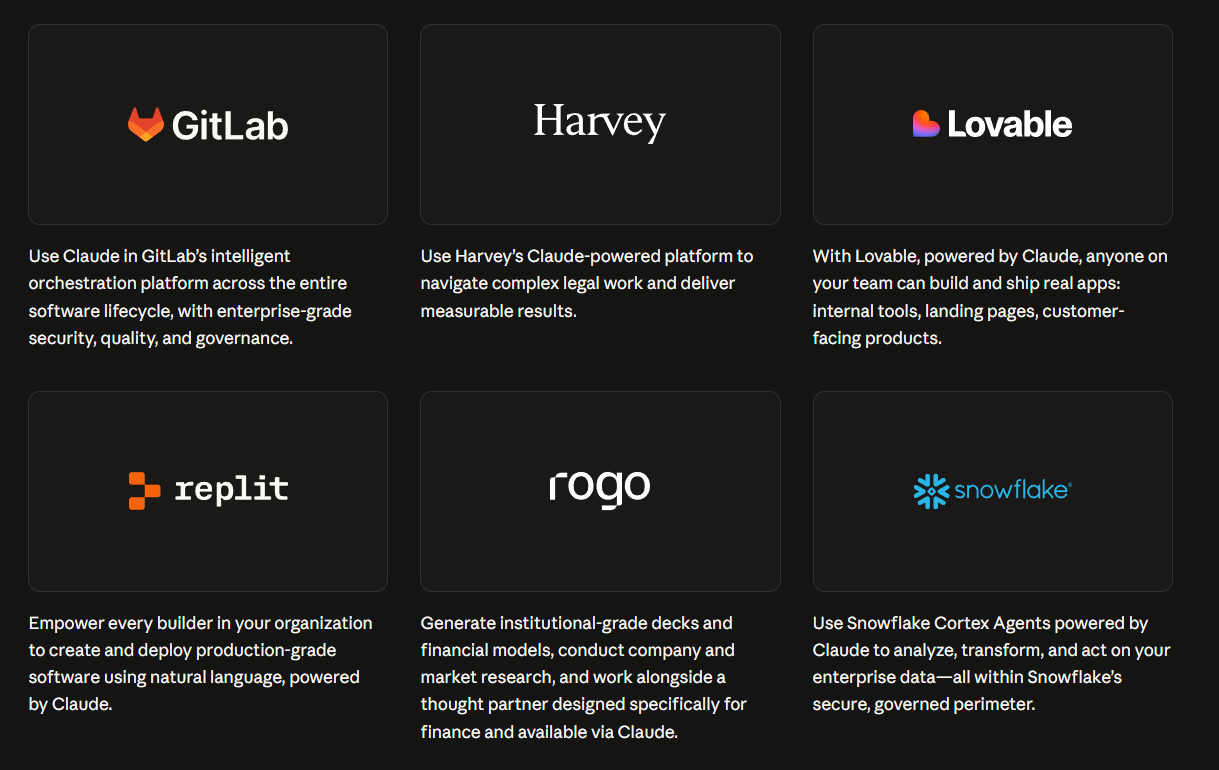
Anthropic is launching the Anthropic Marketplace, a storefront where corporate customers can buy third-party software built on Anthropic's AI models.Launch partners include Snowflake, Harvey, and Replit. Anthropic isn't taking a commission, and customers can put a portion of their existing annual Anthropic spend toward these tools.
First providers on the Anthropic Marketplace. | Image: Screenshot
The strategy mirrors what Amazon does with the AWS Marketplace or Microsoft with Azure: Anthropic is positioning itself as the orchestrator of a growing AI software ecosystem. By waiving commissions and letting customers tap existing budgets for third-party tools, the company makes it easy to stay in its ecosystem.
The commission waiver is less generous than it sounds, though. Every marketplace app runs on Anthropic's models, so partners already pay for the model capacity they use. Anthropic doesn't earn from the marketplace itself (yet), but it profits from the growing demand for its models that the marketplace generates. Interested partners can sign up for the waiting list.
OpenAI launches "Codex Security," an AI-powered security agent built to find vulnerabilities in software projects. The tool, formerly known as "Aardvark," is now available as a research preview for ChatGPT Enterprise, Business, and Edu customers, free for the first month. Codex Security analyzes code repositories, builds a project-specific threat model, and tests any vulnerabilities it finds in isolated test environments, OpenAI says.
During the beta phase, OpenAI says the system cut false positives by more than 50 percent and reduced redundant alerts by 84 percent in one case. Over the past 30 days, Codex Security scanned more than 1.2 million commits and flagged 792 critical vulnerabilities.
The Pentagon formally notified Anthropic on March 4 that the company and its products have been designated as a supply chain risk to US national security. Anthropic CEO Dario Amodei announced on March 5 that the company will challenge the designation in court. According to Amodei, the measure only applies to the use of Claude as a direct part of contracts with the Department of War, not all customers.
The dispute escalated after Anthropic demanded assurances that its AI would not be used for mass surveillance of Americans or autonomous weapons deployment. According to Bloomberg, Claude is currently the only AI system operating in the Pentagon's classified cloud and is actively used in US operations against Iran.
Amodei also apologized for an internal post that was leaked to the press. "It does not reflect my careful or considered views," Amodei said. The post was written within hours of Trump's Truth Social post, Secretary of War Hegseth's announcement on X, and a Pentagon deal with OpenAI.
Anthropic is offering to continue providing its models to the military at nominal cost until a transition is complete. According to Bloomberg, the company is currently valued at $380 billion and is approaching an annual revenue run rate of $20 billion.
Anyone worried about an AI bubble now has more reason for concern: Softbank is looking to borrow up to $40 billion, primarily to finance its stake in OpenAI, Bloomberg reports. If the deal goes through, it would be the largest pure dollar borrowing in the Japanese conglomerate's history. The bridge loan would run for about twelve months, with four banks—including JPMorgan Chase—underwriting it. Negotiations are still ongoing.
SoftBank founder Masayoshi Son is making a massive bet on artificial intelligence. Beyond the $30 billion earmarked for OpenAI, the company has already poured over $30 billion into the startup and held roughly eleven percent of its shares as of late December. To fund these investments, SoftBank sold off Nvidia shares, among other assets.
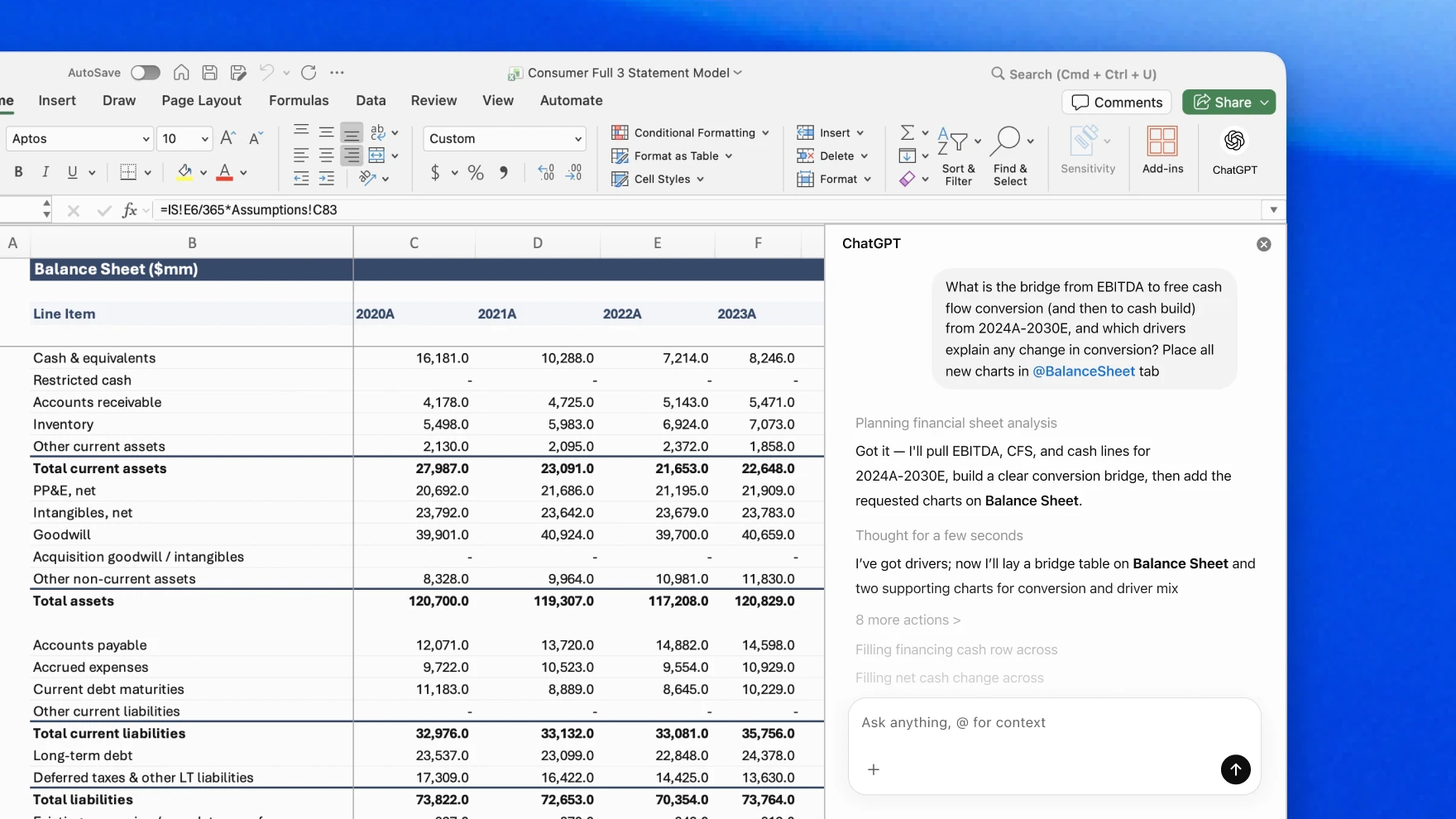
OpenAI is launching "ChatGPT for Excel," a beta add-in that lets users create, edit, and analyze spreadsheets through natural language. The tool runs on the new GPT-5.4 model, which OpenAI says is specifically optimized for financial tasks like modeling, scenario analysis, and data evaluation.
ChatGPT running as an add-in inside Microsoft Excel. The left side shows a balance sheet with financial data from 2020 to 2023, while the right panel shows ChatGPT responding to a cash flow analysis question and making changes directly in the worksheet. | Image: OpenAI
OpenAI tested its own models alongside Opus 4.6 on an internal benchmark designed to evaluate real investment banking tasks, such as building a three-statement model with correct formatting and sources.
Model
Average Score (higher is better)
GPT-5
0,437
GPT-5.2 Thinking
0,684
GPT-5.2 Pro
0,717
GPT-5.4 Thinking
0,873
Opus 4.6
0,641
OpenAI is also rolling out financial data connections for providers like FactSet, Moody's, S&P Global, and LSEG. ChatGPT for Excel is initially available in the US, Canada, and Australia for Business, Enterprise, Pro, and Plus users. A version for Google Sheets is planned to follow.