Ad
Skip to content

Matthias Bastian

Matthias is the co-founder and publisher of THE DECODER, exploring how AI is fundamentally changing the relationship between humans and computers.
Read full article about: Open source Nomic Embed text embedding model outperforms OpenAI's Ada-002

Nomic AI has released an open-source embedding model called Nomic Embed that outperforms OpenAI's Ada-002 and text-embedding-3-small models on both short and long-context tasks. The model is fully reproducible, auditable, and supports a context length of 8192. Nomic Embed outperformed its competitors on the Massive Text Embedding Benchmark (MTEB) and the LoCo Benchmark, but fell short on the Jina Long Context Benchmark. Model weights and full training data are published for "complete model auditability". Nomic Embed is also available via the Nomic Atlas Embedding API with one million free tokens for production workloads and via the Nomic Atlas Enterprise offering for enterprises.
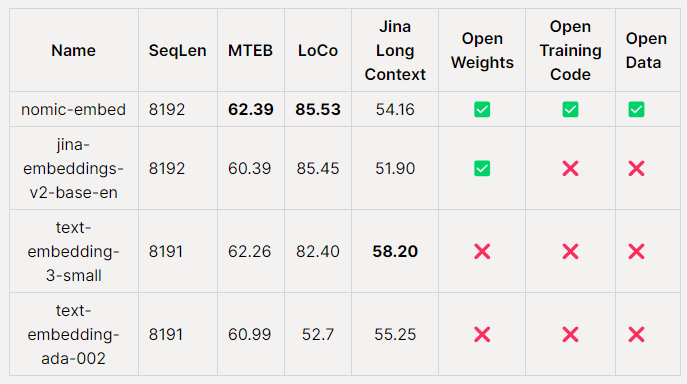

Image: Nomic AI
Read full article about: Safe AI tools for young people: OpenAI and Common Sense Media form partnership

Common Sense Media, a leading US advocacy group for children and families, has announced a partnership with OpenAI. The goal is to harness the full potential of AI for youth and families and minimize the risks. The collaboration will begin with the creation of AI guidelines and educational materials for parents, educators, and youth, as well as a selection of family-friendly GPTs in the GPT Store, based on Common Sense's ratings and standards.

"Humans are tool users and we better teach people to use the tools that are going to be out in the world. To not teach people to use those would be a mistake."

Sam Altman

Read full article about: Google's "AI Opportunity whitepaper" aims to guide ASEAN governments in adopting AI

Google has released an "AI Opportunity whitepaper" to aid ASEAN governments in leveraging AI's potential. The paper outlines policy recommendations for ASEAN member states (AMS) on how to maximize the benefits of AI. Three key suggestions include investing in innovation infrastructure, building an AI-ready workforce, and promoting inclusive adoption and accessibility. Google has also pledged to support infrastructure, skilling, and accessibility efforts through various initiatives. These include partnering with the Singapore government to launch AI programs, supporting AI Singapore to organize cross-sector industry roundtables, and launching an AI Policy and Skilling Lab for Southeast Asia.

Read full article about: China's AI boom continues as 40 new models clear regulatory hurdles for public use

In the first six months since China began regulating AI models, the country has approved more than 40 models for public use, with the latest batch of 14 large language models (LLMs) granted last week. The recipients include Xiaomi Corp, 4Paradigm, and 01.AI, Reuters reports. Beijing began requiring tech companies to seek approval for their LLMs for public use in August, underscoring the nation's approach to AI development while maintaining control over the technology. The first batch of AI models approved included Baidu, Alibaba and ByteDance. One of the most interesting questions will be how effective these approval processes are. A recent experiment showed that you can get Chinese LLMs to talk about topics that the CCP probably doesn't want them to talk about.