New Top 100 AI list shows a maturing market where ChatGPT leads but users are shopping around

Key Points
- ChatGPT continues to dominate the consumer AI market by a wide margin, but competitors like Gemini and Claude are gaining ground at a significantly faster growth rate.
- According to a16z, users regularly switch between multiple AI assistants, a pattern that resembles the early smartphone platform wars rather than the winner-takes-all dynamic seen with search engines like Google.
- Standalone creative tools such as Midjourney are losing significant market relevance as major chatbot platforms have built their own image generation capabilities directly into their products.
The latest edition of Andreessen Horowitz's Top 100 list for AI consumer products reveals a market in transition: ChatGPT still dominates, but competitors are gaining ground fast, and global usage is splitting along geopolitical lines.
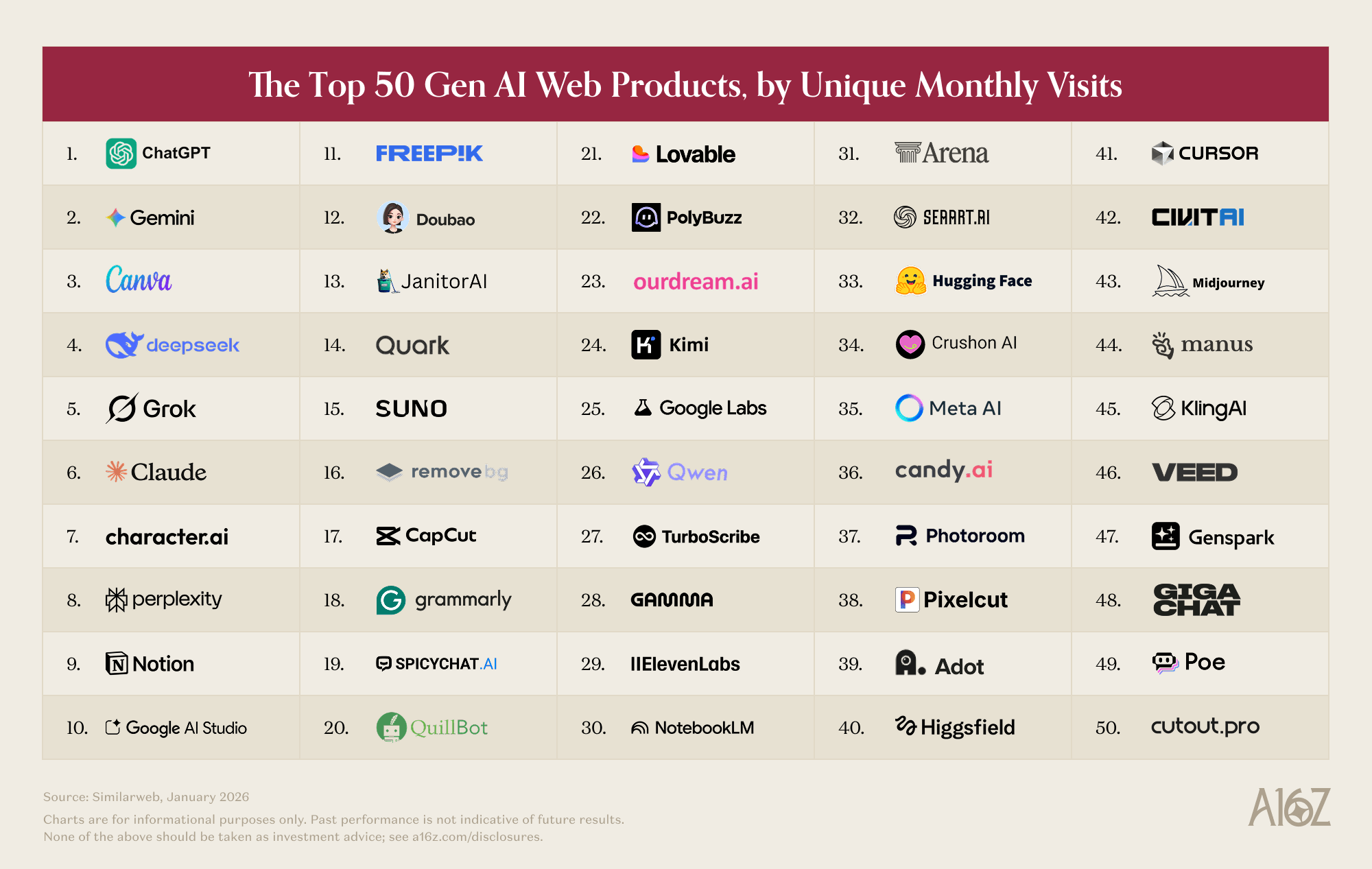
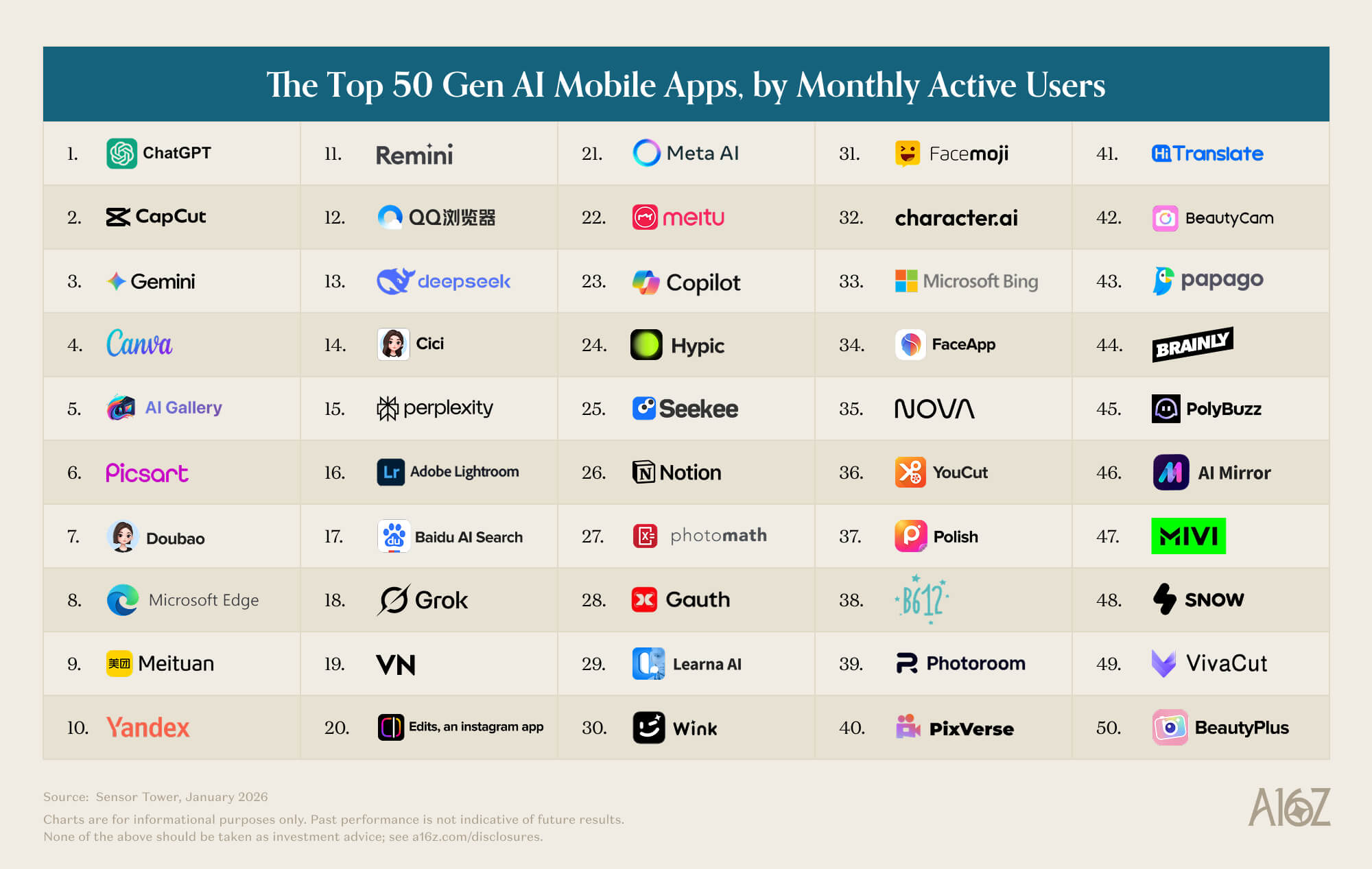
Venture capital firm Andreessen Horowitz (a16z) has been publishing its ranking of the most widely used AI consumer products for three years now. The sixth edition draws on SimilarWeb and Sensor Tower data, both from January 2026. For the first time, the list also includes products where generative AI has become central but that weren't originally founded as AI companies, such as CapCut, Canva, and Notion.
ChatGPT still leads, but competitors are closing the gap
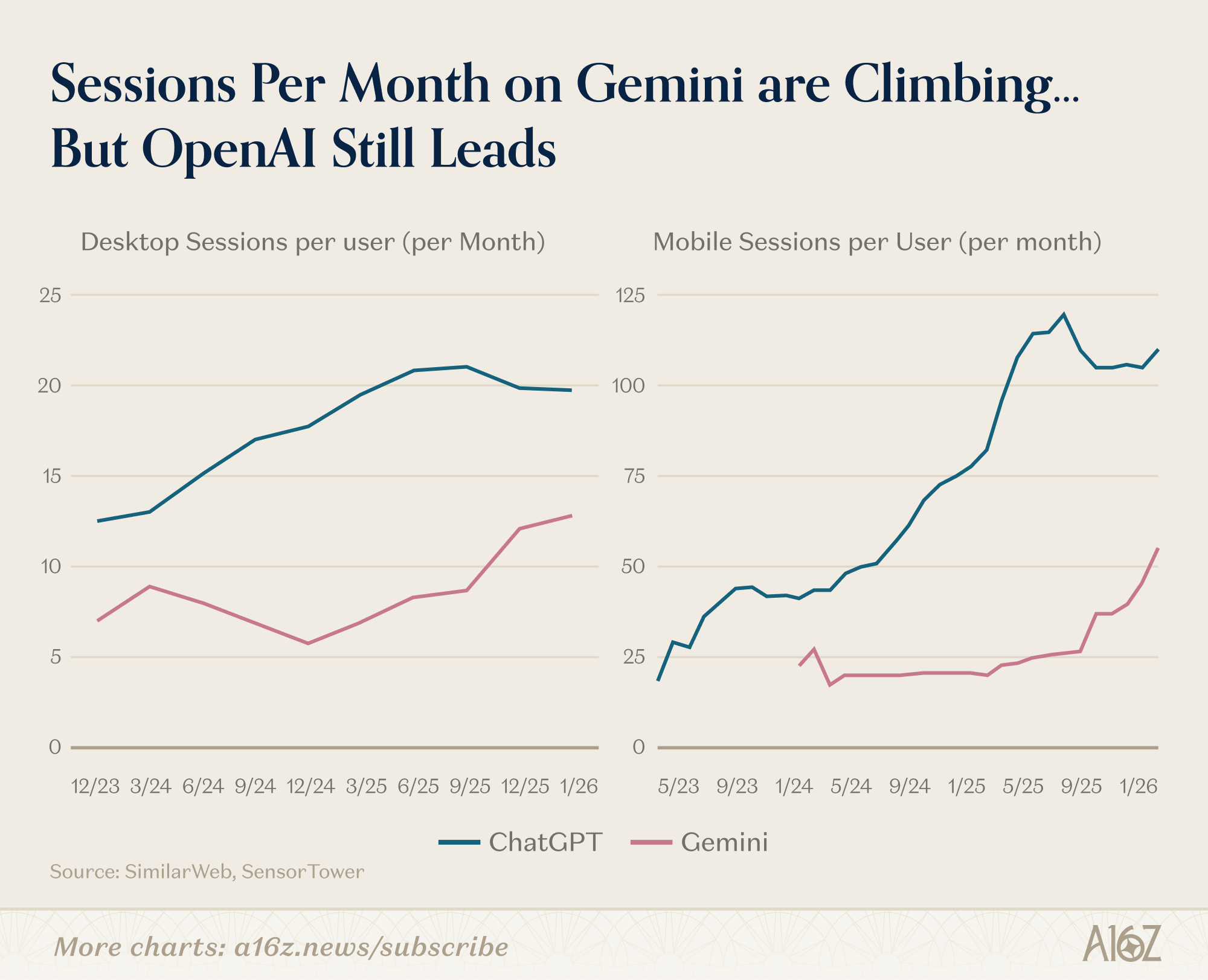
ChatGPT remains the largest AI consumer product by a wide margin. On the web, it pulls 2.7 times as much traffic as second-place Gemini. Weekly active users grew by 500 million to 900 million over the past year, meaning more than ten percent of the world's population now uses ChatGPT every week.
The competition is catching up, though. According to data from market research firm Yipit, Claude's paying US subscribers grew more than 200 percent year over year, while Gemini's grew by 258 percent. About 20 percent of weekly ChatGPT web users also use Gemini in any given week, a sign that people are increasingly switching between multiple AI assistants.
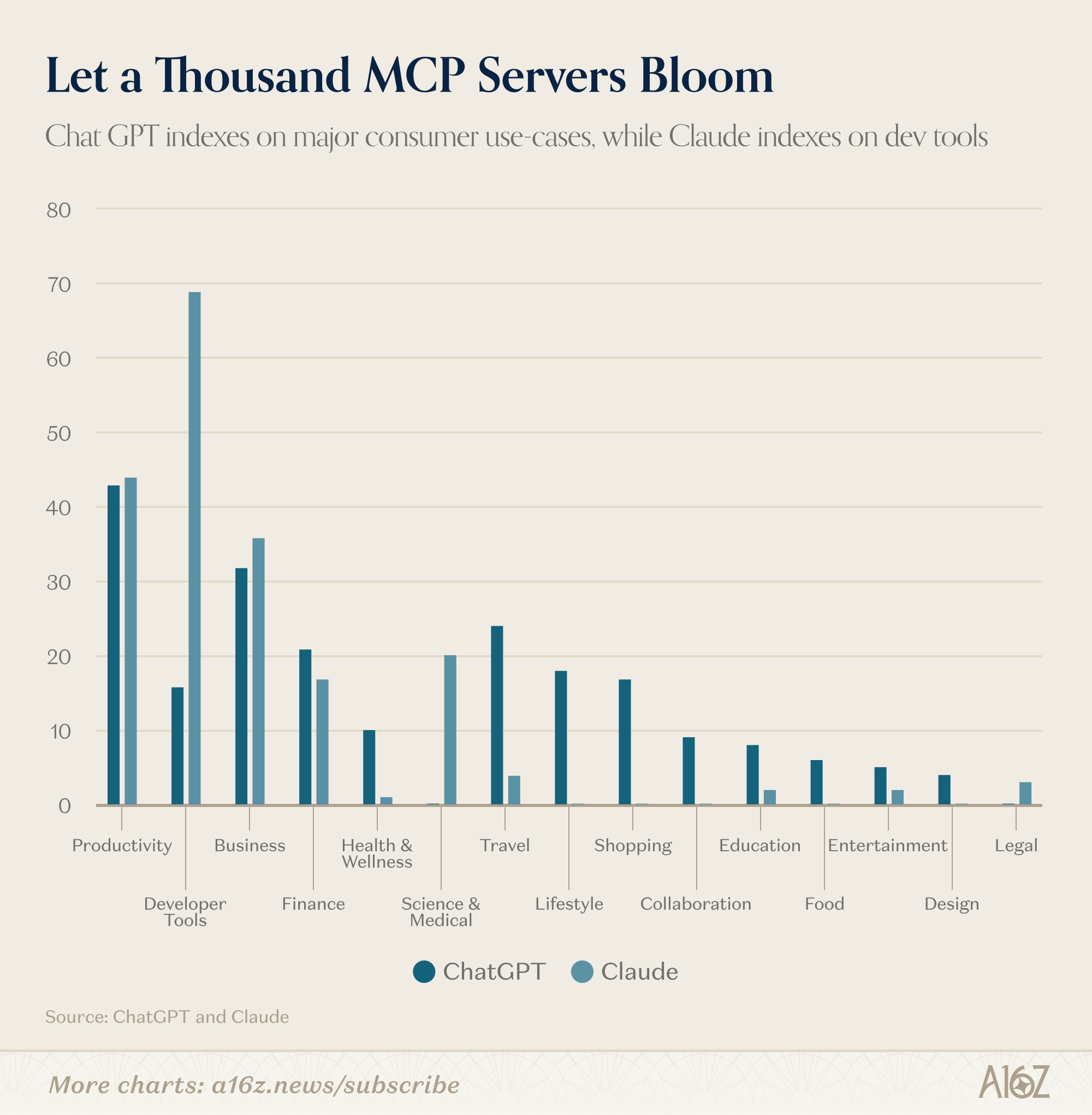
According to a16z, the platforms are pursuing different strategies. ChatGPT now offers more than 85 apps across travel, shopping, food, and health categories, making it what the report calls "the most aggressive play any AI company has made to become a consumer super-app."
Claude's integrations, on the other hand, focus on financial data providers, developer tools, and scientific databases. The analysts suggest the outcome might look less like the search engine wars, where one provider captured 90 percent of the market, and more like the smartphone platform wars, where two systems with fundamentally different philosophies each built massive ecosystems.
Global AI usage is splitting into three distinct blocks
Geographically, the market has fractured into three ecosystems. Western tools share a similar user base drawn from the US, India, Brazil, the UK, and Indonesia. Deepseek is the only product that bridges the divide, pulling traffic from China, Russia, and the US.
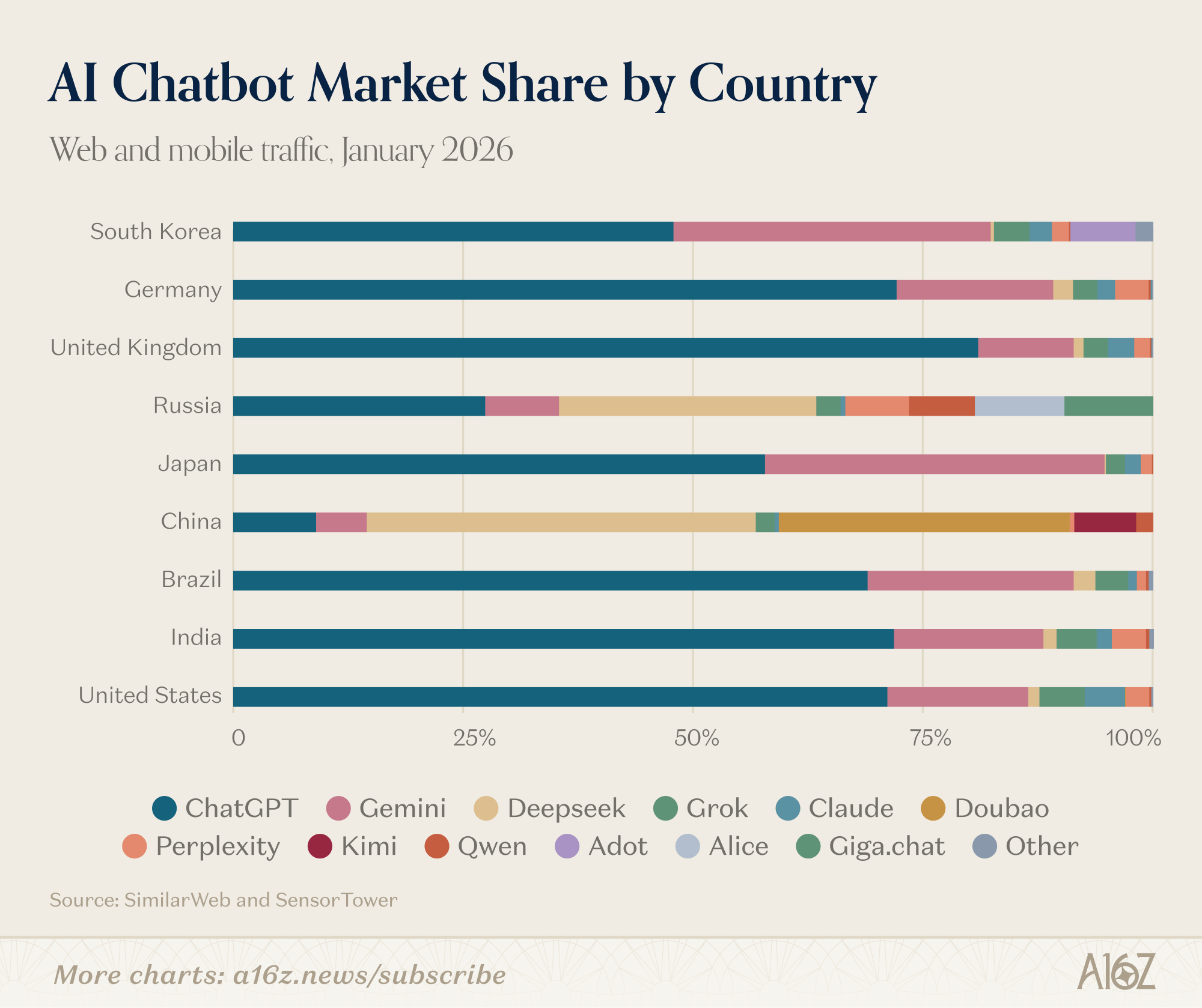
Russia has established itself as the third pole: Yandex Browser with its AI assistant Alice reached 71 million monthly active users. "Sanctions created the gap, and local products filled it within two years," the report notes. On a per person basis, Singapore ranks first, while the US comes in 20th.
Midjourney drops as agents emerge as a new category
Creative tools have changed fundamentally, according to a16z. Now that ChatGPT and Gemini have built in their own capable image generators, most users have little reason to rely on a standalone tool.
Midjourney, which is about to release v8 of its model, has fallen from the top 10 all the way to 43rd place. Chinese models like Kling AI and Hailuo lead the way in video generation, while Sora 2 failed to break through as a social app despite a strong launch. Against that backdrop, the rumored integration of Sora into ChatGPT seems like a logical next step.
Agents are showing up as an entirely new category. OpenClaw, an open-source project by Austrian developer Peter Steinberger, grew to 68,000 GitHub stars within just a few weeks. Chinese company Manus was acquired by Meta for an estimated two billion dollars.
According to a16z, its own rankings increasingly underestimate which AI products people actually use. As AI shifts from standalone products to embedded features, web traffic and app downloads become less reliable as measurements. Google, for example, launched "Personal Intelligence," which connects Gemini with Gmail, Photos, and YouTube.
SimilarWeb data recently showed that ChatGPT is losing market share despite its continued dominance: its share of global AI web traffic fell from 75.7 to 61.7 percent within a year, while Google Gemini more than quadrupled its share from 5.7 to 24.4 percent.
The enterprise market tells a similar story: according to an a16z survey of 100 CIOs, OpenAI still leads with 78 percent usage in production, but Anthropic has increased its enterprise penetration by 25 percent to 44 percent since May 2025. 81 percent of the companies surveyed now use three or more model families.
AI News Without the Hype – Curated by Humans
As a THE DECODER subscriber, you get ad-free reading, our weekly AI newsletter, the exclusive "AI Radar" Frontier Report 6× per year, access to comments, and our complete archive.
Subscribe now