Over 100 fake citations slip through peer review at top AI conference

An analysis of nearly 5,000 accepted research papers from the AI conference NeurIPS 2025 uncovered more than 100 fabricated citations - despite review by multiple experts.
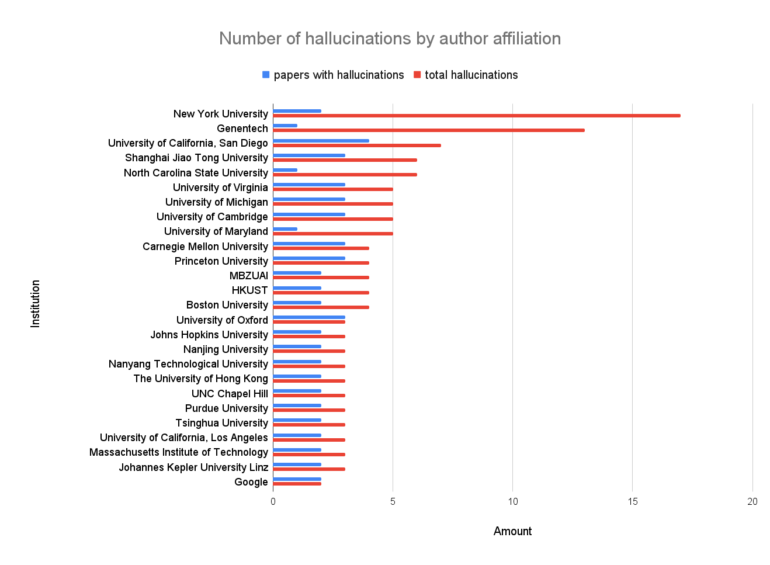
The Conference on Neural Information Processing Systems (NeurIPS) is one of the world's most prestigious AI conferences. But when AI detection company GPTZero analyzed 4,841 of the 5,290 papers accepted for the November 2025 conference, it found at least 100 confirmed hallucinated citations spread across 51 scientific papers.
These papers went through the full peer review process, where at least three reviewers evaluate each submission. With an acceptance rate of 24.52 percent, these papers beat out around 15,000 other submissions - despite containing fabricated sources.
From "John Doe" to fake DOIs
The documented cases reveal a wide range of errors. The paper "SimWorld" lists the obviously fictional authors "John Doe and Jane Smith." In "Unmasking Puppeteers," DOIs and URLs lead nowhere. A paper on semantic uncertainty quantification contains 15 hallucinated citations, including incomplete arXiv IDs like "arXiv:2305.XXXX."
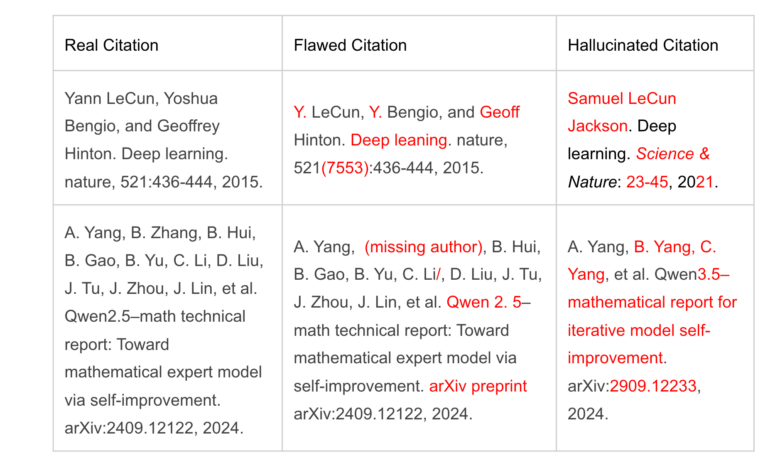
GPTZero coined the term "Vibe Citing" for this phenomenon. These are citations that look correct at first glance but fall apart under scrutiny. Common patterns include titles, authors, or sources combined or paraphrased from real publications. Authors, URLs, and DOIs are simply invented. Sometimes author names are extrapolated from initials or titles slightly altered.
Fabricated sources and fabricated facts
Back in December 2025, GPTZero had already identified more than 50 hallucinated citations in papers submitted for review at ICLR 2026. GPTZero's Alex Cui notes that while incorrect citations existed before, AI has increased their frequency. He doesn't provide specific numbers. Both NeurIPS and ICLR consider hallucinated citations grounds for rejection or retraction.
The investigation deliberately focuses on citations. Reliably identifying AI-generated text remains difficult, and GPTZero is also using the analysis to promote its new citation verification product. The more interesting question - whether the papers contain factual hallucinations in their content - remains unanswered.
According to Cui, the company plans to examine paper appendices next. He believes these are read less frequently and therefore more likely to contain hallucinations. Finding such content errors would be significantly more labor-intensive than flagging fabricated sources: even clearly AI-generated text can be factually correct. The company would need to do real fact-checking rather than just detecting statistical patterns.
A tsunami of submissions overwhelms the system
Behind the problem lies a capacity issue. Between 2020 and 2025, NeurIPS submissions increased by more than 220 percent - from 9,467 to 21,575. To handle this flood, organizers had to recruit ever more reviewers, leading to problems with oversight, expertise matching, and thoroughness.
But the problem isn't limited to authors. As a Reddit thread ahead of ICLR 2026 showed, distrust of reviewers is also growing. Authors of the paper "Efficient Fine-Tuning of Quantized Models" withdrew their submission in protest. Their complaint: reviewers hadn't read the paper and instead used AI tools to generate criticisms. They were faulted for supposedly missing experiments that the authors say were explicitly included in the text.
"Where the water is too clean, there are no fish"
These incidents are symptoms of deeper structural problems. A 2024 study published in the journal Research Ethics by researchers Xinqu Zhang and Peng Wang analyzed how government initiatives create toxic incentive structures, using Chinese elite universities as a case study.
The study identifies the mechanism of "cengceng jiama" - a gradual increase of pressure within the bureaucratic hierarchy. While the central government sets vague goals like "world-class status," university administrators interpret this as strict ranking requirements. These get passed down to faculties, which tighten requirements further out of fear of failure.
According to the study, the resulting pressure leads to a "decoupling of goals and means." To meet unrealistic productivity targets, researchers detach from ethical norms. Junior scientists openly admitted they had "no choice" but to fabricate data or use ghostwriting services. Today, generative AI fills that role, with frameworks like Sakana's "AI Scientist" explicitly designed for AI-generated research. The study cites data from publisher Hindawi, which retracted more than 9,600 papers in 2023 - roughly 8,200 of them had co-authors from China.
According to the report, institutions tacitly tolerate misconduct as long as results are delivered. One dean is quoted using a Chinese proverb: "Where the water is too clean, there are no fish." Being too strict about punishing misconduct would hurt research efficiency, the thinking goes.
AI News Without the Hype – Curated by Humans
As a THE DECODER subscriber, you get ad-free reading, our weekly AI newsletter, the exclusive "AI Radar" Frontier Report 6× per year, access to comments, and our complete archive.
Subscribe nowAI news without the hype
Curated by humans.
- Over 20 percent launch discount.
- Read without distractions – no Google ads.
- Access to comments and community discussions.
- Weekly AI newsletter.
- 6 times a year: “AI Radar” – deep dives on key AI topics.
- Up to 25 % off on KI Pro online events.
- Access to our full ten-year archive.
- Get the latest AI news from The Decoder.