Baidu claims its Ernie X1 reasoning model matches Deepseek-R1 performance at half the price

Baidu has introduced two new AI models that take aim at Western competitors with aggressive pricing and plans for open-source release.
The Chinese tech company says its Ernie X1 model delivers performance on par with Deepseek-R1 at 50 percent of the cost, though it hasn't yet published benchmarks or technical details to support these claims.
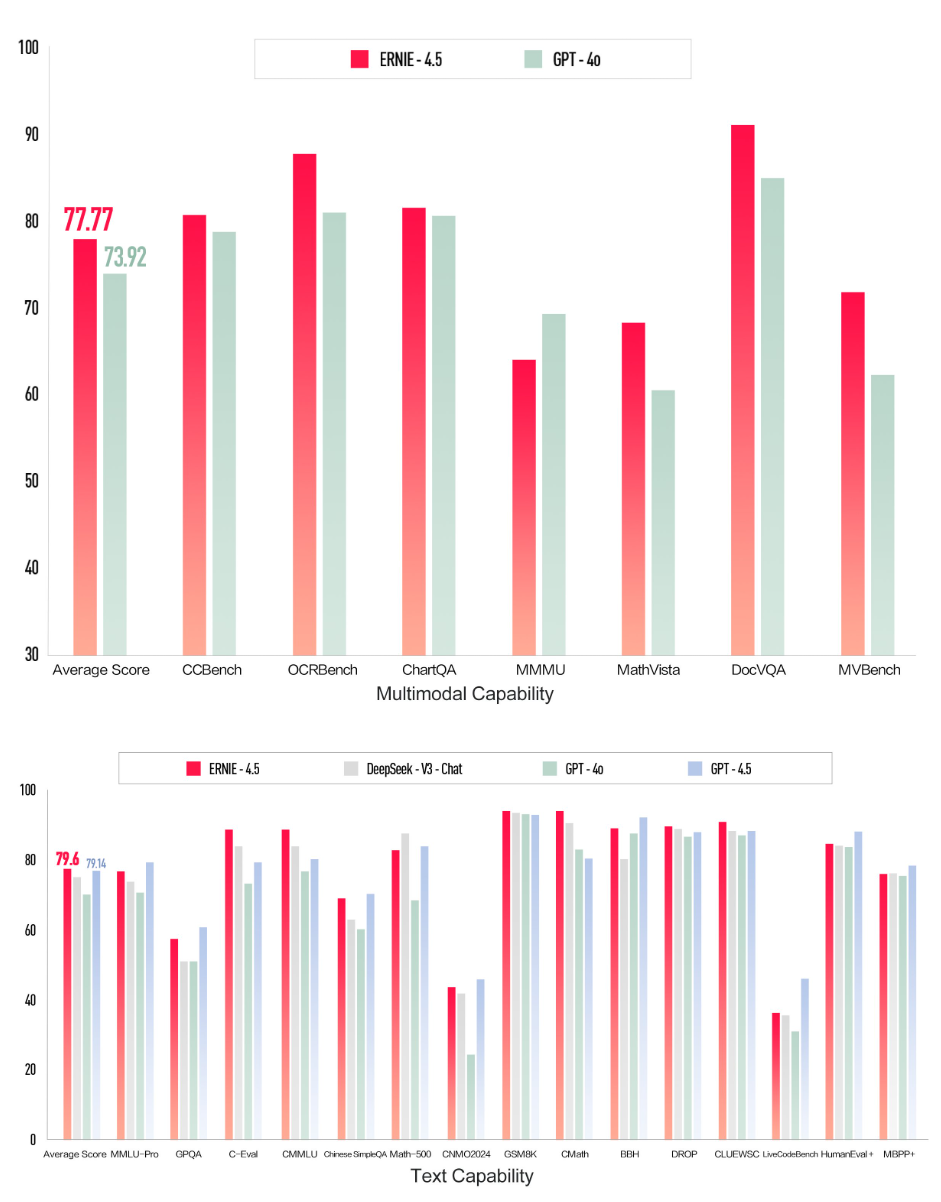
The company also unveiled Ernie 4.5, a new multimodal base model that processes videos, photos, and text more effectively than its predecessors. According to Baidu, the model shows marked improvements in reducing hallucinations, handling complex reasoning tasks, and writing code. Internal benchmarks suggest it performs better than OpenAI's standard GPT-4o and matches capabilities with the newer GPT-4.5.
Through its Qianfan cloud platform, Baidu has set Ernie 4.5's pricing at $0.55 per million input tokens and $2.20 for output - a fraction of GPT-4.5's rates of $75 per million input tokens and $150 per million output tokens. The company's Ernie X1 model comes in even lower at $0.28 per million input tokens and $1.10 for output - half the API cost of Deepseek-R1, though Deepseek's model is also available as open source.
Beyond enterprise services, Baidu now offers its AI chatbot Ernie Bot at no cost to individual users. The company plans to incorporate both new models into its existing products, including Baidu Search and the Wenxiaoyan app.
Video: Baidu
Baidu goes open source
Mid-February, Baidu CEO Robin Li announced a major change in direction: the company will make its Ernie 4.5 series open-source starting June 30. Li, who historically supported keeping models closed, said that open source would "spread the technology much faster."
While Baidu hasn't announced open-source plans for X1, such a move appears likely since Deepseek-R1, which Baidu currently uses in some of its products, is already open source.
This development adds to the pressure on Western AI companies that maintain higher pricing for comparable capabilities. The shift began with what's now called the "Deepseek moment" - when, in January 2025, Deepseek demonstrated that it could match the performance of Western AI labs with significantly fewer resources.
Western AI companies have taken notice. Both Anthropic and OpenAI have petitioned the US government to regulate Chinese AI development, citing national security and political concerns. But it's also true that open-source Chinese models could significantly impact these companies' commercial API offerings.
As China's dominant search provider, Baidu aimed to establish itself early in the AI race. The company launched Ernie Bot as China's first ChatGPT alternative in 2023, drawing 70 million users within three months. These new releases suggest Baidu is accelerating development as domestic rival Deepseek gains international recognition.
AI News Without the Hype – Curated by Humans
As a THE DECODER subscriber, you get ad-free reading, our weekly AI newsletter, the exclusive "AI Radar" Frontier Report 6× per year, access to comments, and our complete archive.
Subscribe nowAI news without the hype
Curated by humans.
- More than 16% discount.
- Read without distractions – no Google ads.
- Access to comments and community discussions.
- Weekly AI newsletter.
- 6 times a year: “AI Radar” – deep dives on key AI topics.
- Up to 25 % off on KI Pro online events.
- Access to our full ten-year archive.
- Get the latest AI news from The Decoder.