A simple text file beats complex skill systems for AI coding agents


Vercel set out to find the best way for AI coding agents to access up-to-date framework knowledge. The answer turned out to be surprisingly simple.
AI coding agents depend on training data that inevitably goes stale. When a framework like Next.js ships new APIs, agents either generate broken code or fall back on outdated patterns.
Vercel tested two approaches: a Skill system where agents actively retrieve documentation, and AGENTS.md, a Markdown file that provides persistent context. The results surprised even the team. The compressed AGENTS.md file hit a perfect 100 percent success rate, while the more complex Skill system topped out at 79 percent.
Agents ignored skills in more than half of all test cases
The Skill system bundles knowledge into packages that AI agents can pull up on demand. The idea is straightforward: the agent recognizes when it needs framework-specific help, triggers the skill, and gets access to the relevant docs.
In practice, that didn't happen. According to Vercel, the agent never called the skill in 56 percent of cases. It had access to the documentation but simply didn't use it. The pass rate with skills was identical to the baseline without any documentation at all: 53 percent.
Only explicit instructions telling the agent to use the skill pushed the trigger rate above 95 percent and the pass rate to 79 percent. But this created a new problem: the exact wording made a dramatic difference. "You MUST invoke the skill" caused the agent to miss project context, while "Explore project first, then invoke skill" produced better results.
Passive context delivered a perfect score
The alternative was dead simple. Instead of relying on the agent's judgment, the team embedded a compressed documentation index directly into the AGENTS.md file. This Markdown file sits in the project root and gives the agent persistent context on every turn, without the agent having to actively decide anything.
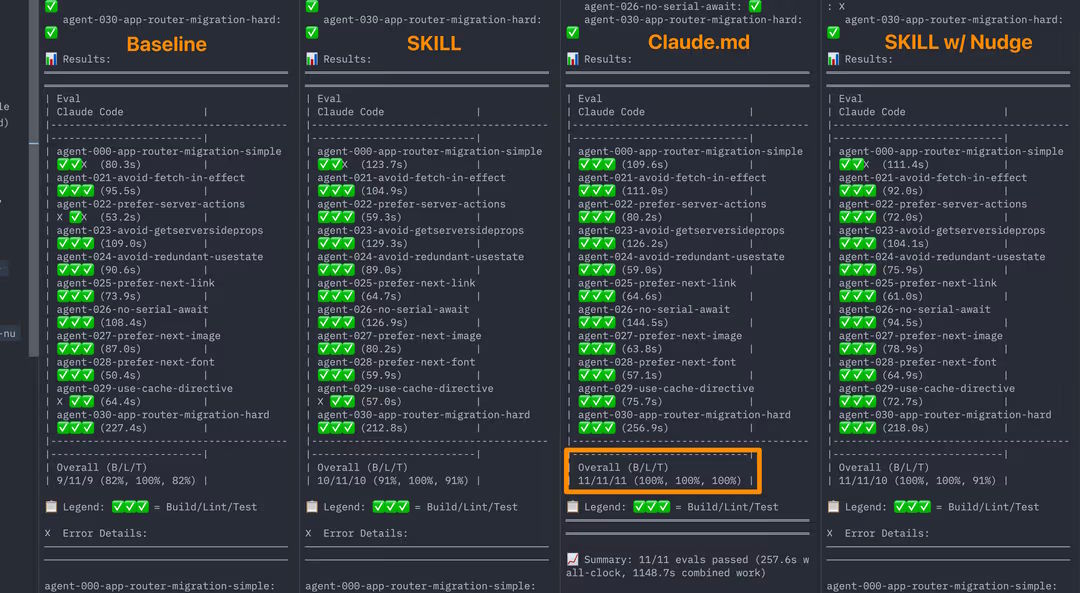
The original 40-kilobyte documentation index was compressed down to 8 kilobytes with no drop in success rate. The agent knows where to find specific docs without needing the full content in context.
Vercel's team points to three reasons the passive approach won out. First, there's no decision point, since the information is already there. Second, availability is consistent because AGENTS.md content gets included in the system prompt on every turn. Third, there are no sequencing issues like the ones that caused inconsistent results with skills.
Vercel is clear that skills aren't useless. The company says they're better suited for vertical, action-specific workflows like "upgrade my Next.js version." For general framework knowledge, though, passive context currently outperforms on-demand retrieval.
For Next.js projects, Vercel provides a command that automates the setup: npx @next/codemod@canary agents-md detects the installed version, pulls the right documentation, and injects the compressed index.
AGENTS.md is becoming part of a broader industry standard
Vercel's findings highlight the growing importance of AGENTS.md, which has become part of a wider industry push. In December 2025, the Linux Foundation launched the Agentic AI Foundation (AAIF), bringing direct competitors like OpenAI, Anthropic, Google, and Microsoft together to build open standards for AI agents.
Three open-source projects make up the core. Anthropic's Model Context Protocol (MCP) connects models with external data, Block's Goose serves as a framework for agent workflows, and OpenAI's AGENTS.md sets standards for coding instructions. According to the Linux Foundation, AGENTS.md has already been adopted by more than 60,000 open-source projects and is natively supported by agent frameworks like Cursor, Devin, GitHub Copilot, and Gemini CLI.
The Skill system Vercel tested is an open standard that Anthropic also uses in its Claude products. In October 2025, the company rolled out Skills as a modular system where Claude figures out on its own which specialized instructions and resources a given task needs.
AI News Without the Hype – Curated by Humans
As a THE DECODER subscriber, you get ad-free reading, our weekly AI newsletter, the exclusive "AI Radar" Frontier Report 6× per year, access to comments, and our complete archive.
Subscribe nowAI news without the hype
Curated by humans.
- More than 16% discount.
- Read without distractions – no Google ads.
- Access to comments and community discussions.
- Weekly AI newsletter.
- 6 times a year: “AI Radar” – deep dives on key AI topics.
- Up to 25 % off on KI Pro online events.
- Access to our full ten-year archive.
- Get the latest AI news from The Decoder.