A calendar invite is all it took to hijack Perplexity's Comet browser and steal 1Password credentials
Security researchers demonstrate how a manipulated calendar invite can trick Perplexity’s agentic Comet browser into stealing local files and taking over a full 1Password account.
Anthropic entered a $100 million Pentagon competition in early 2026. The company was proposing to use Claude for voice-controlled autonomous drone swarm technology, Bloomberg reports.
The idea was to use Claude to translate a commander's spoken orders into digital instructions and coordinate drone fleets without using AI for autonomous targeting or weapons decisions. Humans would be able to monitor and shut down the system. This approach lines up with Anthropic's position in its ongoing dispute with the Pentagon, where the company has stressed that human oversight is essential for autonomous weapons because current AI models aren't reliable enough to operate without it.
Anthropic didn't win the contract. Instead, the Pentagon awarded it to SpaceX/xAI and two defense companies partnered with OpenAI.
ASML, the world's sole manufacturer of EUV lithography machines used to produce advanced chips, is looking to expand beyond its core business. That's according to a Reuters report citing ASML Chief Technology Officer Marco Pieters.
The Dutch company is specifically planning to move into advanced packaging - a technique where multiple specialized chips are connected and stacked on top of each other. This approach is critical for modern AI chips and the high-bandwidth memory that feeds them. TSMC already uses advanced packaging to build Nvidia's most powerful AI processors, among others.
Pieters told Reuters that ASML is planning 10 to 15 years ahead, studying what kinds of machines the industry will need for packaging and bonding. The company is also exploring whether chips can be printed beyond their current size limit. On top of that, ASML wants to use AI to speed up the control software running its machines and improve quality checks during chip manufacturing.
Thousands of procurement documents show how China's army wants to weaponize AI
Researchers at Georgetown University have analyzed thousands of procurement requests from China’s People’s Liberation Army. The documents reveal how broadly Beijing is already experimenting with military AI, from drone swarms and deepfake tools to autonomous decision-making systems.
Anthropic's new prompt forces ChatGPT to reveal everything it knows about you
Anthropic is capitalizing on OpenAI’s bad press with a new import function for Claude. A single prompt exports your saved context from ChatGPT or other chatbots, letting you transfer it straight to Claude’s memory.
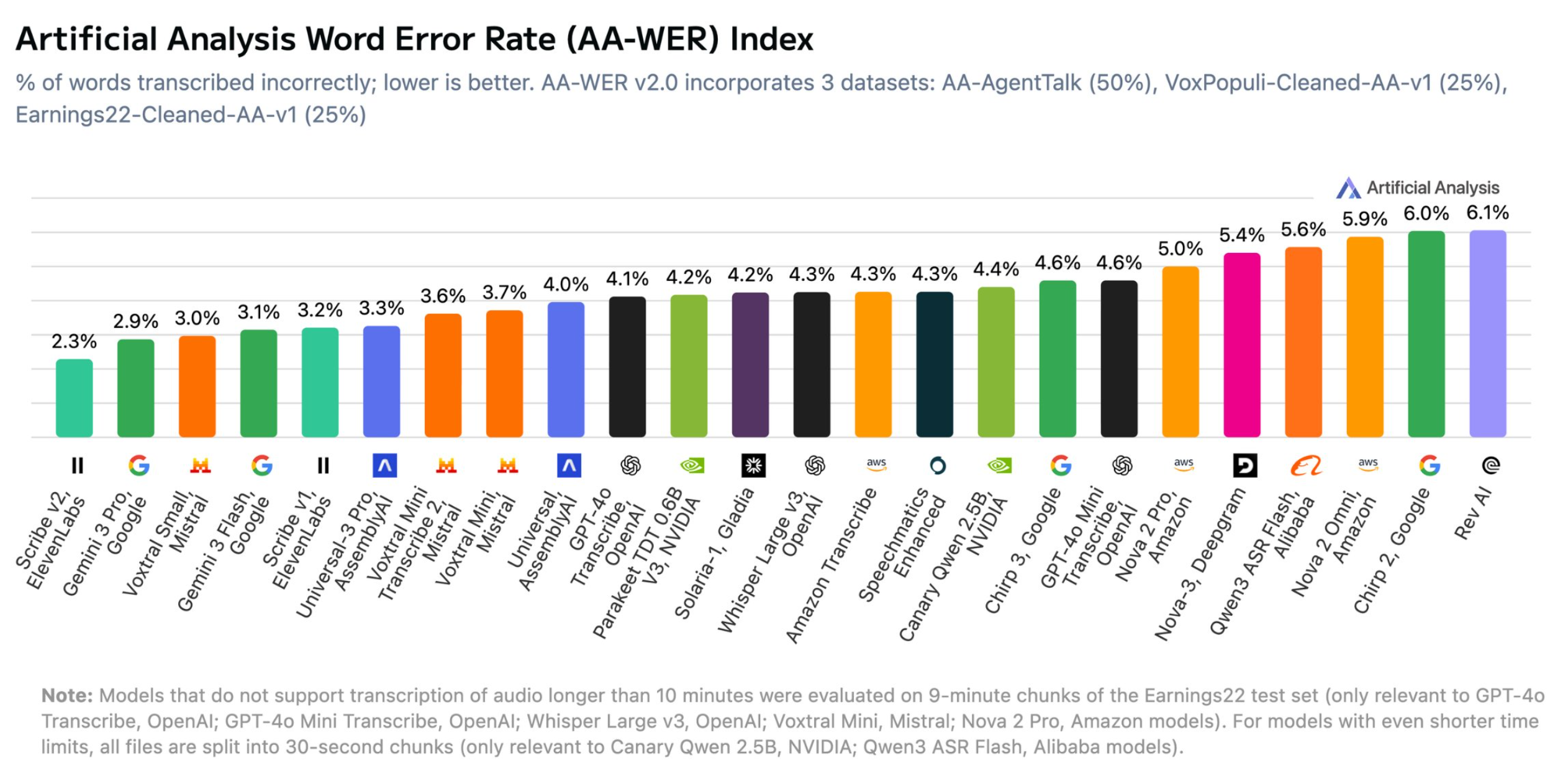
Artificial Analysis has released version 2.0 of its AA-WER speech-to-text benchmark. ElevenLabs' Scribe v2 leads with a word error rate of just 2.3 percent, followed by Google's Gemini 3 Pro (2.9%) and Mistral's Voxtral Small (3.0%). Google's Gemini 3 Flash (3.1%) and ElevenLabs' older Scribe v1 (3.2%) are close behind. Notably, Google didn't specifically train for transcription—the strong results come from Gemini's general multimodal capabilities. OpenAI's popular open-source Whisper Large v3 (4.2%) lands mid-pack, while Alibaba's Qwen3 ASR Flash (5.9%), Amazon's Nova 2 Omni (6.0%), and Rev AI (6.1%) bring up the rear.
ElevenLabs' Scribe v2 tops the AA-WER v2.0 overall ranking with the lowest word error rate, followed by Google's Gemini 3 Pro and Mistral's Voxtral Small. | Image: Artificial Analysis
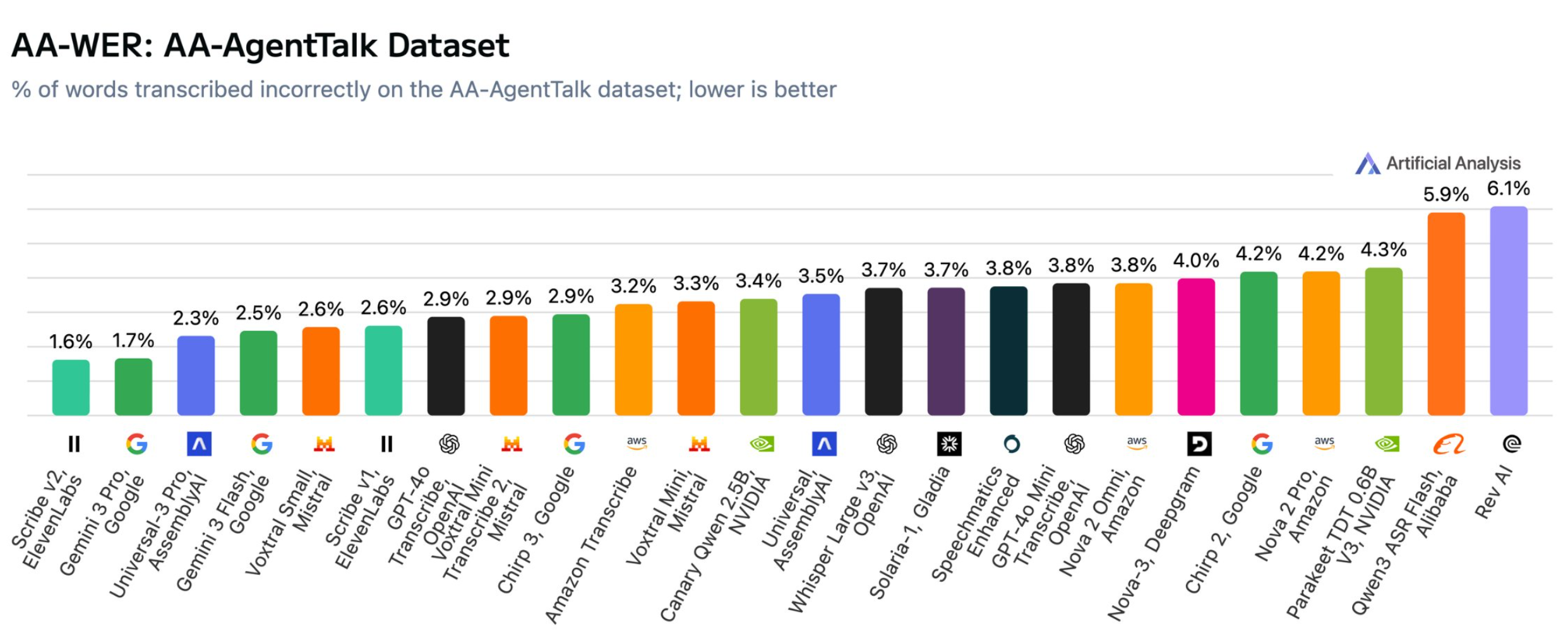
The results hold up in the separate AA-AgentTalk test for speech directed at voice assistants: Scribe v2 (1.6%) and Gemini 3 Pro (1.7%) pull well ahead, with AssemblyAI's Universal-3 Pro taking third at 2.3%.
ElevenLabs' Scribe v2 and Google's Gemini 3 Pro also dominate the AA-AgentTalk voice assistant test with the lowest error rates. | Image: Artificial Analysi
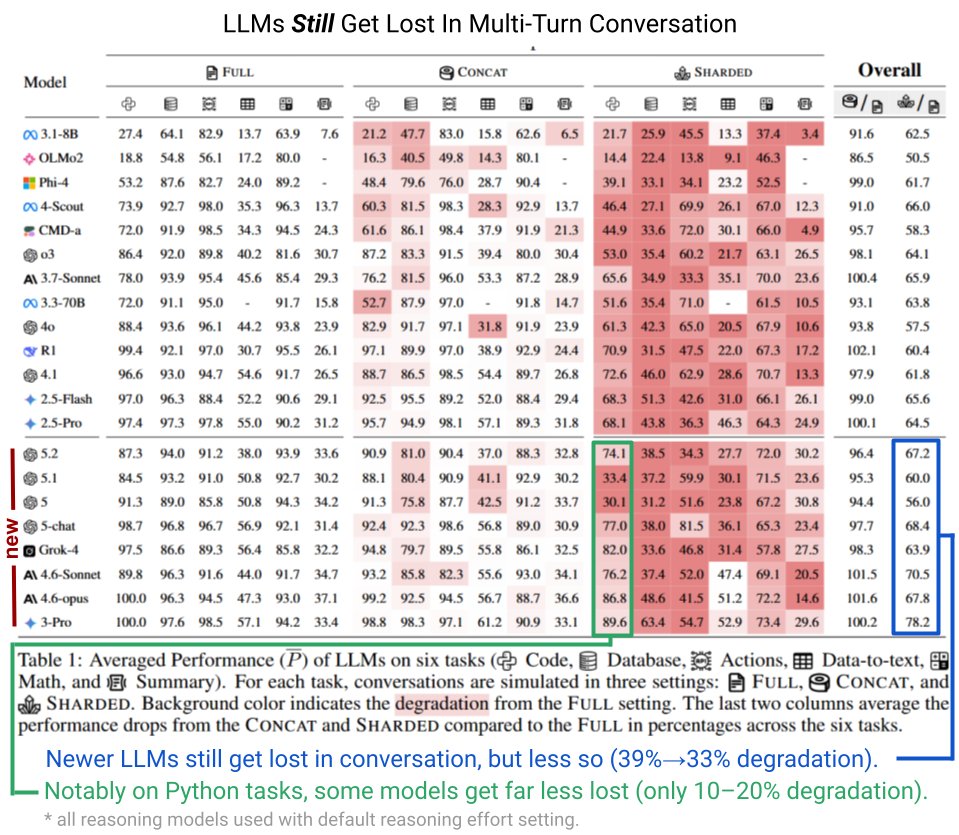
The latest generation of large language models—from GPT-5 onward—still struggles when tasks are spread across multiple conversation turns. Researcher Philippe Laban and his team tested current models on six tasks covering code, databases, actions, data-to-text, math, and summarization. Performance drops significantly when information is split across several messages (sharded) instead of a single prompt (concat).
Newer models did slightly better—performance degradation shrank from 39 to 33 percent—but the issue is far from solved. The biggest gains showed up in Python tasks, where some models only lost 10 to 20 percent. Laban suspects real-world losses could be even worse, since the tests used simple user simulations. Users who change their mind mid-conversation would likely cause steeper drops.
Technical tweaks like lowering temperature values don't fix the problem, the original study found. The researchers recommend starting a fresh conversation when things go sideways, ideally by having the model summarize all requests first and using that summary as the starting point for a new chat.
Anthropic says it will take the US government to court after Secretary of Defense Pete Hegseth moved to classify the AI company as a supply chain risk, a designation previously reserved for foreign adversaries. Anthropic calls the classification illegal and says it will "challenge any supply chain risk designation in court."
We believe this designation would both be legally unsound and set a dangerous precedent for any American company that negotiates with the government.
Anthropic
Hegseth also implied military suppliers should no longer be allowed to do business with Anthropic. But according to Anthropic, there's no legal basis for that move: the classification under 10 USC 3252 only applies to the use of Claude in direct contracts with the Department of Defense. For private customers, commercial contracts, and access through the API or claude.ai, nothing would change.