Singapore's government wants to use authors' works to train a large AI language model, but is facing resistance from writers. The government has requested permission to use published texts for its $52 million National Multimodal LLM Program (NMLP). But many authors and publishers are opposed, citing unresolved issues of compensation and copyright. They are concerned that AI could misuse their works. Without their consent, the NMLP would have to rely on lower quality content, which could negatively impact the model's performance. Authors around the world are increasingly resisting the unauthorized and unpaid use of their texts for AI training. Recently, eight major US publishers sued OpenAI and Microsoft for copyright infringement. OpenAI and other AI companies are currently entering into non-transparent agreements with select publishers to better position themselves for future AI models and ongoing litigation.
The U.S. government is considering new export restrictions on advanced AI models to limit access by China and Russia. According to Japan Times sources, the Commerce Department is considering restrictions on proprietary AI models whose software and training data are kept under wraps. The goal is to prevent U.S. adversaries from using the models for cyberattacks or to develop biological weapons. One criterion could be the computing power required for training. Until now, U.S. companies such as OpenAI have been able to sell their models without restriction. The planned controls complement previous measures such as export bans on AI chips. They would affect back-end software, but not end-user applications like ChatGPT. However, experts question the feasibility of these measures given the rapid pace of AI development. It is estimated that China is only two years behind the US in AI. The Chinese embassy criticized the plans as a "typical act of economic coercion and unilateral bullying, which China firmly opposes."
Microsoft has developed a generative AI model for the U.S. Secret Service that can run without an Internet connection, Bloomberg reports. This is the first time a large-scale language model has been run completely isolated from the cloud, according to William Chappell, Microsoft's CTO for strategic missions and technology. The company spent 18 months working on the system, rebuilding an AI supercomputer in Iowa specifically for the purpose. The static GPT-4 model can read files but cannot learn from them, a design choice intended to prevent classified information from leaking onto the platform. The service went live on Thursday and will now undergo testing and accreditation by the intelligence community. Chappell says the system is already capable of answering questions and writing code.
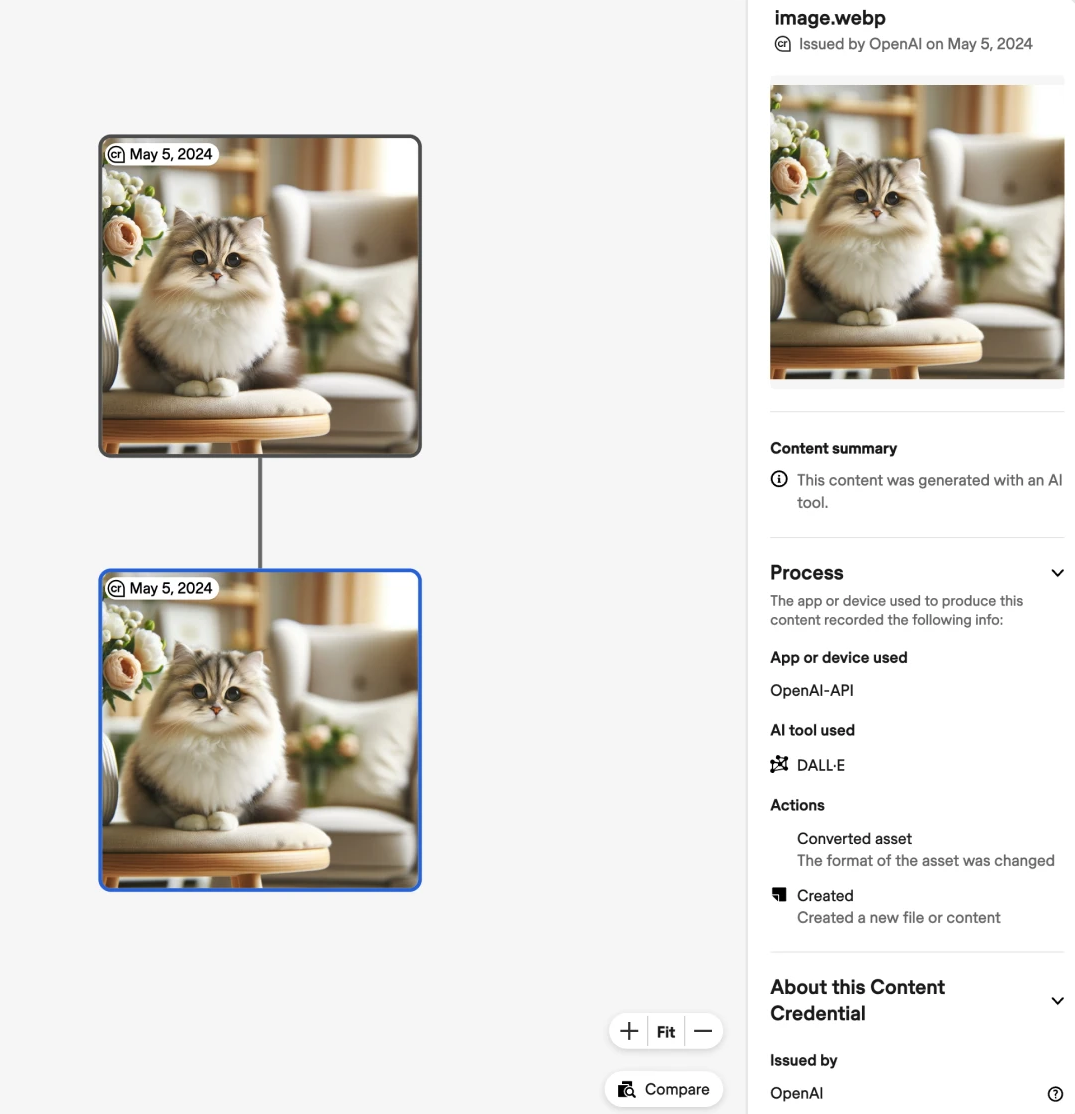
OpenAI supports the C2PA standard for traceability in AI images and provides the first researchers with access to its own AI image classifier. The company joins the C2PA Steering Committee to help develop the digital content traceability standard. OpenAI adds C2PA metadata to DALL-E 3 images and plans to do the same for the Sora video model. In addition to supporting the C2PA standard, OpenAI is developing its own tamper-proof watermarks and AI-based recognition classifiers for detecting AI-generated images. The company has made its DALL-E 3 image classifier available to select research institutions. In internal tests, OpenAI's classifier correctly identified 98 percent of the images generated by DALL-E 3, while mislabeling less than 0.5 percent of non-AI-generated images. However, the classifier identified only 5 to 10 percent of images generated by other AI models as AI-generated. According to OpenAI, collective industry approaches are needed to effectively address the issues associated with AI-generated images.
The research team at Temporal Games has developed a plugin for real-time streaming of volumetric video using Gaussian splatting in Unreal Engine 5. Animated Gaussian splatting makes it possible to represent real events or performances as three-dimensional projections of reality. The challenge lies in the large amount of data required to render the animation. The team was able to reduce the data size by a factor of 15. In a recently published video, the researchers also show how the integrated image can be dynamically lit in real time. The team plans to develop a client-server solution for 4DGS streaming and to make the technology available for games and web platforms.