Google has introduced the Agent Payments Protocol (AP2), a new open standard aimed at enabling AI agents to carry out secure payments across different platforms. AP2 builds on the existing Agent2Agent protocol and supports a wide range of payment methods, including credit cards, stablecoins, and bank transfers.
A key element of the design is digital mandates, which are cryptographic authorizations that lock in user intent. These mandates are intended to ensure that transactions remain verifiable and secure, whether for real-time purchases or automated transactions when the user is not directly involved.
The initiative is already backed by more than 60 companies, among them Mastercard, PayPal, Coinbase, and Adobe. By creating a unified framework, the goal is to establish a standardized and trustworthy system for agent-driven commerce. Google has made the documentation available on GitHub.
OpenAI has hired Mike Liberatore, the former finance chief of Elon Musk's AI startup xAI, as its new head of business finance.
According to the company, Liberatore will oversee OpenAI's rapidly growing budget for data centers and infrastructure. He will report to CFO Sarah Friar and work closely with Greg Brockman's team, which manages contracts and investments tied to OpenAI's compute strategy.
At xAI, Liberatore helped organize a $10 billion funding round and led efforts to expand its data center footprint before leaving the company in July. OpenAI, recently valued at $500 billion, also signed a cloud deal worth $300 billion with Oracle.
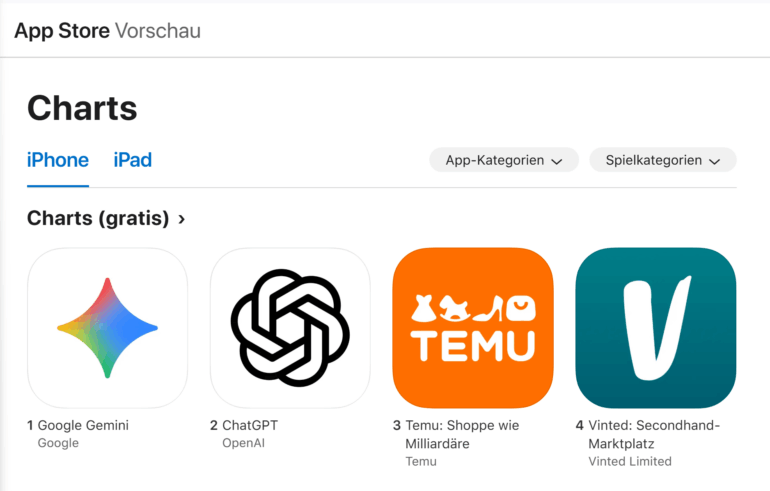
Google’s "Nano Banana" image editing model has gone viral, pushing the Gemini app to the top of the app store charts. In the US, Canada, the UK, and Germany, Google Gemini now holds the number one spot, ahead of ChatGPT at number two.
Gemini in first place in Germany on September 15, 2025 | Image: THE DECODER
According to Google, Gemini reached nearly 450 million monthly active users in July, a number that has likely increased since then. During this time, the "Nano Banana" model, also known as "Gemini 2.5 Flash Image Generation," was used more than 500 million times.