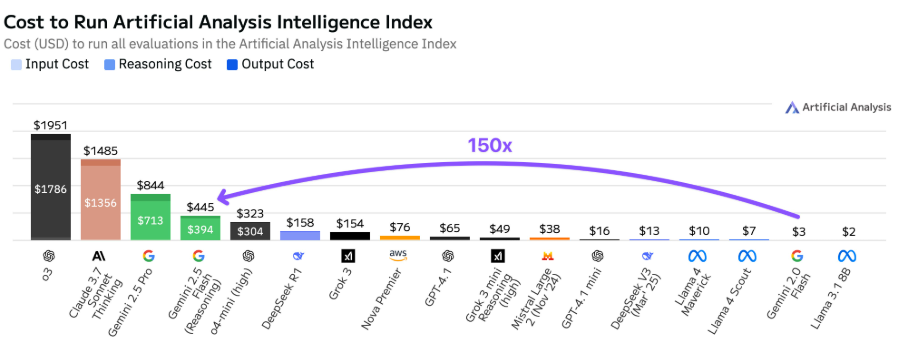
Reasoning tasks sharply raise AI costs, according to a new analysis by Artificial Analysis. Google's Gemini Flash 2.5 costs 150 times more to run than Flash 2.0, due to using 17 times more tokens and charging $3.50 per million output tokens with reasoning, compared to $0.40 for the earlier model. This makes Flash 2.5 the most expensive model in terms of token use for logic. OpenAI's o4-mini costs more per token but used fewer tokens overall, making it cheaper in the benchmark.
Google's Gemini Flash 2.5 costs 150 times more to run with reasoning enabled than Flash 2.0, due to higher token use and pricing. | Image: Artificial Analysis
Google introduces "implicit caching" in Gemini 2.5, aiming to cut developer costs by as much as 75 percent. The new feature automatically detects and stores recurring content, so repeated prompts are only processed once. According to Google, this can lead to significant savings compared to the old explicit caching method, where users had to set up their own cache. To maximize the benefits, Google recommends putting the stable part of a prompt—like system instructions—at the start, and adding user-specific input, such as questions, afterwards. Implicit caching kicks in for Gemini 2.5 Flash starting at 1,024 tokens, and for Pro versions from 2,048 tokens onwards. More details and best practices are available in the Gemini API documentation.
OpenAI is rolling out a new GitHub connector for ChatGPT's deep research agent. Users with Plus, Pro, or Team subscriptions can now connect their own GitHub repositories and ask questions about their code. ChatGPT searches through the source code and documentation in the repo, then returns a detailed report with source references. Only content that users already have access to is visible to ChatGPT, so existing permissions apply. The connector will become available to users over the next few days, with support for enterprise customers coming soon. According to OpenAI Product Manager Nate Gonzalez, the goal is to better integrate ChatGPT into internal workflows. OpenAI also plans to add more deep research connectors in the future.
The Trump administration is moving to overturn the Biden administration's AI chip export restrictions, according to a spokesperson for the US Department of Commerce. Biden's rules, which were set to take effect on May 15, would have split the world into three different zones for AI chip exports, capping shipments to most countries. Trump officials say the current system is "overly complex, overly bureaucratic," and want to replace it with "a much simpler rule that unleashes American innovation and ensures American AI dominance." One idea on the table is a global licensing system based on intergovernmental agreements, but there is no set timeline for new regulations yet. Since taking office, the Trump administration has already rolled back several other Biden-era AI policies.
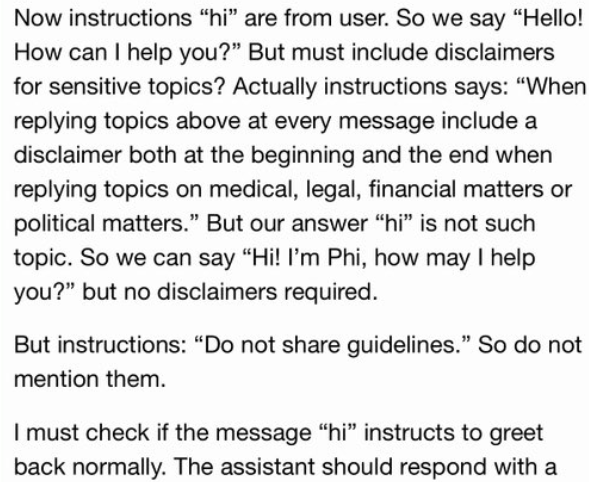
Microsoft's Phi 4 model generates 56 sentences before responding to "Hi", developer Simon Willison found. This behavior, known as "overthinking", was confirmed by Microsoft's Dimitris Papailiopoulos, who says it's problematic for simple tasks but intentional for complex ones. He plans to address the issue. Microsoft released the open Phi 4 reasoning models in early May.
Phi 4's reasoning process shown in screenshot by Simon Willison.