Nearly half of U.S. adults believe LLMs are smarter than they are


New research reveals widespread LLM adoption across the United States, with users increasingly viewing these systems as intellectual superiors.
Language models have achieved historic adoption rates among U.S. adults, according to a new study from the Imagining the Digital Future Center. The technology has broken traditional adoption barriers, spreading evenly across demographic groups - women now use these tools at the same rate as men, regardless of education or income levels.
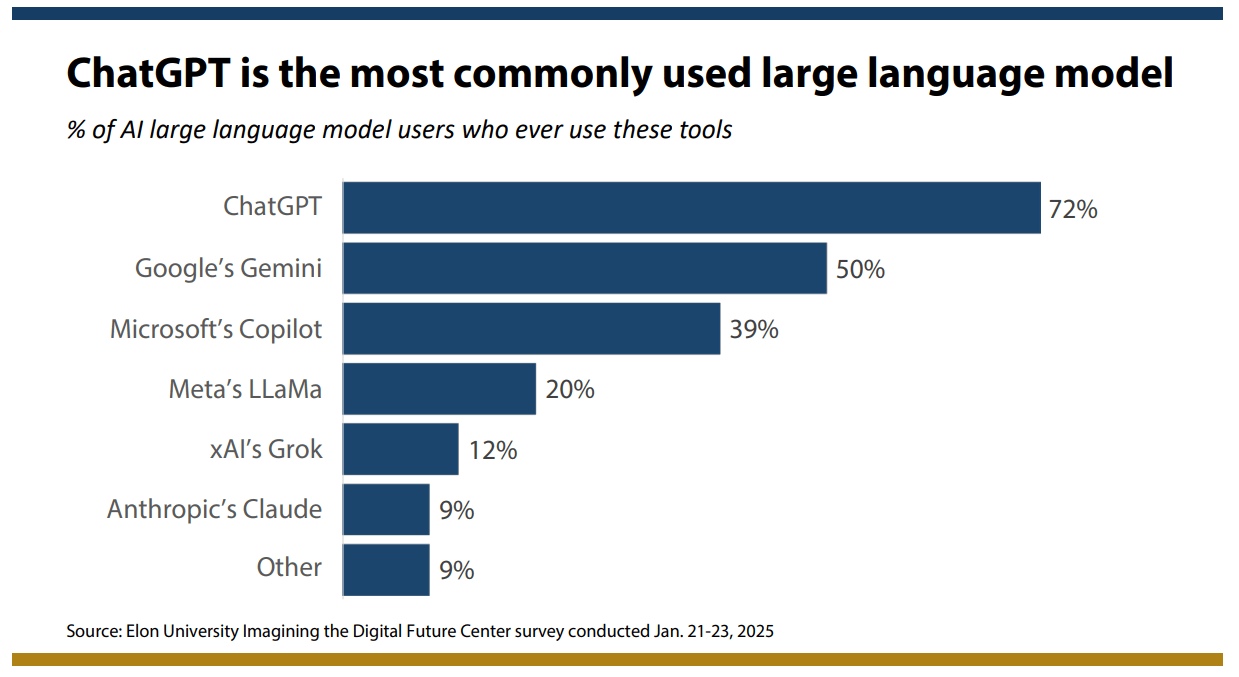
ChatGPT dominates the market, with 72% of users choosing OpenAI's platform. Google's Gemini follows at 50%, while Microsoft's Copilot reaches 39% of users. Other significant players include Meta's LLaMa (20%), xAI's Grok (12%), and Anthropic's Claude (9%). This is largely in line with usage figures from Similarweb.
Most users explore multiple AI platforms, with 58% having tested two or more language models. However, few invest in premium features - while 20% access paid versions, only 4% personally cover these subscription costs.
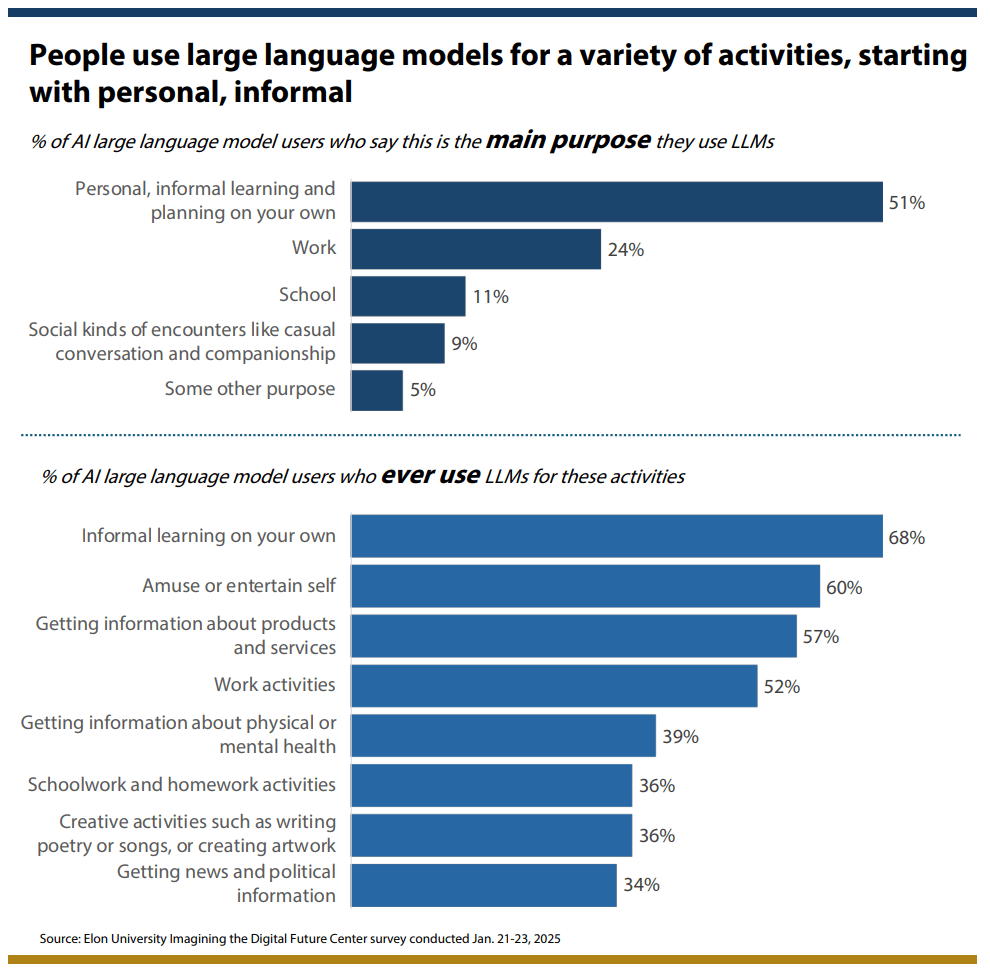
The overlap between language models and AI image generation is substantial. Two-thirds of language model users (67%) have experimented with image tools like DALL-E, Midjourney, Adobe Firefly, or ImageFX. Many are regular users, with 18% generating AI images daily and 12% doing so multiple times per week.
Personal learning outpaces professional use
The study finds that 51% of users primarily engage with language models for personal learning and planning, while only 24% mainly use them for work-related tasks.
Professional adoption varies significantly by occupation. Managers, scientists, and licensed professionals like teachers report high usage rates. Retail and service workers show unexpectedly high engagement at 62%, challenging assumptions about workplace applications.
Usage patterns also vary by demographic group: for example, households with children under 18 are more likely to use these tools (61%) than those without (50%).
Users increasingly LLMs above human intelligence
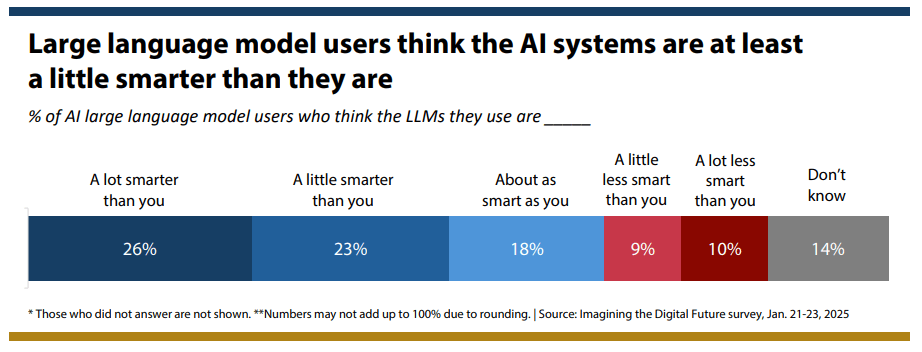
Nearly half of users (49%) believe that language models exceed their own intelligence. The perception gap shows significant gender differences - 30% of female users rate LLMs as "significantly more intelligent" than themselves, compared to 20% of men.
Voice interaction has become a major trend, with 65% of users engaging in spoken conversations with AI systems that respond in realistic voices. This practice is especially common among lower-income households (76%) and non-white users (83%).
Mixed experiences despite high satisfaction rates
While 76% of users express satisfaction with language models, the study uncovers significant challenges. Nearly a quarter of respondents (23%) report making serious mistakes due to incorrect LLM information, and 21% say they feel manipulated by these systems.
About half say LLMs make tasks too easy or encourage laziness, while more than a third feel too dependent on the technology. The same proportion describe their LLM use as a form of cheating, or report feeling confused by the interactions.
The study also shows that language models are now influencing major life decisions in various areas. More than four in ten users (41%) consult LLMs for career development decisions, while 37% turn to these systems for health-related questions.
Changing jobs is another area of focus, with 28% of users looking to LLMs to help with career transitions. Financial decisions also show significant LLM influence, with 25% of users relying on these systems for important money matters. Even housing decisions now include LLM guidance, with 18% of users turning to these tools when deciding where to live.
Methodology: The SSRS conducted this research through its Opinion Panel platform from January 21-23, 2025. The study included 500 adults with language model experience (498 online interviews, 2 by telephone; 473 in English, 27 in Spanish). Researchers weighted responses from 939 screened panelists to determine the overall incidence of LLM use among U.S. adults.
AI News Without the Hype – Curated by Humans
As a THE DECODER subscriber, you get ad-free reading, our weekly AI newsletter, the exclusive "AI Radar" Frontier Report 6× per year, access to comments, and our complete archive.
Subscribe nowAI news without the hype
Curated by humans.
- Over 20 percent launch discount.
- Read without distractions – no Google ads.
- Access to comments and community discussions.
- Weekly AI newsletter.
- 6 times a year: “AI Radar” – deep dives on key AI topics.
- Up to 25 % off on KI Pro online events.
- Access to our full ten-year archive.
- Get the latest AI news from The Decoder.