OpenAI insists its shopping suggestions shouldn't be seen as advertising

Paid ChatGPT users recently reported seeing a prompt labeled "Shop for home and groceries. Connect Target," which appeared to ask them to link their ChatGPT account to OpenAI's retail partner Target. For many users, the message looked like an ad.
But ChatGPT Product Manager Nick Turley pushed back, insisting there are "no live tests for ads" and claiming that the screenshots circulating online "are either not real or not ads." His comments indirectly suggest that internal tests exist, even as he argues that the Target prompt shouldn't be viewed as advertising. It's a position some users find hard to square with what appeared on their screens.
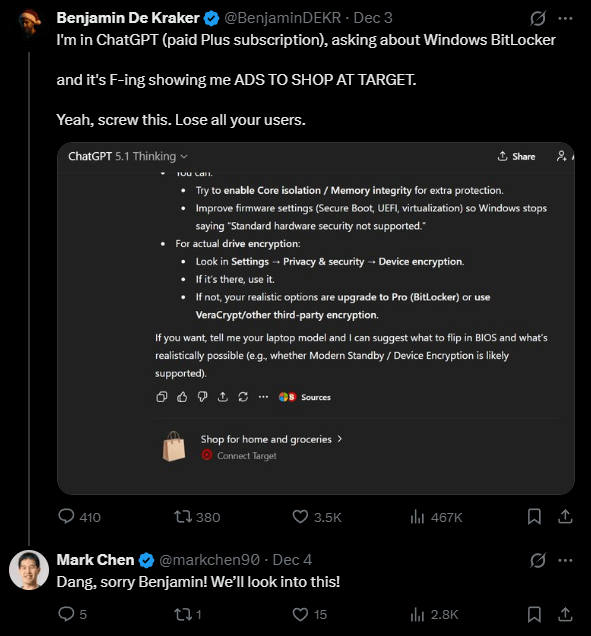
Chief researcher Mark Chen took a more cautious tone, admitting the Target prompt could feel like an ad and noting that these displays need to be handled carefully. According to Chen, OpenAI has already disabled the feature and is now working on improving the model's precision, along with offering settings that let users reduce or completely turn off similar suggestions.
Why is OpenAI splitting hairs over advertising?
The bigger question is why OpenAI is splitting hairs over something that, to most people, clearly looks like ad testing inside ChatGPT. With roughly 95 percent of ChatGPT users on the free tier, OpenAI faces enormous pressure to monetize without alienating the very people who rely on the tool. Targeted shopping prompts would be an obvious path toward revenue, but also a risky one.
Advertising inside a conversational assistant carries a very different risk profile than ads in a search engine. Many people treat ChatGPT as a reliable and even personal adviser, so any suggestion from the model carries more weight than a sponsored link on a search results page.
There's also a historical inconsistency. In the past, CEO Sam Altman openly warned against turning ChatGPT into a vehicle for advertising. He described a future where ChatGPT might tell users "You should think about buying this product" or "You should go here for vacation" as dystopian. Altman emphasized that he preferred a simple business model where paying users weren't the product.
That warning now feels increasingly relevant. OpenAI's new Shopping Research agent already uses ChatGPT's memory system to personalize product recommendations, and internal discussions reported by The Information suggest the company has explored using memory for targeted advertising.
Against that backdrop, even a single shopping prompt inside ChatGPT becomes more than a UI experiment. It highlights the tension between OpenAI’s public stance on advertising and the financial pressure to monetize a massive, mostly free user base.
If OpenAI is preparing to blend recommendations, product research, and commercial partnerships, the company will likely need a clearer public explanation and a more straightforward definition of what it considers advertising.
AI News Without the Hype – Curated by Humans
As a THE DECODER subscriber, you get ad-free reading, our weekly AI newsletter, the exclusive "AI Radar" Frontier Report 6× per year, access to comments, and our complete archive.
Subscribe nowAI news without the hype
Curated by humans.
- More than 16% discount.
- Read without distractions – no Google ads.
- Access to comments and community discussions.
- Weekly AI newsletter.
- 6 times a year: “AI Radar” – deep dives on key AI topics.
- Up to 25 % off on KI Pro online events.
- Access to our full ten-year archive.
- Get the latest AI news from The Decoder.