Google.org, the non-profit arm of Google, is launching a $20 million funding program for non-profit organizations developing generative AI technologies. The six-week "Google.org Accelerator: Generative AI" program will initially support 21 organizations with grants, technical training, workshops and mentors. These include Quill.org, the World Bank and Tarjimly. According to a Google survey, four out of five non-profit organizations see potential in generative AI, but almost half are not yet using the technology due to obstacles such as a lack of expertise and funding. The aim is to use generative AI to help non-profit teams work more productively and effectively for their target groups.
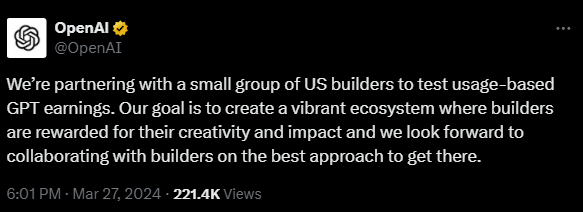
OpenAI is testing a new program that allows US developers to earn money based on the usage of GPT models they create. It was first announced alongside Custom GPTs in November 2023. For now, the AI company has partnered with a small group of developers for this initial test and wants to work with the developer community to determine the best approach for this usage-based compensation model. Details on which developers are participating in the test, the specific terms of revenue sharing, and the timeline for a broader rollout were not disclosed at this time. The announcement comes after reports that GPTs have not been a success so far, and that OpenAI has issues with moderation, political chatbots, and GPT spamming.
Google's Gemini 1.0 Pro chatbot is now available to Google Messages beta testers. To use it, you need to have RCS Messaging enabled, a Google Account, and a newer phone like the Pixel 6 or a newer Samsung Galaxy. Simply start a new Gemini chat in the Google Messages app. Gemini can also access information from Google apps such as Gmail, Maps, Flights, Hotels, and YouTube. Note that chats are not encrypted end-to-end. Gemini over RCS currently works in 165 countries, but not in the European Union. This shows how Google can use its power over Android to get more people using Gemini quickly.