Max is the managing editor of THE DECODER, bringing his background in philosophy to explore questions of consciousness and whether machines truly think or just pretend to.
Tesla unveils the second generation of its Optimus robot. As well as cars, the company is also building a human-like robot that one day might be able to perform many tasks. In a short video, Tesla shows the new Optimus Gen 2, whose design is now closer to the original vision. The robot now has Tesla-developed actuators and sensors, faster and more capable hands with tactile sensors, a 30% faster walking speed, lower overall weight, and an articulated neck.
Nvidia, the world's most valuable chipmaker, has become one of the leading investors in AI start-ups this year, having invested in over two dozen companies. According to Dealroom, Nvidia participated in 35 deals in 2023, nearly six times more than last year, making it the most active large-scale investor in AI. Nvidia's investments total $872 million, over ten times its investment in the same period last year, the Financial Times reports. The companies Nvidia invests in all use its technology, with its portfolio now including Inflection AI, Cohere, Hugging Face, and CoreWeave. Nvidia's latest investment was in Paris-based AI start-up Mistral.
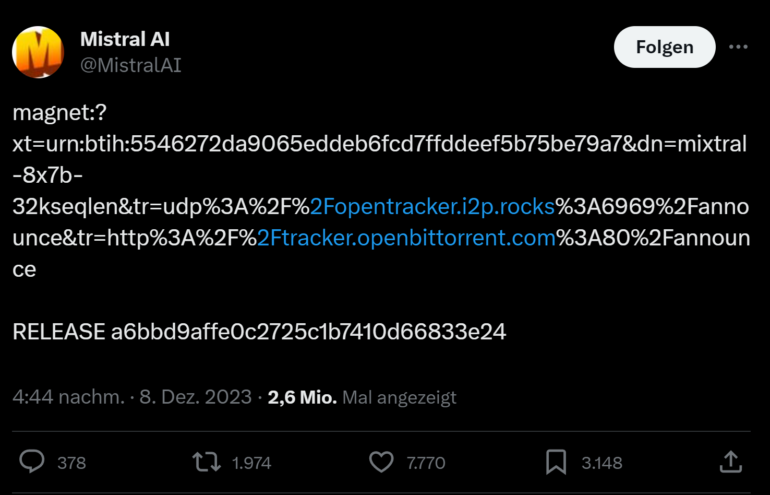
French startup Mistral AI has released its new language model Mixtral 8x7B via a torrent link. Mixtral is a mixture-of-experts model, following an architecture that OpenAI is rumored to be using for GPT-4, but on a much larger scale.
There are no benchmarks, blog posts, or articles about the model yet, but Mistral-7B — the first version of Mistral AI — generally performed very well and was quickly adopted by the open-source community. Mistral is thought to have used the MegaBlocks MoE library for training. The Paris-based company was recently valued at nearly $2 billion.