The White House has reportedly put a hold on a draft executive order that would have let federal law override state-level AI regulations. According to Reuters, the draft called for the Department of Justice, led by Pam Bondi, to form a task force that could challenge states with stricter AI rules. The plan would have shifted full authority for AI legislation to the federal government. Critics warned that this approach threatened consumer protections and states' rights.
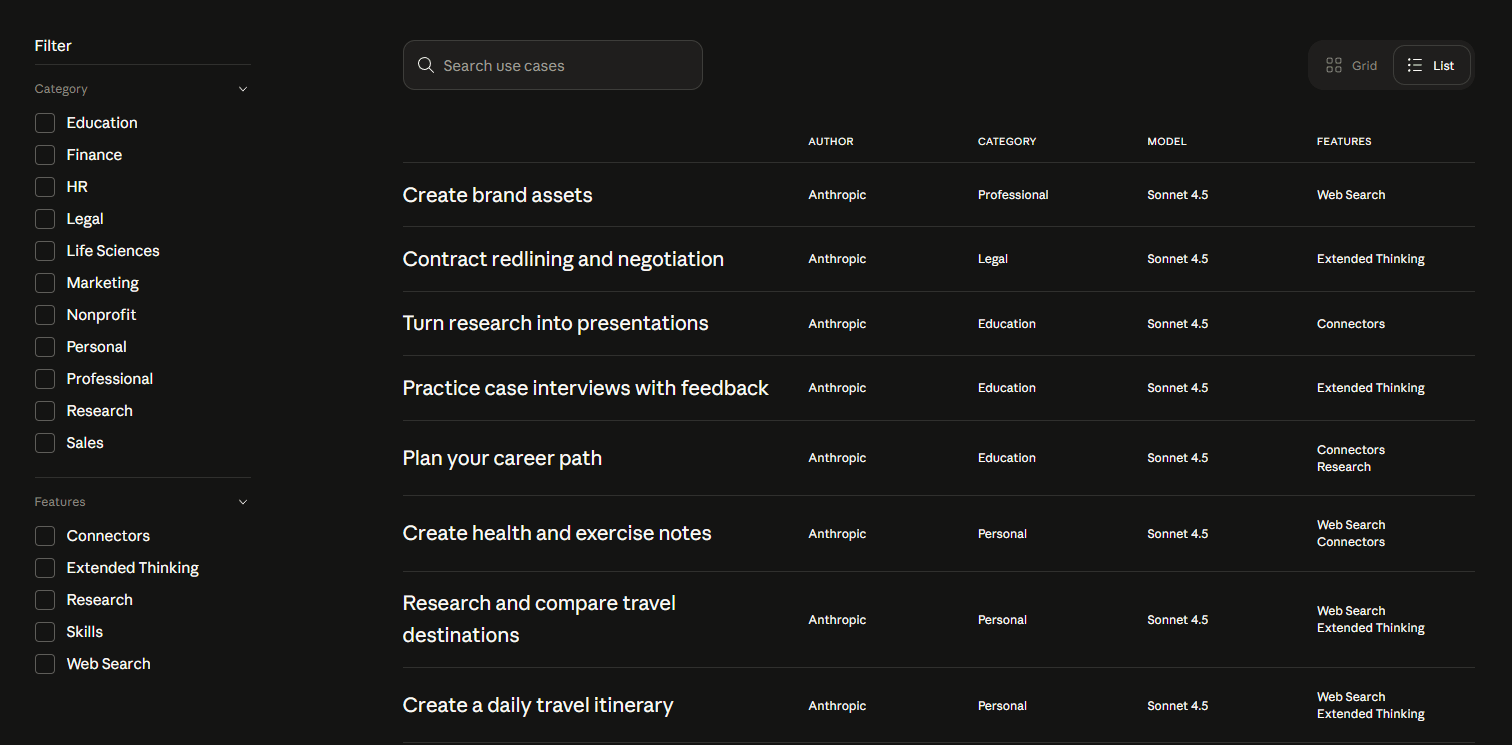
Anyone looking for practical ways to use generative AI can browse Claude's use case collection. The company's website offers an overview of specific tasks, covering everything from contract analysis and marketing materials to trip planning and job interview prep. The examples are sorted into categories like Education, Personal, and Professional, each linking to step-by-step instructions.
A look at Claude's use-case library, which spans education, personal projects, legal work, and professional tasks. | Image: Anthropic
The prompts themselves are fairly generic, so users will need to adapt them to their own projects. Still, having a starting point can sometimes help more than fine-tuned prompt engineering. Often it's simply about having the idea in the first place.
OpenAI is rolling out "ChatGPT for Teachers," a free version of its AI chatbot for verified K-12 teachers in the United States. The offer runs through June 2027 and includes a secure workspace that, according to the company, does not use data for model training by default. OpenAI says teachers are already seeing time savings in lesson planning and other daily tasks.
"Every student today is growing up with AI, and teachers play a central role in helping them learn how to use these tools responsibly and effectively."
OpenAI
The platform meets US privacy standards like FERPA and gives teachers access to the GPT-5.1 Auto model along with integrations for Canva and Google Drive. School administrators can manage and assign licenses centrally. OpenAI is also partnering with groups like the American Federation of Teachers to help educators learn how to use the technology effectively.