Skip to content
Read full article about: Huawei is open sourcing AI models from its Pangu series

Huawei is open sourcing models from its Pangu series. The release includes the Pangu 7B language model with 7 billion parameters, the larger Pangu Pro MoE model with 72 billion parameters, and a model execution technology optimized for Huawei's Ascend chips. The weights for Pangu Pro MoE 72B, along with the base inference code and tools for large-scale MoE models, are already available on GitCode. Huawei says the Pangu 7B model will be released soon. The announcement comes after Baidu open sourced its Ernie model 4.5.

Read full article about: Elon Musk's AI company xAI raises 10 billion US dollars in capital

Elon Musk's AI company xAI has raised $10 billion in funding, split evenly between equity and debt, according to The Information. Morgan Stanley, which handled the debt financing, said the mix lowers capital costs and gives xAI broader access to funding. The bank did not disclose details about the investors involved. Back in December, xAI secured $6 billion from backers including Andreessen Horowitz, BlackRock, Lightspeed Venture Partners, and MGX to build AI data centers and further develop Grok, its competitor to ChatGPT. xAI later acquired Musk's platform X through a share swap, pushing the company's valuation to $113 billion.

Read full article about: LLM search optimization seems to mirror strategies used in classic SEO, study finds

The ERGO Innovation Lab and ECODYNAMICS teamed up to analyze how insurance content shows up in AI-powered search. Their study looked at over 33,000 AI search results and 600 websites, focusing on which types of content large language models like ChatGPT tend to surface. The results show that LLMs favor content that is easy to read, well-structured, and trustworthy - all traits associated with classic SEO. Modular content, presented in a question-and-answer style, and well-linked internally is also more likely to show up in AI-generated answers, just as in classic SEO.

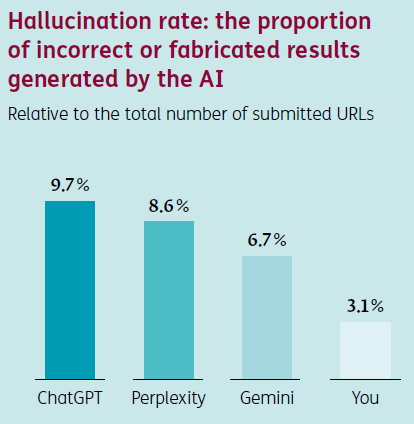
Image: Ergo Innovation Lab

The study also looked at hallucination rates. ChatGPT had the highest rate, with just under ten percent of its responses containing inaccuracies, while you.com delivered much more reliable results. These findings apply specifically to insurance-related queries.