Ad
Skip to content
Read full article about: OpenAI's "Sweetpea" AI wearable allegedly takes aim at Apple's Airpods

A new leak reveals details about OpenAI's planned hardware, an audio device designed to compete with Apple's Airpods. X and Weibo leaker "Smart Pikachu" claims OpenAI is developing a device codenamed "Sweetpea" with designer Jony Ive reportedly involved. The alleged September launch targets 40 to 50 million units in year one.

The device supposedly features an oval metal housing with two capsule-shaped components worn behind the ear, running on a 2nm chip with Samsung Exynos as the frontrunner. A separate chip would enable iPhone control through Siri. Material costs are reportedly close to smartphone level.

Die Komponenten von "Sweetpea": ein EMG-Signalfenster zur Erkennung von Muskelsignalen, ein Keramik-Hautkontaktfenster, Hauptplatine mit Lithium-Ionen-Akku sowie ein Ultraschall-Sende-/Empfangsmodul. | Bild: via zhihuipikachu
The leaked diagram shows "Sweetpea's" alleged components: EMG signal window, ceramic skin contact window, mainboard with lithium-ion battery, and ultrasonic transmitter/receiver module. | Image: via zhihuipikachu

If the leak proves accurate, Foxconn could produce up to five OpenAI devices by 2028, including a pen codenamed "Gumdrop." The manufacturer reportedly sees this as a chance to recover after losing all Airpods programs to Luxshare. OpenAI allegedly favored Luxshare initially but switched to Foxconn to enable production outside China.


Read full article about: Microsoft pledges to cover data center power costs as community pushback grows

Microsoft is rolling out a new initiative for AI data centers after facing mounting opposition from communities across the US. The company says it will fully cover the power costs of its data centers, ensuring residents won't see higher electricity bills as a result. The announcement comes as data center regions like Virginia, Illinois, and Ohio have seen electricity prices climb 12-16 percent faster than the national average.

Beyond power costs, Microsoft is making several other commitments: the company will stop requesting local tax breaks, cut water consumption by 40 percent by 2030, and replenish more water than it uses. Microsoft President Brad Smith told GeekWire that the industry used to operate differently and now needs to change its approach. Trump previewed the announcement on Truth Social before Microsoft made it official.

As part of the initiative, Microsoft also plans to train local workers and invest in AI education programs in affected communities.

Read full article about: Anthropic's Claude Cowork was built in under two weeks using Claude Code to write the code

Anthropic's Claude Code inventor says his tool wrote almost all the code for Claude Cowork. Claude Cowork is a newly launched AI tool from Anthropic that builds on Claude Code but adds a user-friendly interface for non-programmers. According to Claude Code inventor Boris Cherny, "pretty much" all the code was generated using Claude Code.

Claude Code inventor Boris Cherny says his tool wrote nearly all the code for Claude Cowork. | Screenshot via X

Product Manager Felix Rieseberg says the app came together in just a sprint and a half, roughly one and a half weeks. The team had already built some prototypes and explored ideas beforehand, though, and the current release is still a research preview with a few rough edges, Rieseberg says. Claude Code also provided an extensive foundation to build on; Rieseberg is likely referring mainly to the front-end work.

Read full article about: OpenAI acquires Torch to build a "medical memory for AI"

OpenAI is buying health app Torch for around 100 million dollars. The deal includes 60 million upfront and the rest in retention shares, The Information reports. Torch unifies scattered health records into what the founders call a "medical memory for AI", "a context engine that helps you see the full picture, connect the dots, and make sure nothing important gets lost." The app runs on OpenAI models. All four employees, including CEO Ilya Abyzov, are joining OpenAI.

The deal signals OpenAI's push toward a personalized health assistant in ChatGPT. Last week, the company launched a ChatGPT Health section and an offering for healthcare companies. Anthropic recently added health features to Claude as well. The moves reflect a shared bet on a massive market: hundreds of millions of weekly chatbot conversations already focus on health.

Read full article about: Chinese AI industry admits US remains ahead for now

Leading figures in China's AI industry are tempering expectations: China won't overtake the US in the AI race anytime soon. Justin Lin, head of Alibaba's Qwen model series, puts the odds of a Chinese company surpassing OpenAI or Anthropic in the next three to five years at less than 20 percent. Tang Jie from Zhipu AI warned at the AGI Next Summit in Beijing that the gap with the US may actually be widening, though recent open-source releases suggest otherwise.

At the conference, executives cited limited computing capacity and US export controls on advanced chips as key hurdles. US infrastructure is one to two orders of magnitude larger, forcing Chinese companies to focus resources on current projects.

Yao Shunyu, a former OpenAI researcher and now Tencent's AI chief scientist, was more optimistic. He cited three to five years as a realistic timeframe for China to catch up but said the lack of advanced chipmaking machines was the main technical hurdle.

The cautious outlook follows a strong week on the stock market. Startups Zhipu AI and MiniMax Group together raised over one billion dollars in Hong Kong, with MiniMax shares doubling on their first day of trading.

Read full article about: Convogo's founders join OpenAI to close the gap between AI potential and actual use

OpenAI is bringing in the team behind Convogo, an AI startup that built software for evaluating executives, as part of its broader cloud strategy. Founder Matt Cooper announced the news on LinkedIn. Convogo's software used AI to automatically analyze interviews, surveys, and psychometric tests.

According to OpenAI (via Techcrunch), the acquisition is about the people, not the product. The three founders, Matt Cooper, Evan Cater, and Mike Gillett, will help drive OpenAI's AI cloud efforts. The deal was settled entirely in shares, though the amount remains undisclosed. Convogo's software is being shut down.

The founding team's strong product focus likely made them attractive. Cooper writes that the key to closing the gap between AI's potential and its actual use lies in well-designed, purpose-driven applications, a "usage gap" narrative that Microsoft and OpenAI have both pushed before.

The acquisition also fits OpenAI's strategy of controlling the entire value chain, from infrastructure to models to the end product. This push likely reflects how differentiating on model capabilities alone is getting harder as performance converges and cheaper open-source alternatives catch up.

Read full article about: OpenAI reportedly sets aside $50 billion for employee stock program

Last fall, OpenAI reportedly set aside a stock pool for employees worth about ten percent of the company. Based on the $500 billion valuation from October 2024, that comes to around $50 billion, according to The Information, citing two people familiar with the plans.

OpenAI has also already issued $80 billion in allocated shares. Combined with the new stock pool, employees now own about 26 percent of the company. Meanwhile, OpenAI is in early talks with investors about a new funding round worth roughly $750 billion.

A previous analysis found that OpenAI pays its employees more than any tech startup in history, with stock-based compensation averaging about $1.5 million per employee. That level of spending complicates the path to profitability: the company is targeting around $20 billion in ARR. But on top of hefty payroll, development costs, and day-to-day operations, OpenAI faces about $1.4 trillion in data center commitments over the next eight years.

Read full article about: Global AI compute hits 15 million H100 equivalents, Epoch AI finds

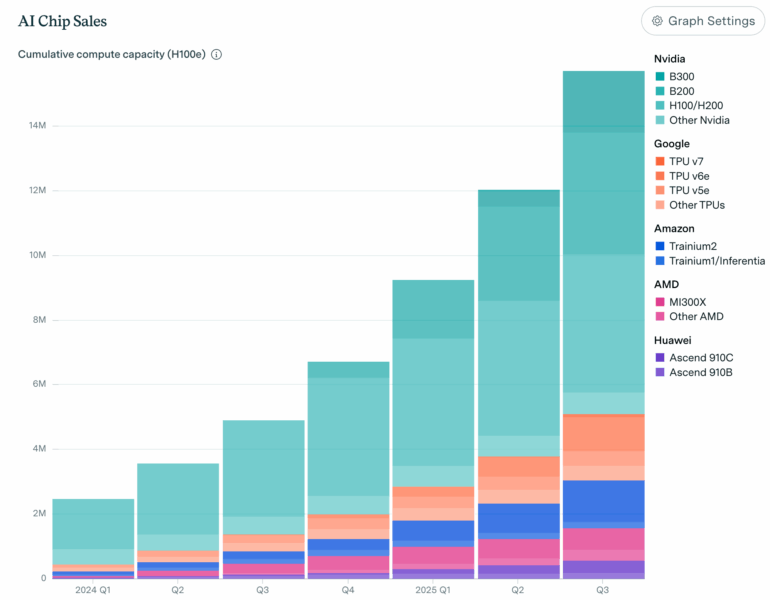
Epoch AI has released a comprehensive database of AI chip sales showing that global computing capacity now exceeds 15 million H100 equivalents. This metric compares the performance of various chips to Nvidia's H100 processor. The data, published on January 8, 2026, reveals that Nvidia's new B300 chip now generates the majority of the company's AI revenue, while the older H100 has dropped below ten percent. The analysis covers chips from Nvidia, Google, Amazon, AMD, and Huawei.

Epoch AI estimates this hardware collectively requires over 10 gigawatts of power - roughly twice what New York City consumes. The figures are based on financial reports and analyst estimates, since exact sales numbers are often not disclosed directly. The dataset is freely available and aims to bring transparency to computing capacity and energy consumption.

Read full article about: Musk's lawsuit against OpenAI heads to trial

Elon Musk's lawsuit against OpenAI and CEO Sam Altman is going to trial. A California federal judge announced Wednesday that she intends to reject attempts by Altman's lawyers to dismiss the case. Judge Yvonne Gonzalez Rogers said during the hearing in Oakland that there is ample evidence to proceed.

Musk accuses OpenAI of deceiving him about its shift from a nonprofit to a for-profit structure. He says he donated $38 million to the company. The trial is scheduled for March. OpenAI denies the allegations, calling the lawsuit baseless and part of ongoing harassment by Musk.

The company claims Musk was informed about its profit plans back in 2018. Musk co-founded OpenAI in 2015 and left the company in 2018.

Read full article about: Minimax stock doubles on Hong Kong debut

Shares of Chinese AI startup Minimax doubled in value during their Hong Kong Stock Exchange debut. The stock closed up 109 percent at 345 Hong Kong dollars, CNBC reports. Minimax significantly outperformed local rival Zhipu AI, whose shares gained just 13 percent the day before. The IPO raised around $620 million for Minimax.

The company, backed by Alibaba and Tencent, develops language models for chatbots and video generation. Despite having over 200 million users and revenue jumping to $53.4 million, Minimax reported a $512 million loss for the first nine months of 2025. The company says it's funneling earnings into research. Meanwhile, Disney, Universal, and Warner Bros have been suing Minimax for copyright infringement since September 2025.

Comment Source: CNBC