Disney pulls out of OpenAI partnership after Sora app and API gets killed just months after launch

Key Points
- OpenAI is shutting down its Sora AI video app and API, with the Sora team thanking the community and promising more details on timelines and how users can save their created work.
- Disney is pulling out of its partnership with OpenAI, which was only signed in December and included a $1 billion investment along with licensing Disney characters for use in Sora.
- The discontinuation likely stems from multiple factors: Sora's app rankings plummeted after an initial viral launch, Chinese competitors offered better video models at lower prices, and OpenAI faced copyright infringement concerns alongside a growing need to refocus on its B2B business.
Update –
- According to an internal memo, Sora won't be coming to ChatGPT either, because OpenAI needs the compute resources more urgently for its core priorities.
- The Sora research team will shift its focus to long-term research on world models.
OpenAI is shutting down its Sora app and API. In response, Disney is pulling out of the partnership the two companies signed just last December.
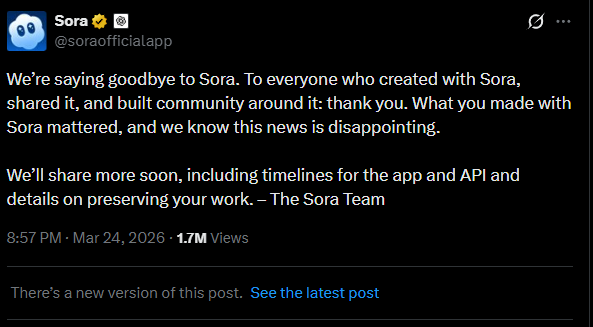
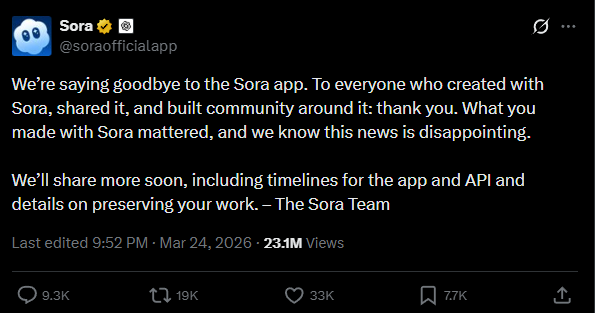
OpenAI has announced that it's discontinuing its Sora AI video app. "We are saying goodbye to the Sora app. To everyone who created with Sora, shared it, and built a community around it: thank you," the Sora team wrote. The company says it will share more details soon, including timelines for the app and API shutdown, along with instructions for backing up any work users created.
It's still unclear what this means for OpenAI's broader video AI plans. The company initially posted a farewell to "Sora" entirely, then edited the wording to "Sora app." That distinction suggests the underlying Sora video model isn't completely dead.
Recently, there have been rumors that Sora will be integrated into ChatGPT as a video feature, as part of a planned "super app." According to the Hollywood Reporter, that's still the plan. The Information, however, reports that the idea has been shelved.
Disney walks away from a billion-dollar OpenAI deal
The fallout was immediate: Disney is pulling out of the deal it signed with OpenAI in December. Disney had agreed to invest one billion dollars in OpenAI and license some of its characters for use in Sora. The goal was to integrate the technology into Disney+.
"As the nascent AI field advances rapidly, we respect OpenAI’s decision to exit the video generation business and to shift its priorities elsewhere," a Disney spokesperson told the Hollywood Reporter, adding that Disney wants to continue working with AI platforms to "find new ways to meet fans where they are while responsibly embracing new technologies that respect IP and the rights of creators."
Sora's turbulent history ends as a footnote
The Sora app only launched in fall 2025 and immediately rattled Hollywood. The platform allowed free use of established intellectual property and well-known actors' likenesses, forcing OpenAI to backpedal within days. Studios and talent eventually got more control over their rights and likenesses on the platform.
OpenAI likely had several reasons for pulling the plug on Sora. The app completely tanked in the app charts after a viral launch. OpenAI CEO Sam Altman said at launch that the app would be discontinued if it didn't satisfy users. That lack of traction was probably the deciding factor—OpenAI wouldn't be killing it if it were growing fast.
But other factors likely played a role too. OpenAI has been shifting its strategy toward B2B lately, where rival Anthropic has been gaining ground. Video models in particular burn through massive compute resources that could be redirected toward research, development, and more profitable enterprise products.
OpenAI CFO Sarah Friar framed the decision as a resource problem. "We just are facing a lack of compute," Friar told CNBC. "We're having to make those really difficult decisions. Often we hold back models, we don't release features. And this was an example of having to prioritize." She added that the move doesn't mean OpenAI is done with creative tools for good: "It's not a 'never.' It's just a, 'We have to make hard choices.'"
Legal pressure added to the mix. OpenAI faced early pressure over copyright issues, the technical challenges of content moderation, and fierce competition from Chinese video models that were already outperforming Sora at lower prices. Chinese providers also largely sidestep Western copyright rules. Google, meanwhile, has made strong progress in video with its Veo models and leads in image generation thanks to Nano Banana. OpenAI would have had to invest heavily just to keep up.
What happens to Sora's world model research
The big remaining question is what happens to the research thesis behind Sora. When OpenAI first unveiled the model in spring 2024, it described Sora as a "world simulator" that could help train advanced AI—a key step toward artificial general intelligence.
Of course, OpenAI can keep pursuing this research without the pressure of turning the video model into a commercial product. But OpenAI's own track record shows a direct link between research depth and product success.
According to an internal memo seen by The Information, the Sora research team will now focus entirely on long-term world model research ("systems that deeply understand the world by learning to simulate arbitrary environments at high fidelity"), with the goal of "automating the physical economy."
AI News Without the Hype – Curated by Humans
As a THE DECODER subscriber, you get ad-free reading, our weekly AI newsletter, the exclusive "AI Radar" Frontier Report 6× per year, access to comments, and our complete archive.
Subscribe now