Ad
Skip to content
Read full article about: OpenAI's new GPT-5.4 model powers ChatGPT for Excel with finance-optimized reasoning

OpenAI is launching "ChatGPT for Excel," a beta add-in that lets users create, edit, and analyze spreadsheets through natural language. The tool runs on the new GPT-5.4 model, which OpenAI says is specifically optimized for financial tasks like modeling, scenario analysis, and data evaluation.
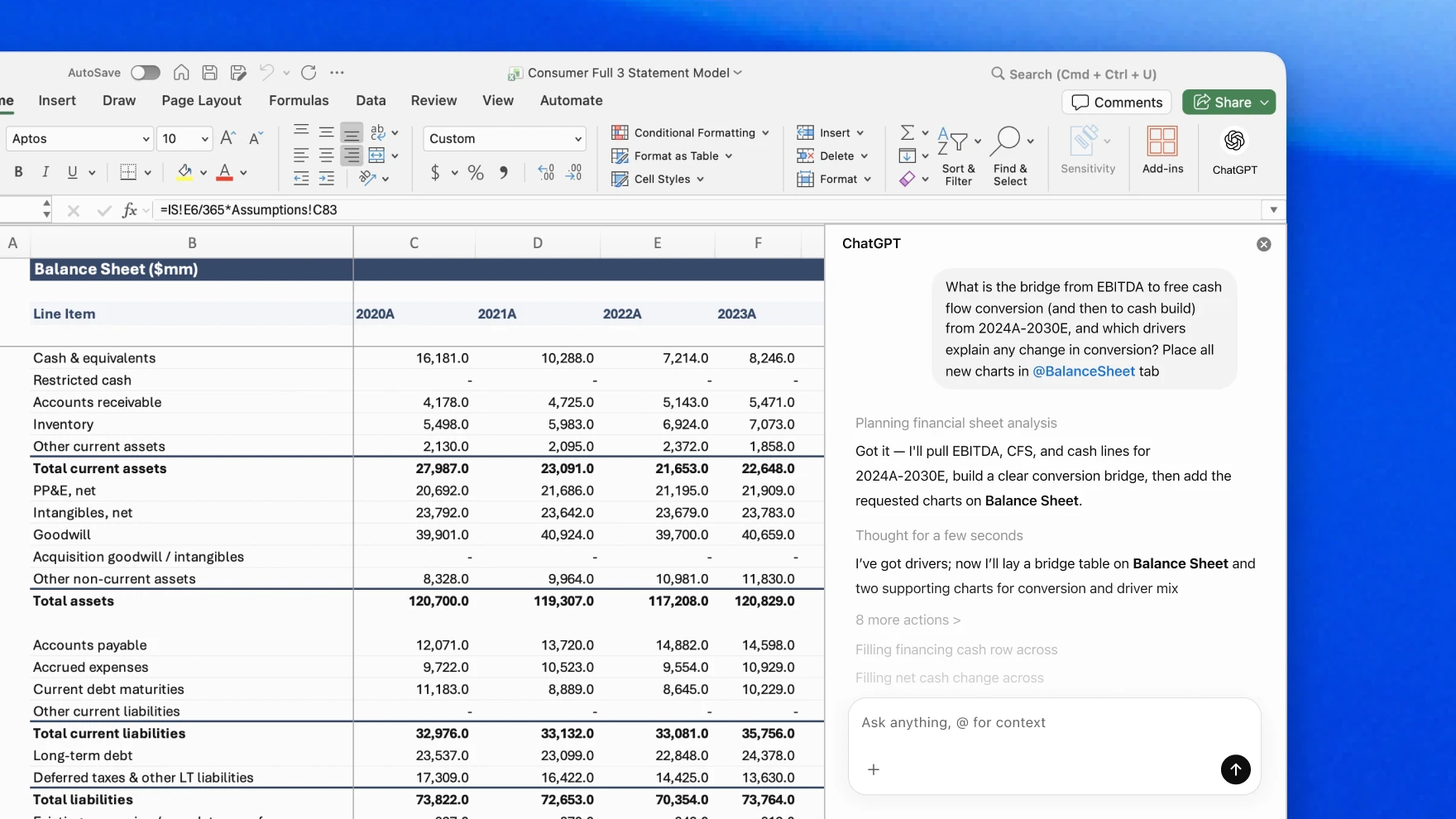
ChatGPT running as an add-in inside Microsoft Excel. The left side shows a balance sheet with financial data from 2020 to 2023, while the right panel shows ChatGPT responding to a cash flow analysis question and making changes directly in the worksheet. | Image: OpenAI

OpenAI tested its own models alongside Opus 4.6 on an internal benchmark designed to evaluate real investment banking tasks, such as building a three-statement model with correct formatting and sources.

Model Average Score (higher is better)
GPT-5 0,437
GPT-5.2 Thinking 0,684
GPT-5.2 Pro 0,717
GPT-5.4 Thinking 0,873
Opus 4.6 0,641

OpenAI is also rolling out financial data connections for providers like FactSet, Moody's, S&P Global, and LSEG. ChatGPT for Excel is initially available in the US, Canada, and Australia for Business, Enterprise, Pro, and Plus users. A version for Google Sheets is planned to follow.

Read full article about: Oracle to cut thousands of jobs as AI spending drains cash

Oracle is planning to cut thousands of jobs to manage the massive costs of its AI data center expansion, Bloomberg reports. The cuts will affect multiple divisions and could be implemented as early as March. Some reductions target job categories the company expects to need less due to AI. Oracle had around 162,000 employees worldwide as of the end of May 2025. Under Chairman Larry Ellison, Oracle is investing heavily in data centers for AI customers like OpenAI.

Analysts expect the company's free cash flow to turn negative in the coming years before the spending starts to pay off around 2030. In February, Oracle announced plans to raise up to $50 billion this year through debt and equity sales. The stock has fallen 54 percent from its September 2025 high. Oracle had already disclosed in September a restructuring plan costing up to $1.6 billion – the largest in the company's history.

Read full article about: Anthropic says Claude is adding over a million new users every day

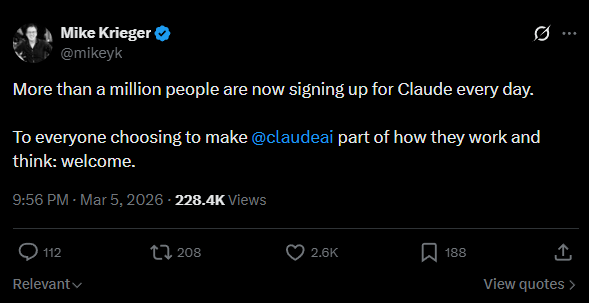
Anthropic's AI chatbot Claude is adding more than a million new users daily. Mike Krieger shared the milestone on X. The Instagram co-founder joined Anthropic in 2024, initially as Chief Product Officer, and now leads the AI lab's new experiments division.

Mike Krieger announced that more than a million people are signing up for Claude every day. | Image: Anthropic

The surge likely has several drivers. In the consumer space, Anthropic has benefited from the ongoing Pentagon controversy, where the company is widely considered the moral winner compared to OpenAI.

At the same time, AI adoption is growing across the board. Since October 2025, annualized revenue for both companies is estimated to have roughly doubled—from $13 billion to $25 billion for OpenAI, and from $7 billion to $19 billion for Anthropic. That said, both companies are still burning through cash, with massive costs and liabilities offsetting those revenue figures.

ChatGPT users research products but won't buy there, forcing OpenAI to rethink its commerce strategy

OpenAI wanted to turn ChatGPT into a shopping destination, but only about a dozen retailers signed up and users weren’t buying. Now the company is handing off purchases to app partners like Instacart and Target.

Read full article about: Google Search quietly becomes an AI assistant as Canvas feature launches for US users

Google is expanding its AI-powered search into the workplace. The company has rolled out the "Canvas" feature in AI mode for all users in the US. Canvas is a workspace built into Google's chat systems that lets users organize projects and plans over time. ChatGPT and Claude offer similar functionality.

The update also adds support for creative writing and coding tasks. Users can create documents or build interactive tools and dashboards directly within search: just type in a prompt, and Google generates a working prototype that pulls together current web information and data from Google's Knowledge Graph. Results can be tested, code viewed, and everything refined through chat. The feature is available now at google.com/ai in the US.

With Canvas, AI mode is looking more and more like the Gemini app. Google seems to be gradually unifying its chat offerings, adding features that blur the line between search and a full AI assistant. At some point, AI mode and Gemini could merge into a single product, giving Google its own direct equivalent to ChatGPT.

Yann LeCun wants to replace the AGI concept with "Superhuman Adaptable Intelligence"

A new paper by researchers at Columbia University and NYU, including Yann LeCun, argues that AGI is a flawed concept. Human intelligence is not general, they say, but specialized. Instead, they propose the term “Superhuman Adaptable Intelligence”.

Read full article about: Apple puts AI disclosure responsibility on labels and distributors

Apple Music is rolling out Transparency Tags that let labels and distributors flag AI-generated content across four categories: Artwork, Tracks, Compositions, and Music Videos. Music Business Worldwide reported the news, citing a newsletter to industry partners. The tags are optional for now but will become mandatory later - putting disclosure responsibility on suppliers, not the platform.

Per Apple's spec, labeling is required when AI generates a "material portion" of the content. The "Composition" tag covers lyrics too, not just melody or instrumentation. "Artwork" applies at the album level, including animated covers, while "Track," "Composition," and "Music Video" are defined per song.

The timing matters. Suno recently hit $300 million in annual revenue but faces a legal battle with the music industry. Universal Music struck a deal with Udio, focusing on licensed AI partnerships. And AI songs are reaching more users than ever - Google recently integrated its music generator Lyria 3 directly into the Gemini app.

Read full article about: Alibaba's chief AI developer quits, taking key team members with him

Alibaba's lead AI researcher Junyang Lin has unexpectedly resigned. Lin was the driving force behind Alibaba's Qwen model series and shaped the company's open-source strategy. According to Chinese technology portal 36Kr, several core team members followed him out the door, including Binyuan Hui (Qwen coder), Bowen Yu (post-training), and Kaixin Li (Qwen 3.5/VL). A number of younger researchers reportedly also quit on the same day.

via X

Alibaba CEO Eddie Wu accepted Lin's resignation and announced a new "Foundation Model Task Force," which he will lead alongside CTO Zeming Wu and Jingren Zhou, The Information reports. The company says it plans to double down on open source and ramp up AI investments. "In technology, standing still means falling behind," Wu wrote in a memo to the team. "In technology, standing still means falling behind. Advancing foundation models is a core strategic priority for our future."