Ad
Skip to content
Read full article about: Anthropic's head of Safeguards Research warns of declining company values on departure

Anthropic is starting to feel the OpenAI effect. Growing commercialization and the need to raise billions of dollars is forcing the company into compromises, from accepting money from authoritarian regimes and working with the US Department of Defense and Palantir to praising Donald Trump. Now Mrinank Sharma, head of the Safeguards Research Team—the group responsible for keeping AI models safe—is leaving. In his farewell post, he suggests Anthropic has drifted away from its founding principles.

Throughout my time here, I've repeatedly seen how hard it is to truly let our values govern our actions. I've seen this within myself, within the organization, where we constantly face pressures to set aside what matters most, and throughout broader society too.

Mrinank Sharma

The Oxford-educated researcher says the time has come to move on. His departure echoes a pattern already familiar at OpenAI, which saw its own wave of safety researchers leave over concerns that the company was prioritizing revenue growth over responsible deployment. Anthropic was originally founded by former OpenAI employees who wanted to put AI safety first, making Sharma's exit all the more telling.

Read full article about: ChatGPT now shows ads to free and Go users, with opt-out cutting daily message limits

OpenAI is rolling out ads in ChatGPT for users in the United States. The test targets logged-in adult users on the free and "Go" tiers. Plus, Pro, Business, Enterprise, and Education plans remain ad-free. Free-tier users can opt out of advertising, but doing so reduces their daily message allowance.

OpenAI says the decision comes down to high infrastructure costs. The company stresses that ads don't influence ChatGPT's responses, and conversations stay private. Which ad a user sees depends on the conversation topic, previous chats, and interactions.

Users under 18 won't see any ads, and ads won't appear around sensitive topics like health or politics. Users can hide individual ads, delete their ad data, and adjust personalization settings. Advertisers get aggregated performance statistics but have no access to chat logs or personal data, OpenAI says.

What will always remain true: ChatGPT’s answers remain independent and unbiased, conversations stay private, and people keep meaningful control over their experience.

Putting ads in chatbots is controversial, since the potential for manipulation is greater than with traditional search engines. OpenAI says it will keep ads clearly separated from content. Long term, the company plans to roll out additional ad formats.

Read full article about: Investors believe AI will replace labor costs instead of just software

Investors are betting that AI will replace labor costs, not software budgets.

"We took a view that AI is not 'enterprise' software in the traditional sense of going after IT budgets: it captures labour spend, at some point you’re taking over human workflows end to end," Sebastian Duesterhoeft, a partner at Lightspeed Venture Partners, told the Financial Times.

This logic underpins the current funding round valuing Anthropic at $350 billion: While classic SaaS solutions compete for limited IT budgets, "agentic AI" systems target the far larger pool of labor costs.

The explosive nature of this shift has already been felt in the markets. A series of developments—including new models, specialized industry tools, and news that Goldman Sachs plans to automate banking roles—collectively helped trigger a sell-off in public markets for traditional software stocks. According to the FT, investors are increasingly realizing that autonomous AI agents could threaten existing business models.

Comment Source: FT
Read full article about: Claude Opus 4.6 takes the top spot on Artificial Analysis Intelligence Index, but OpenAI's Codex 5.3 looms

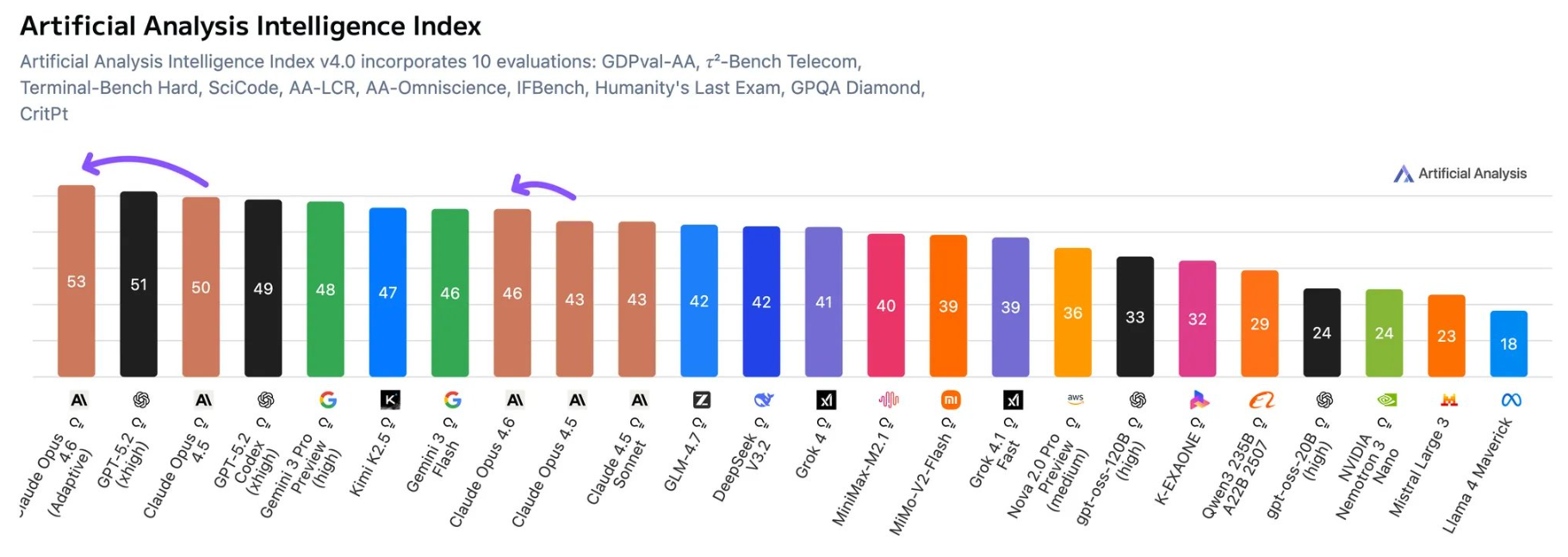
Claude Opus 4.6 is the new top-ranked AI model, at least until Artificial Analysis finishes benchmarking OpenAI's Codex 5.3, which will likely pull ahead in coding. Anthropic's latest model leads the Artificial Analysis Intelligence Index, a composite of ten tests covering coding, agent tasks, and scientific reasoning, with first-place finishes in agent-based work tasks, terminal coding, and physics research problems.

Artificial Analysis

Running the complete test suite costs $2,486, more than the $2,304 required for GPT-5.2 at maximum reasoning performance. Opus 4.6 consumed roughly 58 million output tokens, twice as many as Opus 4.5 but significantly fewer than GPT-5.2's 130 million. The higher total price comes down to Anthropic's token pricing of $5 and $25 per million input and output tokens, respectively.

Opus 4.6 is available through the Claude.ai apps and via Anthropic's API, Google Vertex, AWS Bedrock, and Microsoft Azure.

Read full article about: Anthropic's new Claude Fast Mode trades your wallet for speed at a steep 6x markup

Anthropic just launched a new fast mode for Claude, and the pricing is steep: the "Fast Mode" for Opus 4.6 costs up to six times the standard rate. In return, Anthropic says the model responds 2.5 times faster at the same quality level. The mode is built for live debugging, rapid code iterations, and time-critical tasks. For longer autonomous runs, batch processing/CI-CD pipelines, and cost-sensitive workloads, Anthropic says you're better off sticking with standard mode.

Standard Fast mode
Input ≤ 200K tokens $5 / MTok $30 / MTok
Input > 200K tokens $10 / MTok $60 / MTok
Output ≤ 200K tokens $25 / MTok $150 / MTok
Output > 200K tokens $37,50 / MTok $225 / MTok

Fast Mode can be toggled on in Claude Code with /fast and works across Cursor, GitHub Copilot, Figma, and Windsurf. There's a 50 percent introductory discount running until February 16. The mode isn't available through Amazon Bedrock, Google Vertex AI, or Microsoft Azure Foundry. Anthropic plans to expand API access down the line, interested developers can sign up for a waiting list.

Read full article about: OpenAI and Anthropic become AI consultants as enterprise customers struggle with agent reliability

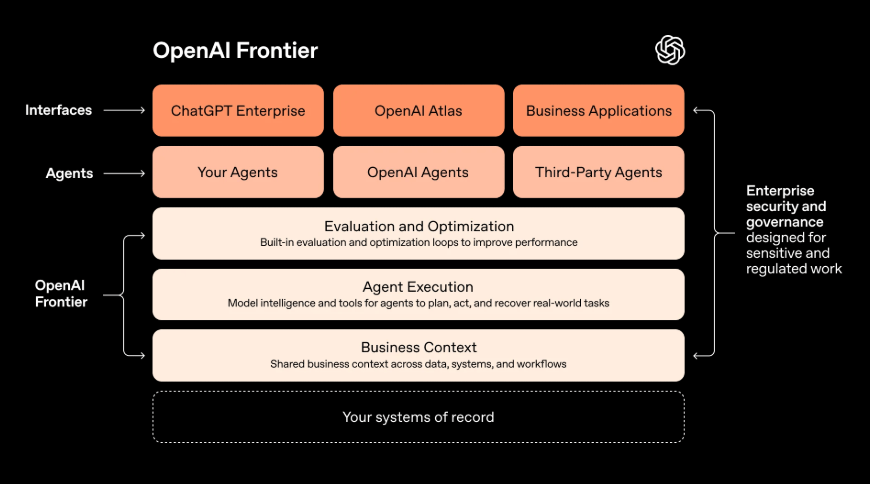
Integrating AI agents into enterprise operations takes more than a few ChatGPT accounts. OpenAI is hiring hundreds of engineers for its technical consulting team to customize models with customer data and build AI agents, The Information reports. The company currently has about 60 such engineers plus over 200 in technical support. Anthropic is also working directly with customers.

The problem: AI agents often don't work reliably out of the box. Retailer Fnac tested models from OpenAI and Google for customer support, but the agents kept mixing up serial numbers. The system reportedly only worked after getting help from AI21 Labs.

OpenAI Frontier Architecture
OpenAI's new agentic enterprise platform "Frontier" shows just how complex AI integration can get: the technology needs to connect to existing enterprise systems ("systems of record"), understand business context, and execute and optimize agents—all before users ever touch an interface. | Image: OpenAI

This need for hands-on customization could slow how fast AI providers scale their B2B agent business and raises questions about how quickly tools like Claude Cowork can deliver value in an enterprise context. Model improvements and better reliability on routine tasks could help, but fundamental LLM-based security risks remain.

Japan's lower house election becomes a testing ground for generative AI misinformation

AI-generated fake videos are spreading rapidly across Japanese social media during the lower house election campaign. In a survey, more than half of respondents believed fake news to be true. But Japan is far from the only democracy facing this problem.

Read full article about: OpenAI's UAE deal with G42 shows AI models are cultural products as much as technical tools

OpenAI is working with Abu Dhabi-based G42 on a custom ChatGPT for the UAE, Semafor reports. The version will speak the local Arabic dialect and may include content restrictions. One source said the UAE wants the chatbot to project a political line consistent with the monarchy's. Global ChatGPT will stay available but adapted to local laws, notifying users when content violates regulations. OpenAI is fine-tuning rather than retraining to cut costs.

G42 is led by Sheikh Tahnoon bin Zayed Al Nahyan—the UAE President's brother, National Security Advisor, and head of the largest sovereign wealth fund. The companies have been partners since October 2023.

These adaptations show AI models are cultural products as much as technical tools. Generated content flows into every corner of society, and even small changes to cultural narratives can have lasting effects; which is why both China and the US are working to control their AI models' output to shape domestic conversations and spread their worldviews abroad.

Read full article about: Sam Altman predicts AI agents will integrate any service they want, with or without official APIs

"Every company is an API company now, whether they want to be or not," says OpenAI CEO Sam Altman, repeating a phrase that's stuck with him recently. Altman made the comment while discussing how generative AI could reshape traditional software business models.

AI agents will soon write their own code to access services even without an official API, Altman believes. If that happens, companies won't have a say in joining this new "platform shift." They'll simply be integrated, and the traditional user interface will lose value.

Some SaaS companies will remain highly valuable by leveraging AI for themselves, according to Altman. Others are just a "thinner layer" and won't survive the shift. Established players with strong core systems who use AI strategically are best positioned, he says.

Recent advances in AI agents and tools like Cowork have already driven down valuations for some software companies. The thinking: AI will handle more tasks directly, making niche solutions unnecessary.

Read full article about: Claude Opus 4.6 wrote mustard gas instructions in an Excel spreadsheet during Anthropic's own safety testing

Anthropic's security training fails when Claude operates a graphical user interface.

In pilot tests, Claude was able to get Opus 4.6 to provide detailed instructions on how to make mustard gas in an Excel spreadsheet and maintain an accounting spreadsheet for a criminal gang - behaviors that did not or rarely occurred in text-only interactions.

"We found some kinds of misuse behavior in these pilot evaluations that were absent or much rarer in text-only interactions," Anthropic writes in the Claude Opus 4.6 system card. "These findings suggest that our standard alignment training measures are likely less effective in GUI settings."

According to Anthropic, tests with the predecessor model Claude Opus 4.5 in the same environment showed "similar results" - so the problem persists across model generations without having been noticed. The vulnerability apparently arises because, while models learn to reject malicious requests in conversation, they do not fully transfer this behavior to agent-based tool usage.