Ad
Skip to content
Read full article about: Despite Pentagon ban, Google, AWS, and Microsoft stick with Anthropic's AI models

Google, Amazon, and Microsoft are assuring customers that Anthropic's AI technology will remain available outside of defense projects, CNBC reports, citing company spokespeople. None of the three have issued public statements.

Microsoft said its legal team reviewed the classification and concluded that Anthropic products, including Claude, can stay available through M365, GitHub, and Microsoft's AI Foundry, except for the US Department of War. Google continues offering Claude through Vertex AI, Amazon through Bedrock and GovCloud.

The reassurances come amid an ongoing dispute between Anthropic and the US Department of War, which designated Anthropic as a supply chain risk. CEO Dario Amodei called the designation legally untenable and said his company plans to fight it in court. Some defense contractors have already told employees to switch to alternatives like OpenAI.

According to the Washington Post, Claude was still used in the recent US attack on Iran despite the designation. The transition to other AI models is expected to take six months, with OpenAI among the new partners.
Comment Source: CNBC
Read full article about: Anthropic's new marketplace lets enterprise customers spend their existing AI budget on third-party tools

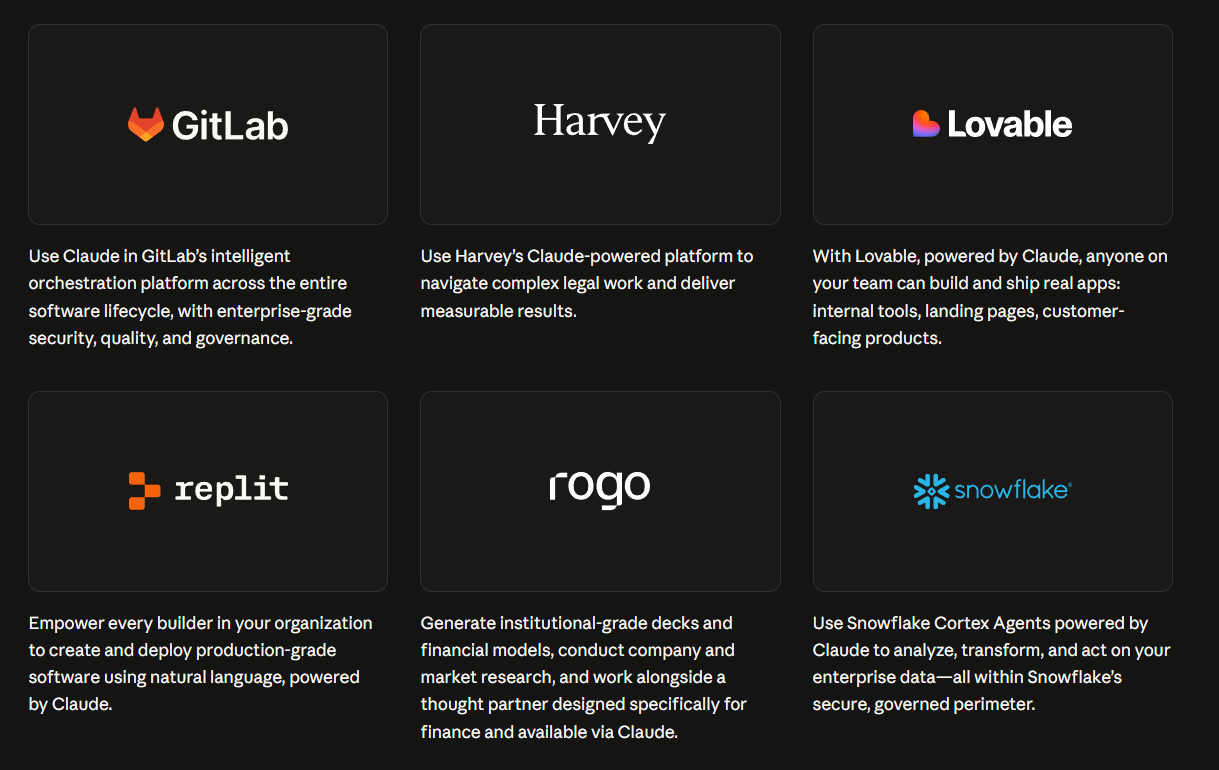
Anthropic is launching the Anthropic Marketplace, a storefront where corporate customers can buy third-party software built on Anthropic's AI models. Launch partners include Snowflake, Harvey, and Replit. Anthropic isn't taking a commission, and customers can put a portion of their existing annual Anthropic spend toward these tools.

First providers on the Anthropic Marketplace. | Image: Screenshot

The strategy mirrors what Amazon does with the AWS Marketplace or Microsoft with Azure: Anthropic is positioning itself as the orchestrator of a growing AI software ecosystem. By waiving commissions and letting customers tap existing budgets for third-party tools, the company makes it easy to stay in its ecosystem.

The commission waiver is less generous than it sounds, though. Every marketplace app runs on Anthropic's models, so partners already pay for the model capacity they use. Anthropic doesn't earn from the marketplace itself (yet), but it profits from the growing demand for its models that the marketplace generates. Interested partners can sign up for the waiting list.

Read full article about: OpenAI launches Codex Security, an AI agent designed to detect vulnerabilities in software projects

OpenAI launches "Codex Security," an AI-powered security agent built to find vulnerabilities in software projects. The tool, formerly known as "Aardvark," is now available as a research preview for ChatGPT Enterprise, Business, and Edu customers, free for the first month. Codex Security analyzes code repositories, builds a project-specific threat model, and tests any vulnerabilities it finds in isolated test environments, OpenAI says.

During the beta phase, OpenAI says the system cut false positives by more than 50 percent and reduced redundant alerts by 84 percent in one case. Over the past 30 days, Codex Security scanned more than 1.2 million commits and flagged 792 critical vulnerabilities.

OpenAI has also reported vulnerabilities in open-source projects, including OpenSSH, GnuTLS, GOGS, Thorium, and Chromium, with 14 CVEs issued so far. A program for open-source maintainers is set to expand. More details on getting started are available in the documentation.

Anthropic also recently shipped its own cybersecurity tool, sending cybersecurity stocks into the red.

Read full article about: Anthropic officially deemed supply chain risk, CEO Amodei announces legal challenge

The Pentagon formally notified Anthropic on March 4 that the company and its products have been designated as a supply chain risk to US national security. Anthropic CEO Dario Amodei announced on March 5 that the company will challenge the designation in court. According to Amodei, the measure only applies to the use of Claude as a direct part of contracts with the Department of War, not all customers.

The dispute escalated after Anthropic demanded assurances that its AI would not be used for mass surveillance of Americans or autonomous weapons deployment. According to Bloomberg, Claude is currently the only AI system operating in the Pentagon's classified cloud and is actively used in US operations against Iran.

Amodei also apologized for an internal post that was leaked to the press. "It does not reflect my careful or considered views," Amodei said. The post was written within hours of Trump's Truth Social post, Secretary of War Hegseth's announcement on X, and a Pentagon deal with OpenAI.

Anthropic is offering to continue providing its models to the military at nominal cost until a transition is complete. According to Bloomberg, the company is currently valued at $380 billion and is approaching an annual revenue run rate of $20 billion.

Read full article about: Softbank seeks record $40 billion loan to fund OpenAI stake

Anyone worried about an AI bubble now has more reason for concern: Softbank is looking to borrow up to $40 billion, primarily to finance its stake in OpenAI, Bloomberg reports. If the deal goes through, it would be the largest pure dollar borrowing in the Japanese conglomerate's history. The bridge loan would run for about twelve months, with four banks—including JPMorgan Chase—underwriting it. Negotiations are still ongoing.

SoftBank founder Masayoshi Son is making a massive bet on artificial intelligence. Beyond the $30 billion earmarked for OpenAI, the company has already poured over $30 billion into the startup and held roughly eleven percent of its shares as of late December. To fund these investments, SoftBank sold off Nvidia shares, among other assets.

The scale of AI-related borrowing is becoming hard to ignore. According to the Financial Times, OpenAI's partners have racked up a combined debt of around $96 billion. Bank of America data shows the five major tech companies took on $121 billion in new debt—four times the usual amount. The Bank of England flagged growing risks at the end of 2025, noting that only three percent of consumers actually pay for AI services so far.

Read full article about: OpenAI's new GPT-5.4 model powers ChatGPT for Excel with finance-optimized reasoning

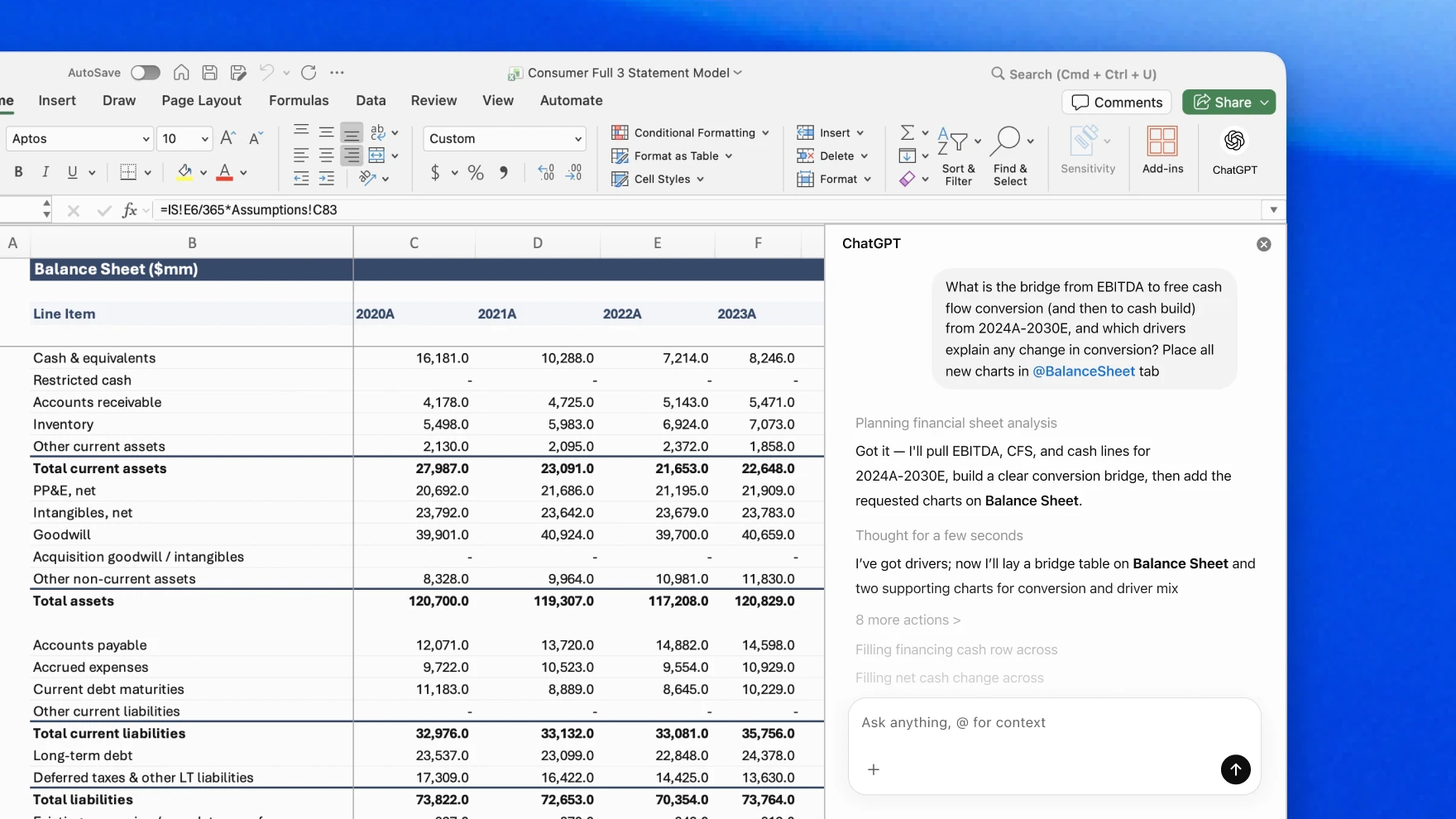
OpenAI is launching "ChatGPT for Excel," a beta add-in that lets users create, edit, and analyze spreadsheets through natural language. The tool runs on the new GPT-5.4 model, which OpenAI says is specifically optimized for financial tasks like modeling, scenario analysis, and data evaluation.

ChatGPT running as an add-in inside Microsoft Excel. The left side shows a balance sheet with financial data from 2020 to 2023, while the right panel shows ChatGPT responding to a cash flow analysis question and making changes directly in the worksheet. | Image: OpenAI

OpenAI tested its own models alongside Opus 4.6 on an internal benchmark designed to evaluate real investment banking tasks, such as building a three-statement model with correct formatting and sources.

Model Average Score (higher is better)
GPT-5 0,437
GPT-5.2 Thinking 0,684
GPT-5.2 Pro 0,717
GPT-5.4 Thinking 0,873
Opus 4.6 0,641

OpenAI is also rolling out financial data connections for providers like FactSet, Moody's, S&P Global, and LSEG. ChatGPT for Excel is initially available in the US, Canada, and Australia for Business, Enterprise, Pro, and Plus users. A version for Google Sheets is planned to follow.

Read full article about: Oracle to cut thousands of jobs as AI spending drains cash

Oracle is planning to cut thousands of jobs to manage the massive costs of its AI data center expansion, Bloomberg reports. The cuts will affect multiple divisions and could be implemented as early as March. Some reductions target job categories the company expects to need less due to AI. Oracle had around 162,000 employees worldwide as of the end of May 2025. Under Chairman Larry Ellison, Oracle is investing heavily in data centers for AI customers like OpenAI.

Analysts expect the company's free cash flow to turn negative in the coming years before the spending starts to pay off around 2030. In February, Oracle announced plans to raise up to $50 billion this year through debt and equity sales. The stock has fallen 54 percent from its September 2025 high. Oracle had already disclosed in September a restructuring plan costing up to $1.6 billion – the largest in the company's history.

Read full article about: Anthropic says Claude is adding over a million new users every day

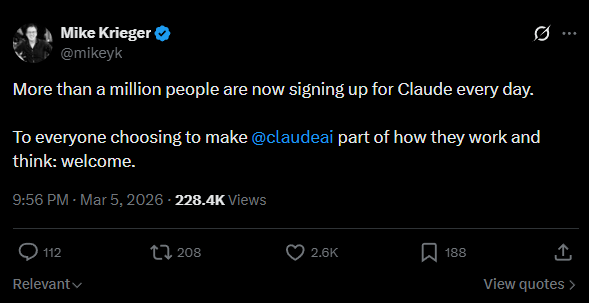
Anthropic's AI chatbot Claude is adding more than a million new users daily. Mike Krieger shared the milestone on X. The Instagram co-founder joined Anthropic in 2024, initially as Chief Product Officer, and now leads the AI lab's new experiments division.

Mike Krieger announced that more than a million people are signing up for Claude every day. | Image: Anthropic

The surge likely has several drivers. In the consumer space, Anthropic has benefited from the ongoing Pentagon controversy, where the company is widely considered the moral winner compared to OpenAI.

At the same time, AI adoption is growing across the board. Since October 2025, annualized revenue for both companies is estimated to have roughly doubled—from $13 billion to $25 billion for OpenAI, and from $7 billion to $19 billion for Anthropic. That said, both companies are still burning through cash, with massive costs and liabilities offsetting those revenue figures.

Read full article about: Google Search quietly becomes an AI assistant as Canvas feature launches for US users

Google is expanding its AI-powered search into the workplace. The company has rolled out the "Canvas" feature in AI mode for all users in the US. Canvas is a workspace built into Google's chat systems that lets users organize projects and plans over time. ChatGPT and Claude offer similar functionality.

The update also adds support for creative writing and coding tasks. Users can create documents or build interactive tools and dashboards directly within search: just type in a prompt, and Google generates a working prototype that pulls together current web information and data from Google's Knowledge Graph. Results can be tested, code viewed, and everything refined through chat. The feature is available now at google.com/ai in the US.

With Canvas, AI mode is looking more and more like the Gemini app. Google seems to be gradually unifying its chat offerings, adding features that blur the line between search and a full AI assistant. At some point, AI mode and Gemini could merge into a single product, giving Google its own direct equivalent to ChatGPT.

Read full article about: Tech giants make non-binding White House pledge to cover AI data center energy costs

Google, Microsoft, Meta, Amazon, Oracle, xAI and OpenAI signed a voluntary pledge at the White House to cover the electricity costs of their data centers themselves. The commitment is not legally binding. The goal is to prevent the massive energy demand of AI data centers from driving up electricity bills for households and small businesses, Reuters reports.

President Trump first announced the so-called "Ratepayer Protection Pledge" during his State of the Union Address. The companies promise to secure their own power sources or expand existing plants and cover grid upgrade costs.

Critics like Jon Gordon of Advanced Energy United doubt that new power plants can be built fast enough to relieve the grids, according to Reuters. Especially since the administration is focusing on natural gas rather than faster-to-build solar and wind energy. The initiative comes ahead of the November midterm elections, where rising energy costs are a key voter concern.