Ad
Skip to content
Read full article about: OpenAI reportedly launches ChatGPT ads at premium TV prices

OpenAI is charging around $60 per 1,000 impressions for its initial ChatGPT ads, far above typical online advertising rates in the low single digits and closer to what advertisers pay for premium TV spots like NFL games, according to The Information. The ads show up below ChatGPT responses in the free and lower-cost "Go" tiers.

OpenAI is also reportedly charging per impression rather than per click. Advertisers typically prefer click-based billing because it's easier to measure results. The decision to go with impressions likely reflects how AI chatbot users behave differently than traditional search users: they click on external links far less often. Perplexity uses the same approach, also charging per 1,000 impressions.

The move toward advertising—at premium prices and in a format that's less appealing to advertisers—suggests OpenAI needs to ramp up revenue quickly to justify its high valuation to investors. Sam Altman previously called ChatGPT advertising a last resort and a potential dystopia.
Read full article about: Microsoft's Maia 200 AI chip claims performance lead over Amazon and Google

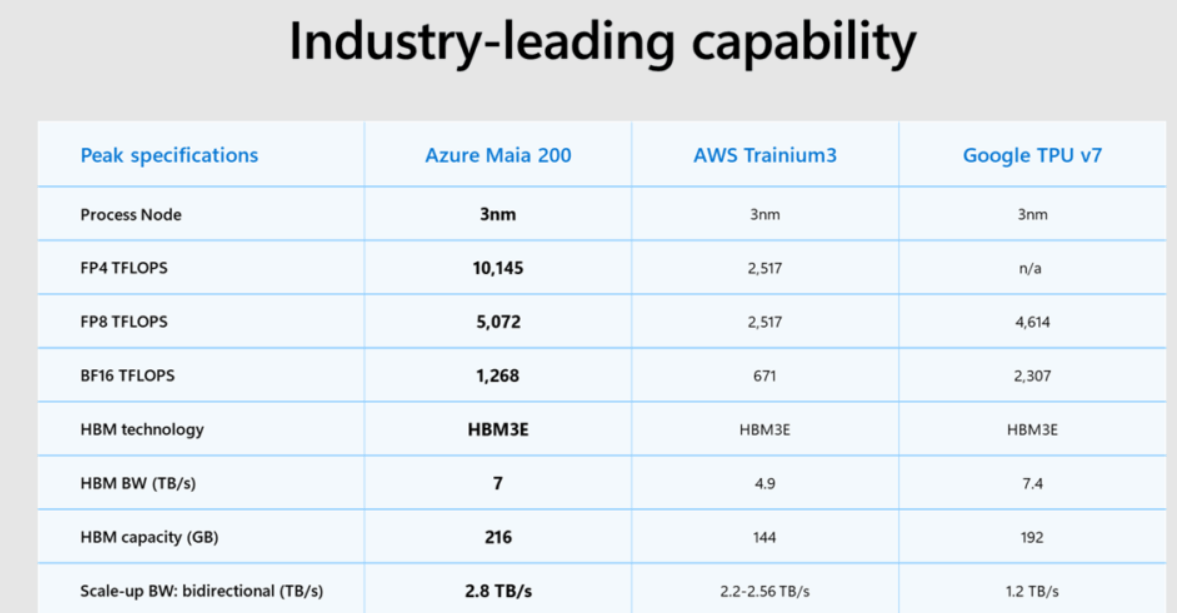
Microsoft has unveiled its new AI inference chip, Maia 200. Built specifically for inference workloads, the chip delivers 30 percent better performance per dollar than current-generation chips in Microsoft's data centers, the company claims. It's manufactured using TSMC's 3-nanometer process, packs over 140 billion transistors, and features 216 GB of high-speed memory.

According to Microsoft, the Maia 200 is now the most powerful in-house chip among major cloud providers. The company claims it delivers three times the FP4 performance of Amazon's Trainium 3 while also outperforming Google's TPU v7 in FP8 calculations—though independent benchmarks have yet to verify these figures.

Microsoft
Microsoft's comparison shows the Maia 200 outperforming Amazon's Trainium 3 and Google's TPU v7 across key specifications. | Image: Microsoft

Microsoft says the chip already powers OpenAI's GPT 5.2 models and Microsoft 365 Copilot. Developers interested in trying it out can sign up for a preview of the Maia SDK. The Maia 200 is currently available in Microsoft's Iowa data center, with Arizona coming next. More technical details about the chip are available here.

Read full article about: Vibe coding may be behind a 60 percent spike in new iOS apps

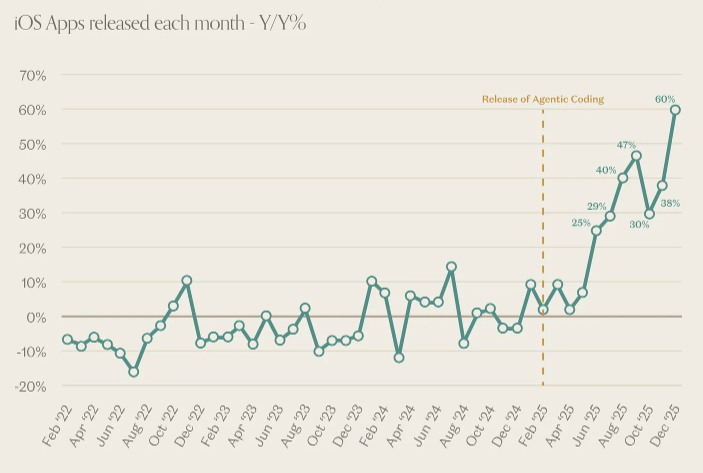
Data from Sensor Tower and Wells Fargo Securities suggests AI coding tools are flooding the iOS App Store. According to a16z, new iOS apps jumped 60 percent in December 2025 year-over-year, with 24 percent growth across the full twelve months. The three years prior, new app numbers stayed essentially flat.

The chart shows year-over-year iOS app releases, with growth accelerating sharply after the release of agentic coding tools. | Image: via a16z

The analysis ties the surge to "agentic coding," AI-powered tools that let users build apps with minimal coding experience. a16z draws a parallel to 2008, when Apple released the iPhone SDK and the App Store launched with 500 apps but hit one million downloads within a weekend.

The analysis doesn't prove vibe coding is causing the increase; the correlation could be coincidental. Still, it makes intuitive sense: building an app has become much easier, meaning more people can now ship their ideas to the App Store.

Comment Source: a16z
Read full article about: Meta shuts down AI character access for minors following reports of problematic chats

Meta is cutting off access to AI characters for teenagers around the globe. Starting in the "coming weeks," teens won't be able to use AI characters in Meta's apps until a revised version is ready. The ban applies to all users who entered a teenage birth date, as well as people who claim to be adults but are flagged as minors by Meta's age recognition technology.

Meta's AI Assistant will stay available for minors with age-appropriate protections, the company says. Meta is also working on new tools that will give parents more visibility and control over how their kids use AI features. Once those tools are ready, they'll apply to the updated version of AI characters.

Meta had already responded to reports about problematic chatbot interactions with minors in the summer of 2025. An internal document revealed that Meta's AI chatbots were allowed to have romantic or "sensual" conversations with minors under the company's guidelines. Following the disclosure, Meta announced that chatbots would no longer be permitted to discuss sensitive topics with teenagers.

Comment Source: Meta
Read full article about: OpenAI's GPT-5.2 Pro solves math problems that stumped every AI model before it

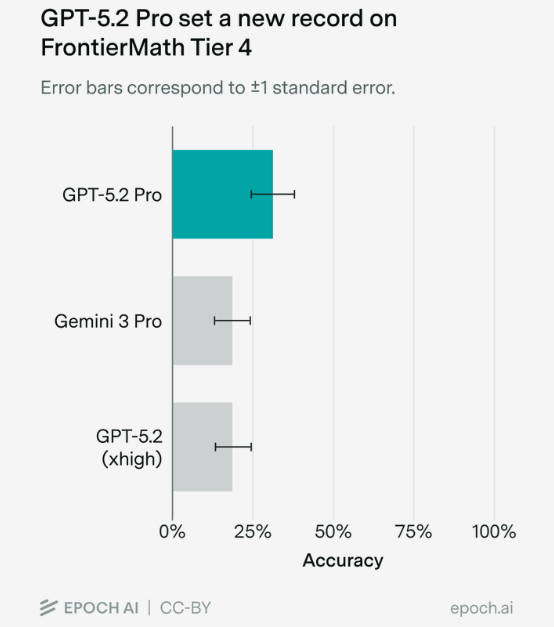
OpenAI has a new math champion. GPT-5.2 Pro just set a record on the notoriously difficult FrontierMath benchmark, according to testing by Epoch AI. The model hit 31 percent on the hardest tier (Tier 4) - a major leap from Gemini 3 Pro's previous best of 19 percent. Epoch AI ran the tests manually through the ChatGPT website because of API issues.

GPT-5.2 Pro scored 31 percent on FrontierMath Tier 4, outpacing Gemini 3 Pro (19 percent) and GPT-5.2 xhigh (17 percent). | Image: Epoch AI

GPT-5.2 Pro cracked 15 of 48 tasks, including four problems no model had solved before. Several mathematicians gave the solutions mostly positive reviews, though some criticized the lack of precision in certain explanations.

The benchmark results line up with recent reports about AI models—particularly GPT-5-Thinking and -Pro—proving genuinely useful for tackling mathematical problems. GPT-5 has reportedly solved Erdős problems on its own and helped researchers work through others. Still, renowned mathematician Terence Tao cautions against drawing premature conclusions.

Read full article about: OpenAI developer predicts programmers will soon "declare bankruptcy" on understanding their own AI-generated code

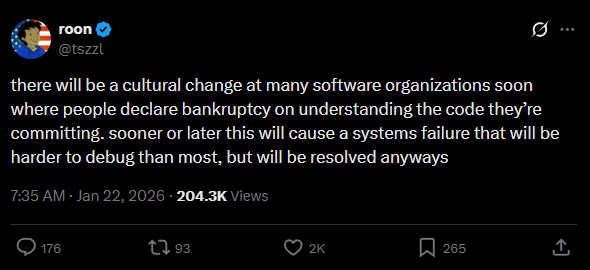
An OpenAI developer known by the pseudonym "roon" has a blunt prediction for the future of software development: many developers at software companies will soon openly admit they no longer fully understand the code they're submitting. Eventually, this will cause system failures that are harder to debug than usual but will still get fixed in the end, roon writes, adding that he doesn't "write code anymore."

OpenAI developer "roon" predicts a cultural shift where programmers "declare bankruptcy" on understanding their own code. | Screenshot via X

The prediction cuts to the heart of an ongoing debate: Is AI-assisted programming a fundamental shift in how developers work, or a risky breaking point? Some enthusiasts point to massive productivity gains, while critics fear growing dependencies and bugs that slip through undetected.

A developer survey from summer 2025 captures this split: only 33 percent of developers trust AI-generated code, yet 84 percent are already using AI tools or plan to start. As usual, the truth probably lands somewhere in the middle.

Read full article about: Google AI Search taps Gmail and Photos for personalized results

Google is connecting Gmail and Google Photos to its AI-powered search. Subscribers to Google AI Pro and Ultra in the US can now opt in to share their emails and photos for personalized search results.

The system reads hotel confirmations and analyzes vacation photos to suggest relevant restaurants or activities. For shopping queries, search results factor in brands you've purchased and your travel dates.

The feature, called "Personal Intelligence," is already available in Gemini and runs on the Gemini 3 model. It's opt-in only and Google acknowledges the system can make mistakes. Workspace business and education accounts are excluded entirely.

Read full article about: OpenAI's API business grew by $1 billion ARR last month

OpenAI's API business is growing rapidly, with CEO Sam Altman reporting that the company added over $1 billion in annual recurring revenue in just the last month.

OpenAI hit an ARR of over $20 billion by the end of 2025 - up from $6 billion in 2024 and $2 billion in 2023. ARR (Annual Recurring Revenue) represents the annualized value of recurring revenue from active subscriptions and contracts, typically excluding one-time payments.

The API growth Altman announced on X - roughly $1 billion in ARR in a single month - represents about five percent of the company's total ARR. That said, this figure reflects additional growth, not the API's share of overall revenue. How much of OpenAI's total ARR comes from API customers remains unclear.

On the other side of the ledger, OpenAI faces commitments of around $1.4 trillion for computing power over the coming years. To help cover these costs, the company is preparing to introduce ads in ChatGPT - despite Altman calling advertising a "last resort" just two years ago. The ads will initially roll out for free users and those on the new ChatGPT Go subscription tier.

Read full article about: Elon Musk's AI chatbot Grok flooded X with millions of sexualized images

Elon Musk's AI chatbot Grok generated at least 1.8 million sexualized images of women and posted them on X over just nine days. That's according to the New York Times and the Center for Countering Digital Hate (CCDH), which conducted a data analysis. The CCDH estimates that roughly 65 percent of the images contained sexualized depictions of men, women, or children.

  Count in sample Out of 20,000 sampled (based on AI-assisted analysis) Share of sample Percentage of 20,000 sampled (based on AI-assisted analysis) Estimated Total on X
Extrapolated estimate (based on overall total of 4.6m images made by Grok)
Sexualized Images (Adults &
Children)
12,995 65% 3,002,712
Sexualized Images
(Likely Children)
101 0.5% 23,338

The flood of images started on December 31 after Musk shared a bikini picture of himself that Grok had created. Users quickly figured out they could ask the chatbot to undress or sexualize real photos of women and children. X didn't restrict the feature until January 8 and expanded those restrictions last week after authorities in the UK, India, Malaysia, and the US launched investigations.

Read full article about: Ernie 5.0: Baidu's 2.4 trillion parameter model becomes China's best in LMArena

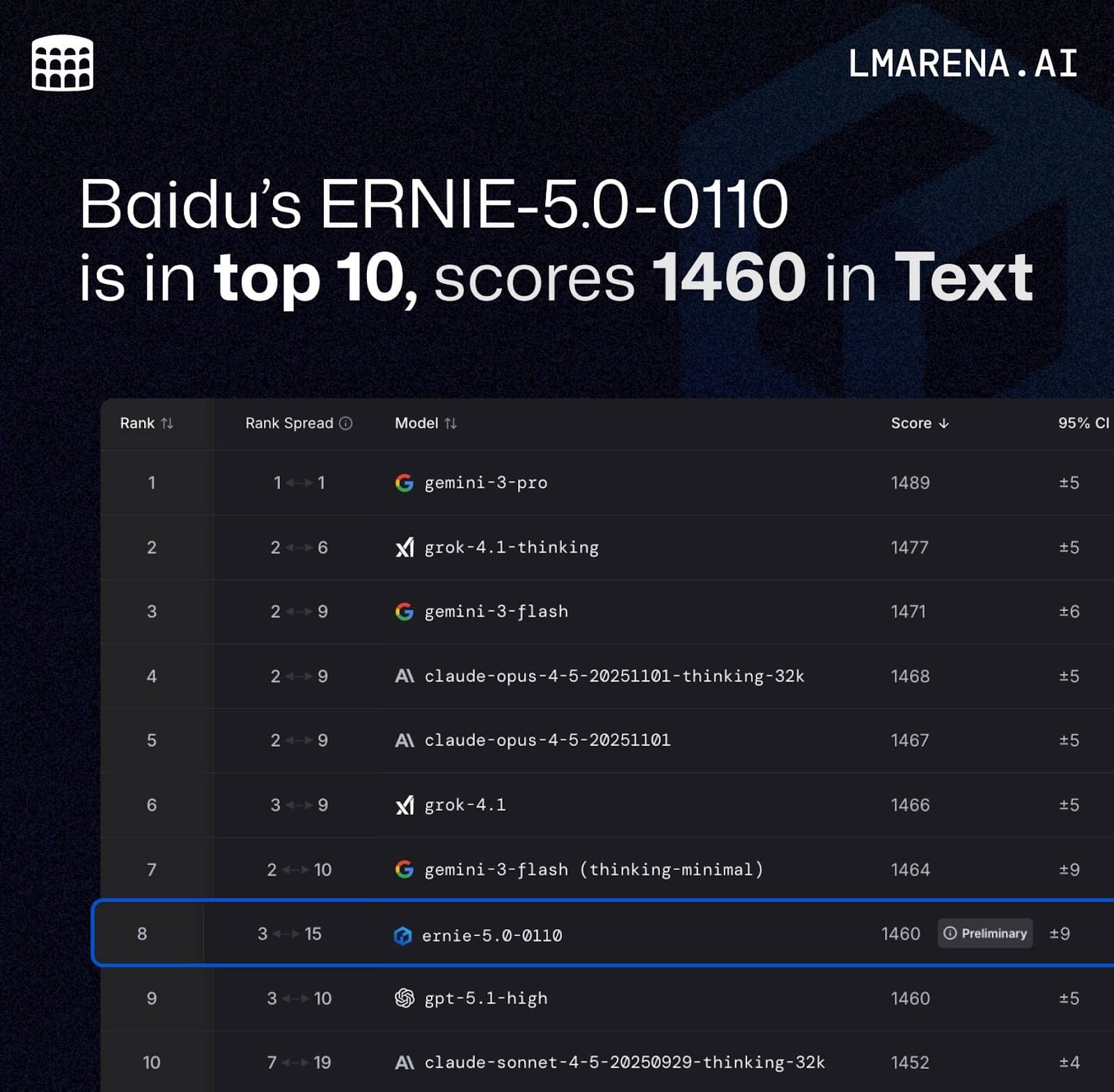
Baidu's new AI model Ernie 5.0, which processes text, images, audio, and video in a unified architecture, is now officially available. According to the LMArena ranking from January 15, 2026, Ernie-5.0-0110 scored 1,460 points, placing 8th globally and 1st among all Chinese models. That puts it on par with OpenAI's slightly older GPT-5.1 (High) and ahead of both Google's Gemini 2.5 Pro and Anthropic's Claude Sonnet 4.5. The next best Chinese model is GLM-4.7 from Zhipu AI. In the math category, Ernie 5.0 came in second worldwide, trailing only GPT 5.2 (High).

LM-Arena-Ranking: Baidu Ernie-5.0-0110 belegt Platz 8 mit 1460 Punkten in Textbenchmarks der Top 10.
The LMArena ranking is determined from numerous anonymous pair comparisons in which users choose the better model answer.

Under the hood, the model uses a mixture-of-experts architecture with around 2.4 trillion parameters - but less than 3 percent of those are active for any given query. For now, the model is only available at ernie.baidu.com. Unlike previous releases, Baidu hasn't published any weights yet, and there's no technical report or detailed documentation available. The company's most recent open release was Ernie-4.5-VL-28B-A3B-Thinking, a model that can manipulate images during its reasoning process - for example, zooming in on text to read it more clearly.