Ad
Skip to content
Read full article about: Report: OpenAI may embed sponsored content directly into ChatGPT responses

OpenAI's advertising plans for ChatGPT are taking shape. According to The Information, employees are discussing various ad formats for the chatbot. One option would have AI models preferentially weave sponsored content into their responses. So a question about mascara recommendations might surface a Sephora ad. Internal mockups also show ads appearing in a sidebar next to the response window.

Another approach would only show ads after users request further details. If someone asks about a trip to Barcelona and clicks on a suggestion like the Sagrada Familia, sponsored links to tour packages could appear. A spokesperson confirmed to The Information that the company is exploring how advertising might work in the product without compromising user trust.

OpenAI CEO Sam Altman has previously called AI responses shaped by advertising a dystopian future—especially if those recommendations draw on earlier, private conversations with the chatbot. Yet that appears to be precisely what OpenAI is now working on: advertising powered by ChatGPT's memory function, which could tap into personal conversation histories for targeted ads.

Read full article about: Qwen updates image editing model with better character consistency

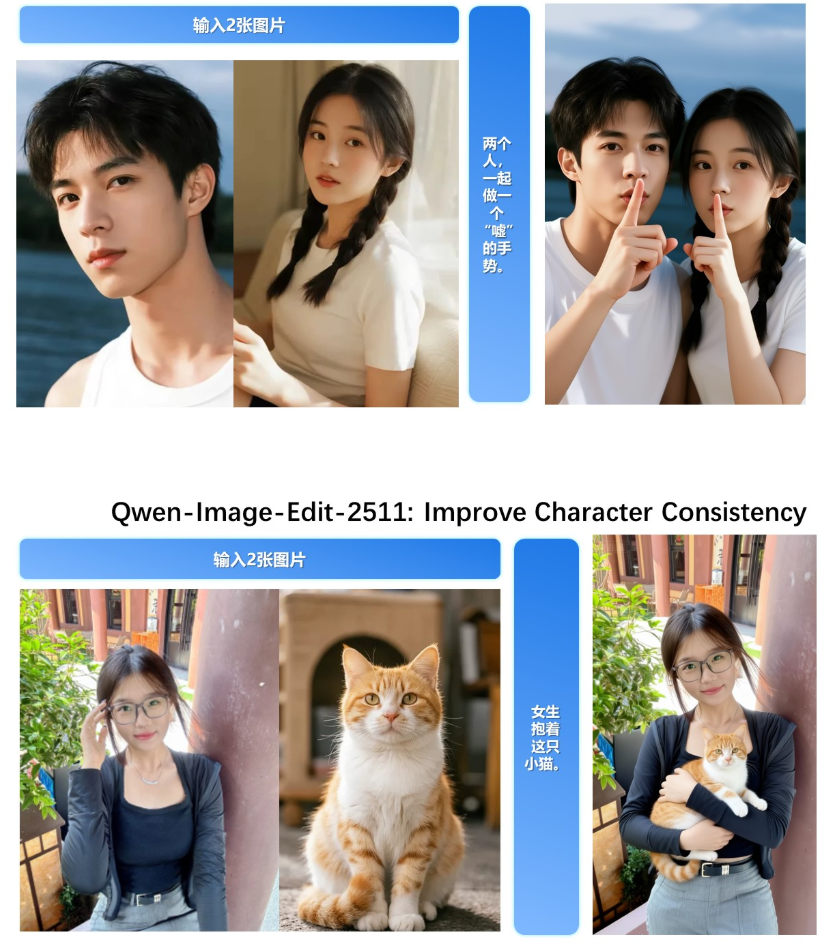
Qwen has released an improved version of its image editing model that better maintains facial identity during edits. The Chinese AI company published Qwen-Image-Edit-2511 on Hugging Face, an upgrade to the earlier Qwen-Image-Edit-2509. The biggest improvement is how the model handles people. It can now make creative changes to portraits while keeping the subject recognizable, the company claims. Group photos with multiple people also work better now.

The updated model can combine separate portrait images and edit group photos while preserving each person's (or cat's) identity. | Image: Qwen

The update also brings improvements to lighting control, camera angles, industrial product design, and geometric calculations. Qwen has baked popular community LoRAs (small add-on models) directly into the base model. The model ships under the Apache 2.0 license. A demo is available on Hugging Face, and users can test the model for free via Qwen Chat.

Read full article about: GitHub repository offers more than 50 customizable Claude Skills

A comprehensive collection of "Claude Skills" is now available on GitHub. These skills are customizable workflows that teach Anthropic's AI assistant Claude to perform specific tasks repeatedly and in a standardized way. The collection includes more than 50 skills across nine categories: Document Processing (Word, PDF, PowerPoint), Development Tools (Playwright, AWS, Git), Data Analysis, Business and Marketing, Communication, Creative Media, Productivity, Project Management, and Security.

Users can add skills in Claude.ai through the settings, store them in Claude Code's configuration folder, or integrate them via API. Each skill consists of a folder with a SKILL.md file. The repository is under Apache 2.0 license and accepts contributions.

Since skills are essentially just a collection of prompts in a folder, getting the most out of AI means customizing these prompts to fit your needs. That said, the repository is a solid source of inspiration. And as skills seem to be becoming the standard approach, it's worth exploring the topic beyond Claude.ai.

Read full article about: Zhipu AI challenges Western rivals with low-cost GLM-4.7

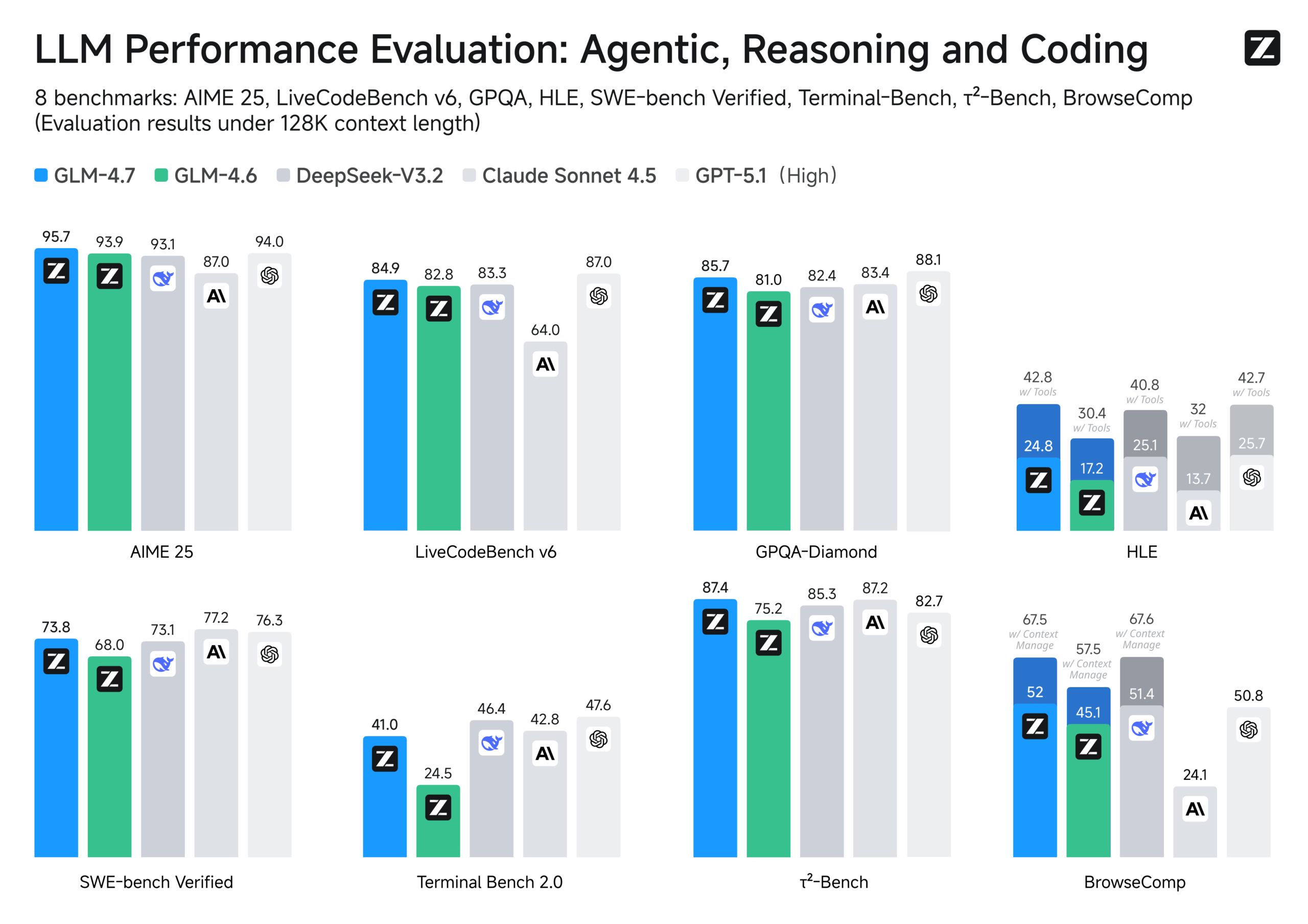
Zhipu AI has introduced GLM-4.7, a new model specialized in autonomous programming that uses "Preserved Thinking" to retain reasoning across long conversations. This capability works alongside the "Interleaved Thinking" feature introduced in GLM-4.5, which allows the system to pause and reflect before executing tasks. The model shows a significant performance jump over its predecessor, GLM-4.6, scoring 73.8 percent on the SWE-bench Verified test. Beyond writing code, Zhipu says GLM-4.7 excels at "vibe coding" - generating aesthetically pleasing websites and presentations. In a blog post, the company showcased several sites reportedly created from a single prompt. Benchmark comparisons show a tight race between GLM-4.7 and commercial Western models from providers like OpenAI and Anthropic. | Image: Zhipu AI

A table with benchmark results comparing the GLM-4.7 AI model with competitors; the model shows leading values in categories such as Reasoning, Code Agent and General Agent.
Benchmark comparisons show a tight race between GLM-4.7 and commercial Western models from providers like OpenAI and Anthropic.

The model is available through the Z.ai platform and OpenRouter, or as a local download on Hugging Face. It also integrates directly into coding workflows like Claude Code. Z.ai is positioning the release as a cost-effective alternative, claiming it costs just one-seventh as much as comparable models.

Read full article about: Alibaba's new Qwen models can clone voices from three seconds of audio

The Qwen team at Alibaba Cloud has released two new AI models that create or clone voices using text commands. The Qwen3-TTS-VD-Flash model lets users generate voices based on detailed descriptions, allowing them to precisely define characteristics like emotion and speaking tempo. For example, a user could request a "Male, middle-aged, booming baritone - hyper-energetic infomercial voice with rapid-fire delivery and exaggerated pitch rises, dripping with salesmanship." According to the manufacturer, the model outperforms the API for OpenAI's GPT-4o mini-tts, which launched earlier this spring.

The second release, Qwen3-TTS-VC-Flash, can copy voices from just three seconds of audio and reproduce them in ten languages. Qwen claims the model achieves a lower error rate than competitors like Elevenlabs or MiniMax. The AI is also capable of processing complex texts, imitating animal sounds, and extracting voices from recordings. Both models are accessible via the Alibaba Cloud API. You can try demos for the design model and the clone model on Hugging Face.

Comment Source: Qwen
Read full article about: OpenAI reportedly dramatically improved its compute profit margins

OpenAI has reportedly made major strides in improving the profitability of its AI services. The company's compute margin—the share of revenue left after paying for server costs from paying users—jumped from around 35 percent in January 2024 to roughly 70 percent by October 2025, according to internal financial data obtained by The Information. For comparison, Anthropic is expected to reach 53 percent by year's end.

OpenAI achieved these gains by cutting rental costs for computing power, optimizing its models, and launching a pricier subscription tier. Still, the company has a long road ahead before reaching profitability. CEO Sam Altman continues to plan major investments in additional computing power while pursuing further circular business arrangements.

OpenAI is reportedly working on a funding round of up to 100 billion dollars.

Read full article about: Nvidia wants to create universal AI agents for all worlds with NitroGen

Nvidia has released a new base model for gaming agents. NitroGen is an open vision action model trained on 40,000 hours of gameplay videos from more than 1,000 games. The researchers tapped into a previously overlooked resource: YouTube and Twitch videos with visible controller overlays. Using template matching and a fine-tuned SegFormer model, they extracted player inputs directly from these recordings.

NitroGen builds on Nvidia's GR00T N1.5 robotics model. According to the researchers, it's the first model to demonstrate that robotics foundation models can work as universal agents across virtual environments with different physics engines and visual styles. The model handles various genres—action RPGs, platformers, roguelikes, and more. When dropped into unfamiliar games, it achieves up to 52 percent better success rates than models trained from scratch.

The team, which includes researchers from Nvidia, Stanford, Caltech, and other universities, has made the dataset, model weights, paper, and code publicly available.

Read full article about: Alibaba's Qwen releases AI model that splits images into editable layers like Photoshop

Alibaba's AI unit Qwen has released a new image editing model that breaks down photos into separate, editable components. Qwen-Image-Layered splits images into multiple individual layers with transparent backgrounds (RGBA layers), letting users edit each layer independently without affecting the rest of the image.

The model handles straightforward edits like resizing, repositioning, and recoloring individual elements. Users can swap out backgrounds, replace people, modify text, or delete, move, and enlarge objects. Images can be split into either 3 or 8 layers, and the process is repeatable - each layer can be broken down into additional layers as needed. The Qwen team describes this approach as a bridge between standard images and structured, editable representations.

The Qwen team has published the code on GitHub, with models available on Hugging Face and ModelScope. More details are available in the blog post and technical report. For hands-on testing, demos are available on Hugging Face and ModelScope.

Comment Source: Blog
Read full article about: Anthropic's Claude Opus 4.5 can tackle some tasks lasting nearly five hours

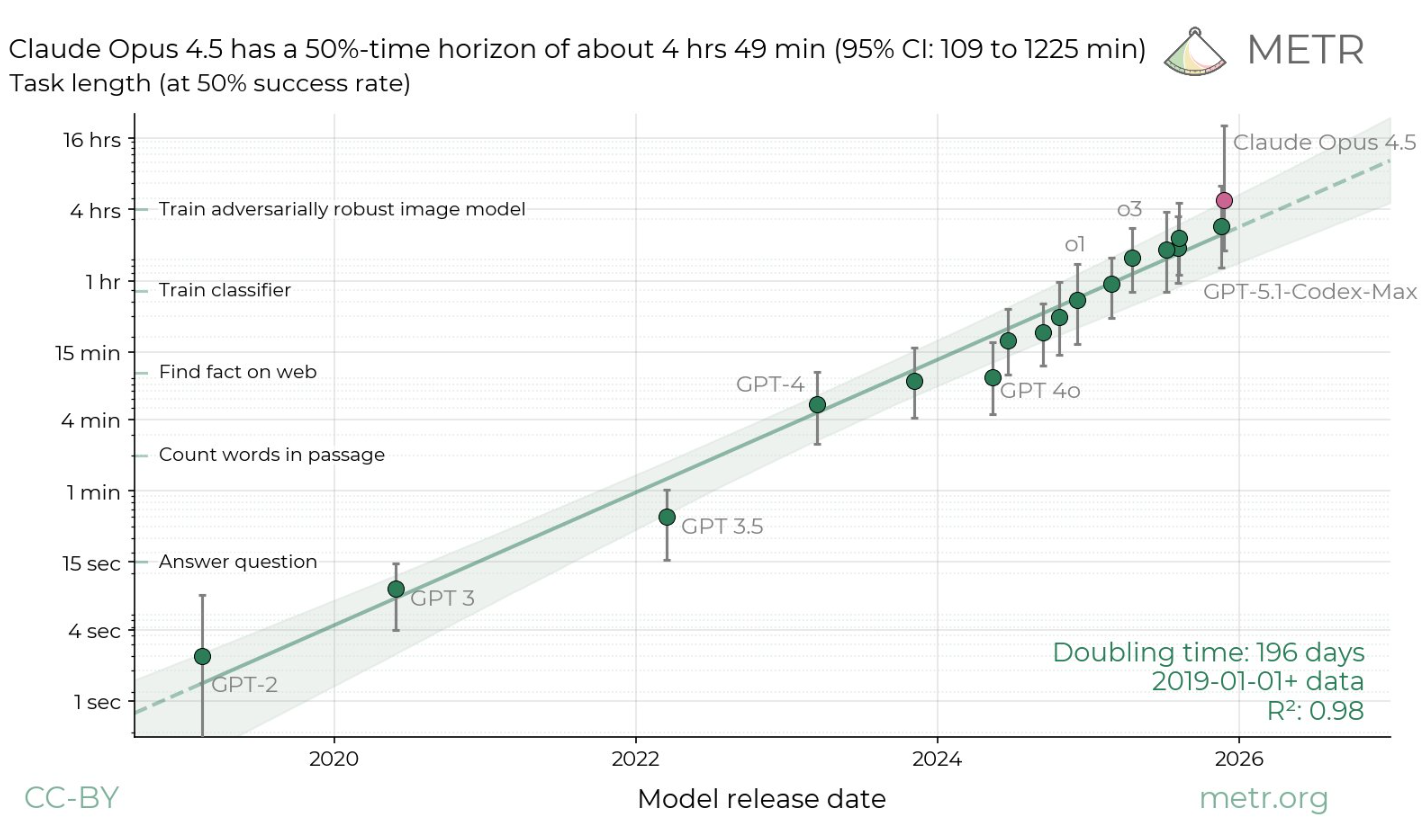
AI research organization METR has released new benchmark results for Claude Opus 4.5. Anthropic's latest model achieved a 50 percent time horizon of roughly 4 hours and 49 minutes—the highest score ever recorded. The time horizon measures how long a task can be while still being solved by an AI model at a given success rate (in this case, 50 percent).

METR

The gap between difficulty levels is big. At the 80 percent success rate, the time horizon drops to just 27 minutes, about the same as older models, so Opus 4.5 mainly shines on longer tasks. The theoretical upper limit of over 20 hours is likely noise from limited test data, METR says.

Like any benchmark, the METR test has its limits, most notably, it only covers 14 samples. A detailed breakdown by Shashwat Goel of the weaknesses is here.

Comment Source: METR
Read full article about: ChatGPT gets tone controls: OpenAI adds new personalization options

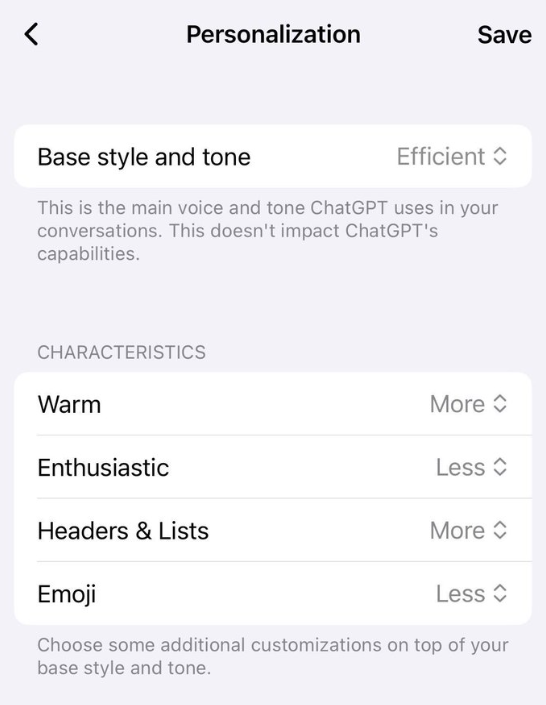
OpenAI now lets users customize how ChatGPT communicates. The new "Personalization" settings include options for adjusting warmth, enthusiasm, and formatting preferences like headings, lists, and emojis. Each setting can be toggled to "More" or "Less." Users can also pick a base style - like "efficient" for shorter, more direct responses.

OpenAI says these settings only affect the chatbot's tone and style, not its actual capabilities. The company notes that the new options likely work as an extension of the custom instructions feature available in the same settings window.